Comparing Fractions Math Worksheets for Ages 6-8 - Page 3
98 filtered results
-
From - To
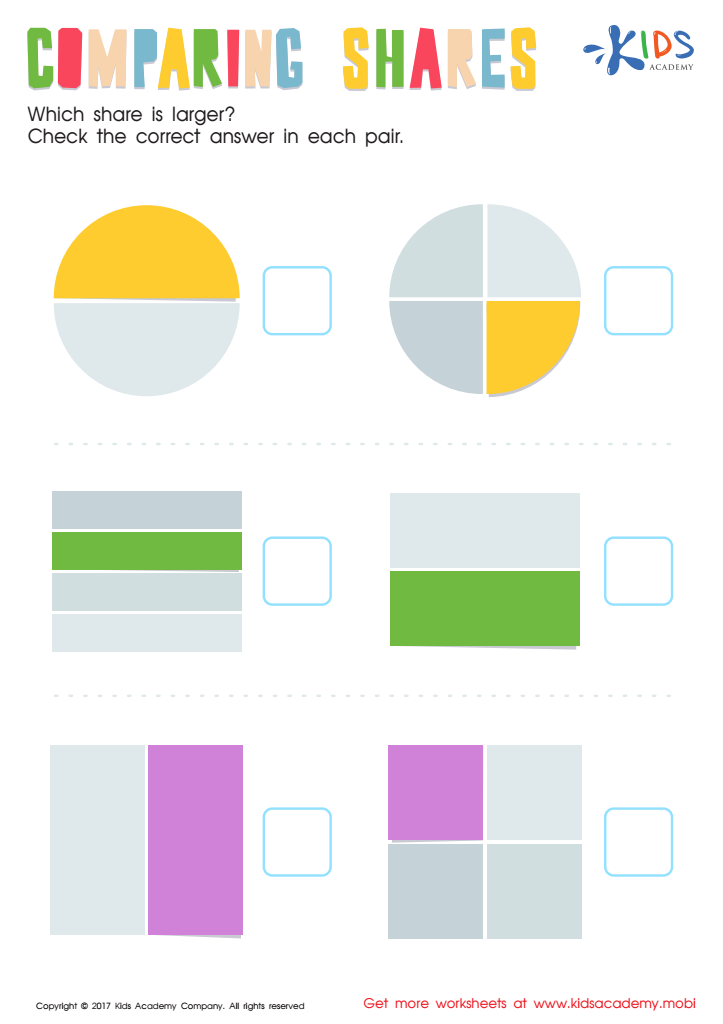
Comparing Shares Worksheet
 Assign to My Students
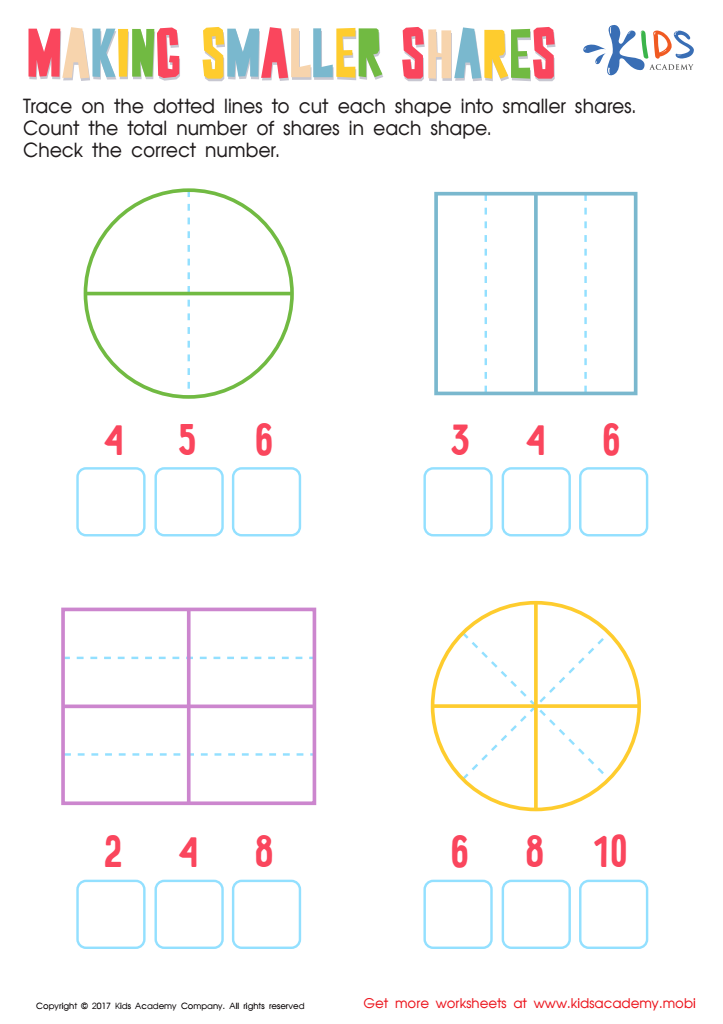
Making Smaller Shares Worksheet








Understanding and comparing fractions is a crucial math skill for children ages 6-8, serving as a foundational block for future mathematical concepts. At this formative age, children's cognitive abilities are rapidly developing, making it a prime time to introduce fundamental arithmetic ideas like fractions. Here's why parents and teachers should prioritize this topic:
First, fractions are ubiquitous in everyday life. Whether it’s dividing a pizza, sharing candy, or measuring ingredients for a recipe, real-world scenarios often involve fractions. Teaching kids to compare fractions at an early age helps them navigate these daily activities with ease.
Second, mastering fractions enhances problem-solving skills. When children learn to compare fractions, they use logical reasoning and critical thinking to determine which fraction is larger or smaller. This process boosts their analytical abilities and prepares them for more complex mathematical operations, such as algebra, in later years.
Third, strong fraction comprehension contributes to overall math competence. A secure grasp of basic math concepts like fractions underpins higher-level math topics, leading to better performance in school and a more positive attitude toward math.
Finally, early competence in fractions builds confidence. Children who understand foundational math concepts feel more capable and are often more enthusiastic about tackling new and challenging problems.
In sum, investing time in teaching and comparing fractions between ages 6-8 sets children up for academic success and practical proficiency in everyday tasks.








