
Fraction identification Math Worksheets for Ages 6-8
6 filtered results
Difficulty Level
Grade
Age
-
From - To
Subject
Activity
Standards
Welcome to our Fraction Identification Math Worksheets designed specifically for children aged 6-8! These engaging and colorful worksheets provide a fun way for young learners to grasp the fundamentals of fractions. With a variety of exercises, kids will practice recognizing, comparing, and working with fractions through appealing illustrations and relatable scenarios. Perfect for homeschooling or classroom use, our worksheets cater to different learning styles, ensuring all students build confidence in their math skills. Watch your child excel in understanding fractions while enjoying a creative learning experience. Start their journey to mathematical mastery today with our comprehensive resources!
Favorites
With answer key
Interactive
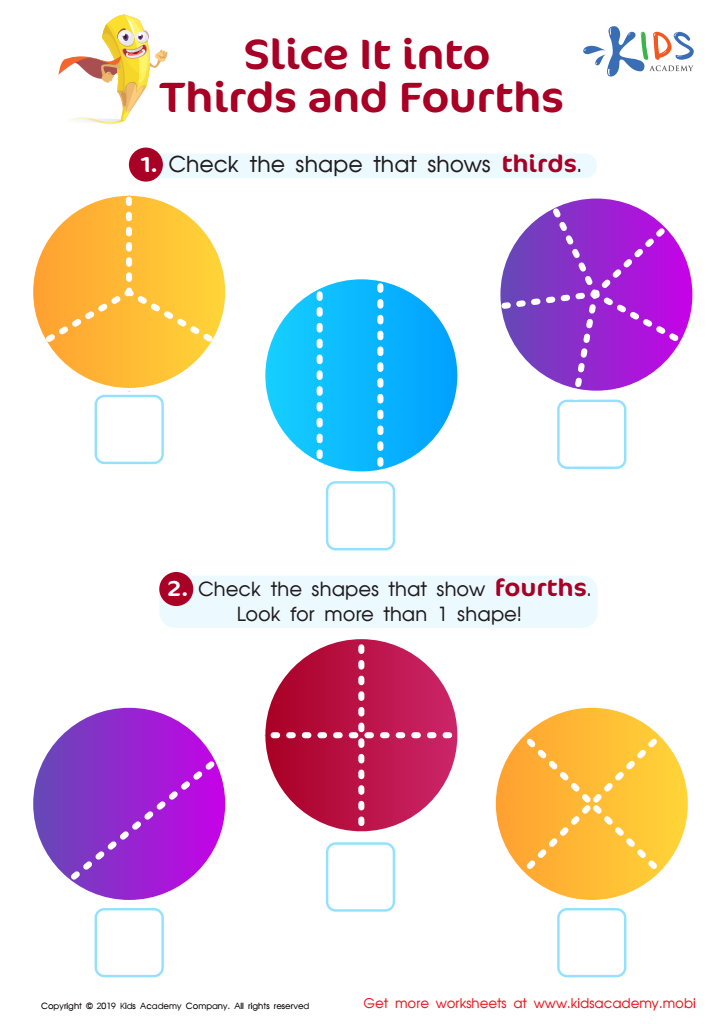
Slice in Thirds Fourths Worksheet
This worksheet helps kids learn fractions visually by dividing circles into thirds and fourths. They will learn that fractions must be equal parts, not just sets, by choosing the right colorful circles. It's an easy way to master fractions and have fun doing it!
 Assign to My Students
Slice in Thirds Fourths Worksheet
Worksheet
Join Kids Academy for Free
Who is primarily going to use this learning content?



.jpg)


Understanding fraction identification is crucial for children aged 6-8, as it lays the groundwork for their future mathematical skills. During these formative years, children start to explore mathematical concepts, and grasping fractions helps them to not only enhance their numeric skills but also develop their ability to think critically and solve problems.
Fractions represent part-to-whole relationships, which are essential in daily life; from sharing food to dividing tasks. By mastering fractions early on, children gain confidence in mathematical reasoning, which paves the way for success in more complex topics like decimals, percentages, and ratios in later grades.
Parents and teachers play a vital role in this process. They can facilitate engaging activities—such as cooking, art projects, or games—that use fractions in a fun and relatable manner. Such experiences make math tangible and relevant, motivating children to learn. Furthermore, an early focus on fractions cultivates a positive attitude towards math, demystifying the subject and foster curiosity. In supporting children’s understanding of fractions, parents and teachers nurture critical life skills while fostering a love for learning that can last a lifetime.








