Fractions understanding Math Worksheets for Ages 6-8
3 filtered results
-
From - To
Discover our engaging "Fractions Understanding Math Worksheets" designed specifically for children aged 6-8! These worksheets provide a fun and interactive way to help young learners grasp the concept of fractions through various activities. With colorful illustrations and hands-on exercises, children will explore fraction basics such as identifying, comparing, and adding fractions. Our carefully crafted materials promote critical thinking and reinforce essential math skills, making learning enjoyable. Parents and teachers can easily download and print the worksheets for at-home or classroom use. Dive into the world of fractions today and nurture your child's mathematical confidence with our comprehensive resources!
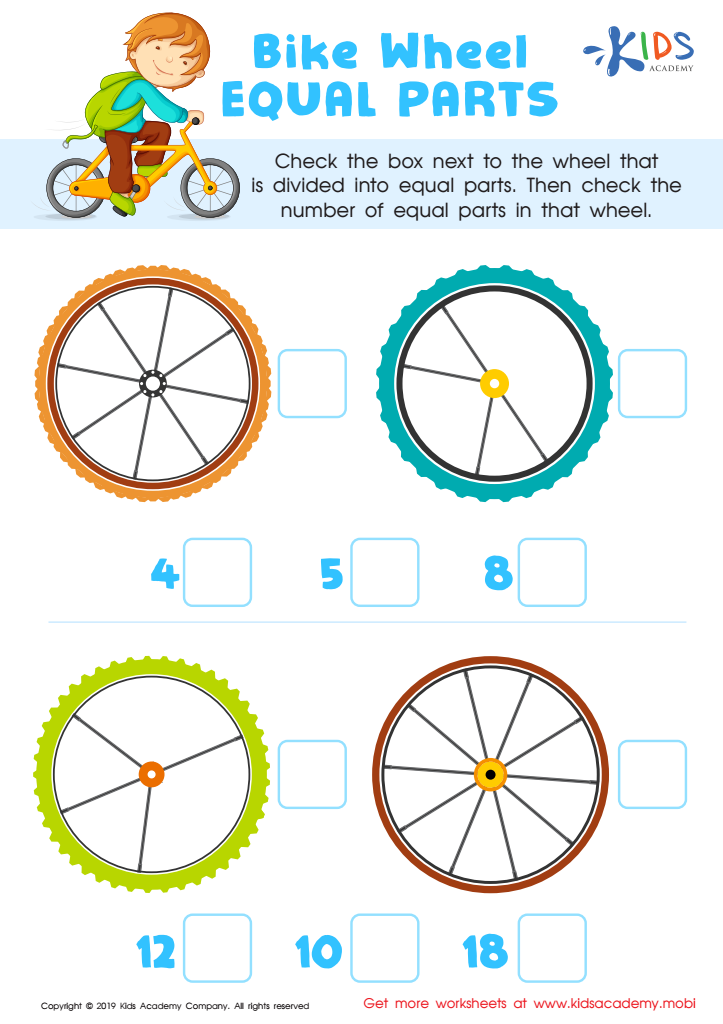
Bike Wheel Equal Parts Worksheet
 Assign to My Students
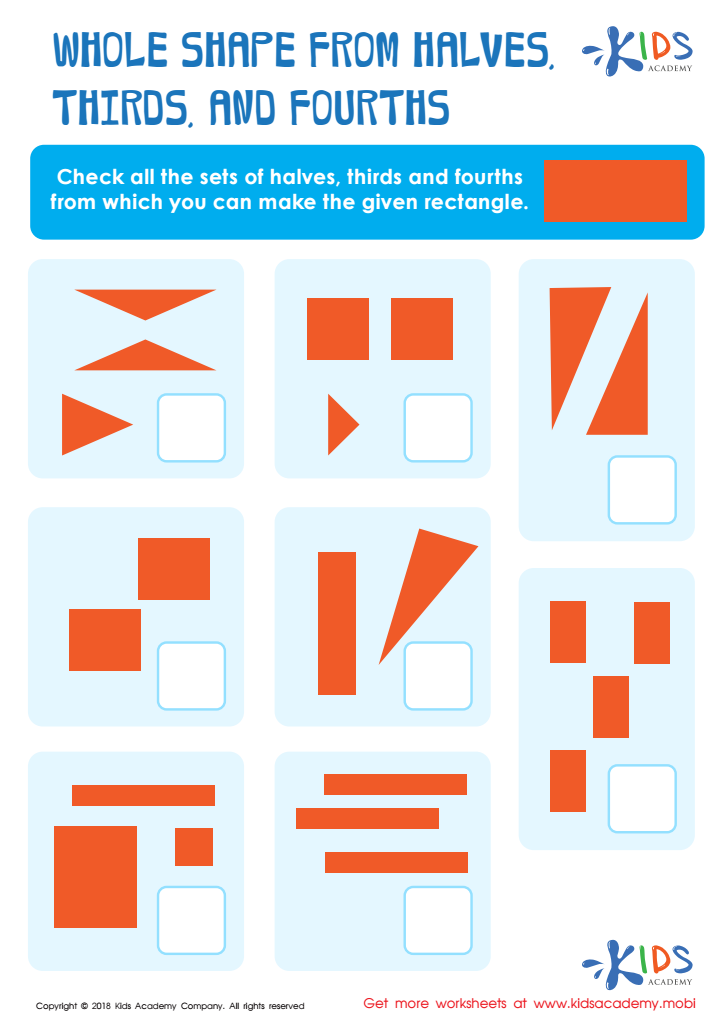
Whole Shape from Halves, Thirds and Fourths Worksheet








Understanding fractions is vital for children aged 6-8, as it lays the foundation for their mathematical development and everyday problem-solving skills. During this critical stage, children begin to grasp the concept of parts of a whole which fosters their analytical thinking, and enhances their ability to visualize and manipulate objects in their surroundings.
Parents and teachers should prioritize fraction understanding because it connects to various areas of math and daily life. Mastery of fractions is essential not only for operations such as addition, subtraction, and multiplication but also for skills in measurement, division, and proportions encountered in real-world situations like cooking or shopping.
Moreover, a solid grasp of fractions builds confidence and motivates children to take on more complex mathematical concepts in later grades, such as decimals and ratios. Engaging children with interactive fraction activities and games can make learning enjoyable, positively impacting their self-esteem and enthusiasm for math.
When parents and teachers focus on foundational math skills, they help nurture a generation that can tackle advanced mathematical concepts with ease, promoting academic success and practical life skills. Fraction understanding is more than just numbers; it equips children with critical thinking abilities that apply beyond the classroom.








