
Grouping skills Math Worksheets for Ages 6-8
3 filtered results
Difficulty Level
Grade
Age
-
From - To
Subject
Activity
Standards
Enhance your child's mathematical abilities with our Grouping Skills Math Worksheets for ages 6-8. These engaging and interactive activities promote critical thinking and problem-solving by teaching kids how to categorize, organize, and group different objects and numbers. Designed by educational experts, these worksheets help young learners understand essential concepts, such as place value, number families, and patterns. They provide a fun, hands-on approach to reinforce classroom learning and build a solid foundation for future math success. Accessible and easy to use, our worksheets ensure your child develops vital skills at their own pace. Download now and make math enjoyable!
Favorites
With answer key
Interactive
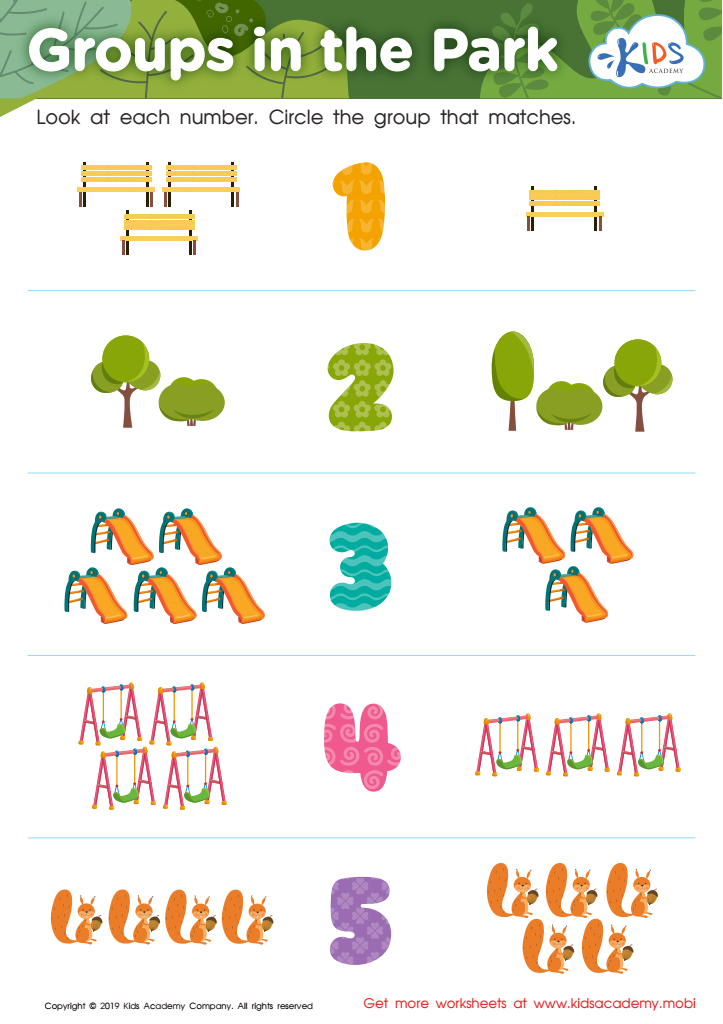
Groups in the Park Worksheet
Take your kids to the park and let them enjoy the freedom to play! Ask them what they love doing most and study a picture together - name items and count objects in the sets, then circle the correct one. It's a fun way for your kids to learn.
 Assign to My Students
Groups in the Park Worksheet
Worksheet
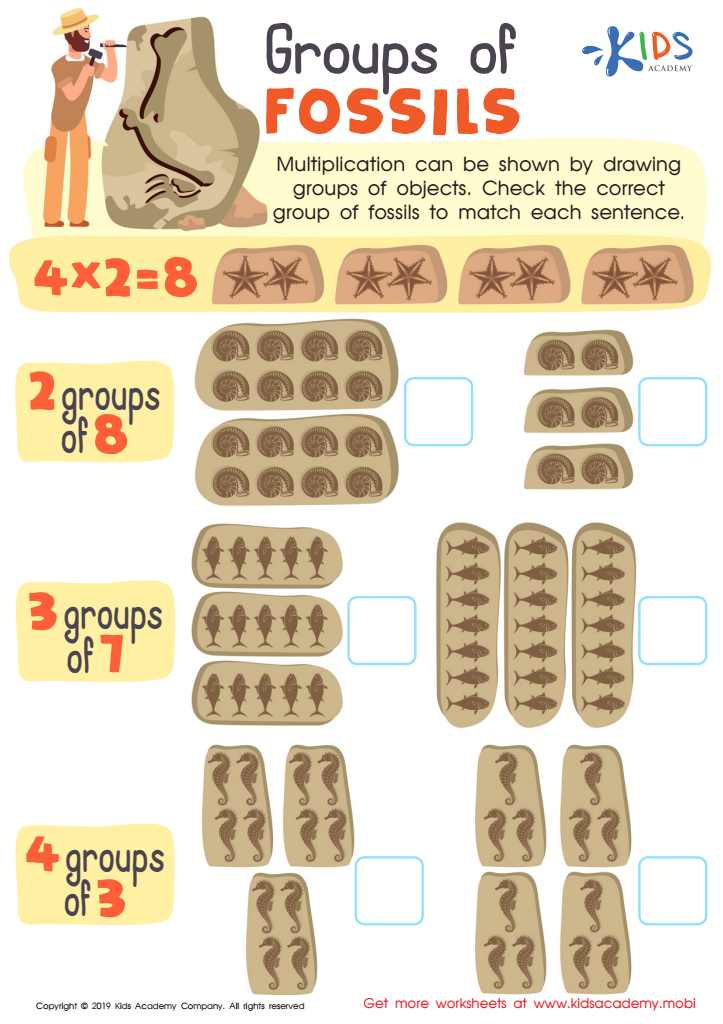
Groups of Fossils Worksheet
Kids need to learn multiplication after mastering addition and subtraction. To make it fun, use worksheets like this one. Have kids draw objects to match each sentence - this helps them understand multiplication better. With this approach, they'll be sure to learn the concepts.
Groups of Fossils Worksheet
Worksheet
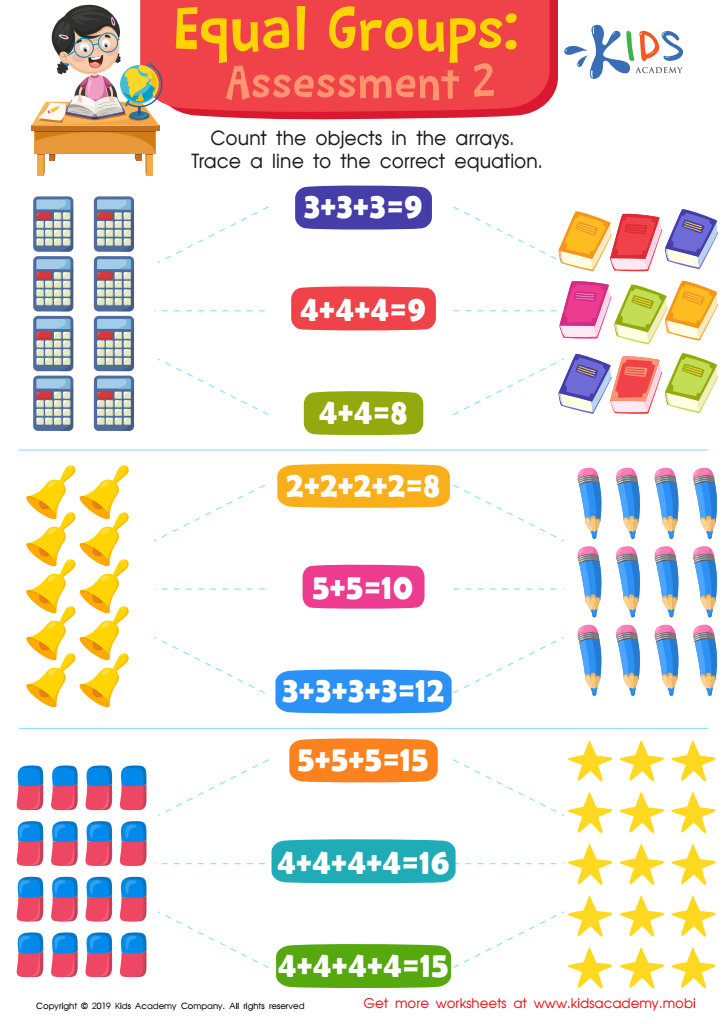
Equal Groups: Assessment 2 Worksheet
Get your kids to pay attention to learning with familiar objects, bright colors, and this worksheet. It has six arrays - ask kids to identify them and count the objects. Then, help them trace a line to the correct equation.
Equal Groups: Assessment 2 Worksheet
Worksheet
Join Kids Academy for Free
Who is primarily going to use this learning content?








Parents and teachers should prioritize developing grouping skills in math for children aged 6-8 because these skills form a foundational block for more advanced mathematical concepts. Grouping helps children understand the concept of place value, which is critical for all arithmetic operations. By mastering grouping, children can easily comprehend larger numbers and learn efficient strategies for adding, subtracting, multiplying, and dividing.
Additionally, grouping reinforces cognitive skills such as sorting, classifying, and pattern recognition, which are integral across various learning domains. It enhances a child’s ability to break down complex problems into simpler, more manageable parts, promoting logical thinking and problem-solving skills.
Beyond academics, grouping fosters collaborative learning. When children work on grouping activities together, they improve their social skills, learning to communicate, negotiate, and share ideas effectively. This collaborative aspect builds a supportive learning environment where children feel more motivated and engaged.
Furthermore, early competence in grouping can boost a child’s confidence in their math abilities, laying a positive, proactive attitude towards the subject. This creates a solid foundation for future academic success, making it essential for parents and teachers to focus on developing grouping skills in the formative years.








