Improve vocabulary Math Worksheets for Ages 6-8
3 filtered results
-
From - To
Enhance your child’s math vocabulary with our engaging worksheets designed for ages 6-8! Our "Improve Vocabulary Math Worksheets" help young learners expand their mathematical language while mastering essential skills. These interactive worksheets focus on key terms and concepts, seamlessly integrating vocabulary development with fun math activities. Tailored to promote comprehension and confidence, our resources make learning engaging and effective. Perfect for both the classroom and at-home learning, these worksheets encourage students to explore mathematical terminology in context and strengthen their understanding of math concepts. Discover the joy of learning and watch your child excel in math while boosting their vocabulary!
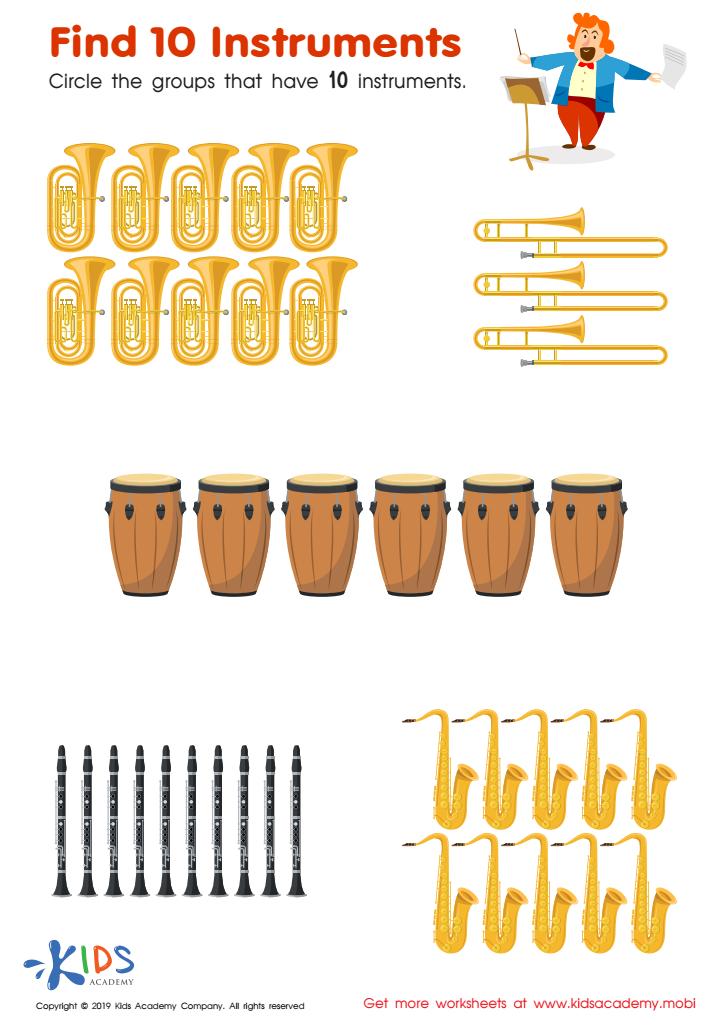
Find 10 Instruments Worksheet
 Assign to My Students








Improving vocabulary in math for children ages 6-8 is crucial for their overall learning and comprehension. At this developmental stage, children are not only learning numerical concepts but also how to communicate these ideas effectively. A strong math vocabulary facilitates a deeper understanding of mathematical principles and operations, enabling students to express their thoughts confidently and accurately.
When children are familiar with terms like "sum," "difference," "multiple," and "fraction," they can better grasp problem-solving techniques and apply them to real-world situations. This linguistic proficiency directly influences their ability to tackle mathematical problems and navigate math-related discussions, fostering a positive learning experience.
Moreover, incorporating math vocabulary in educational settings nurtures critical thinking and enhances literacy skills, as students learn to connect mathematical concepts with language. This synergy between math and language skills paves the way for future academic success, not just in math but across all subjects.
By prioritizing vocabulary development, parents and teachers can create a more engaging, effective learning environment that prepares children for the challenges of advanced math and everyday situations. Plus, a robust grasp of math vocabulary can bolster students' self-esteem, making them more enthusiastic participants in classroom discussions and activities.








