
Math problem-solving skills Math Worksheets for Ages 6-8
4 filtered results
Difficulty Level
Grade
Age
-
From - To
Subject
Activity
Standards
Unlock your child's potential with our Math Problem-Solving Skills Worksheets for ages 6-8. Designed to challenge young minds, these worksheets offer engaging puzzles, word problems, and exercises to foster critical thinking and analytical skills. Tailored for budding mathematicians, our resources help children apply concepts in practical scenarios, enhancing their understanding and boosting their confidence. Perfect for supplementing school learning or homeschooling, these activities build a solid foundation in addition, subtraction, multiplication, and division. With fun and creativity at the core, our printable worksheets make mastering math enjoyable and rewarding for your child. Start their math adventure today!
Favorites
With answer key
Interactive
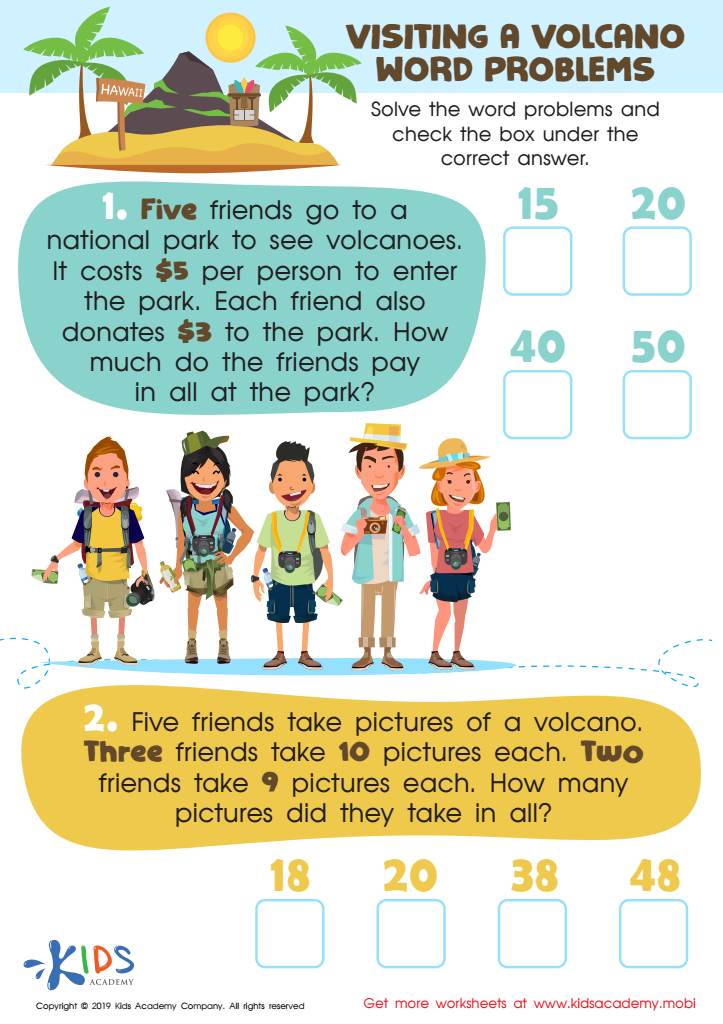
Visiting a Volcano Word Problems Worksheet
Read the word problems to your kids, note down the numbers and help them solve. Check the box under the correct answer. Word problems are sentences posed as math problems; just like regular number problems, first you must understand and interpret the sentence.
 Assign to My Students
Visiting a Volcano Word Problems Worksheet
Worksheet
Join Kids Academy for Free
Who is primarily going to use this learning content?








Math problem-solving skills are essential for children aged 6-8 because they lay the foundation for critical thinking, creativity, and future academic success. At this age, children's cognitive abilities are rapidly developing, making it the perfect time to nurture these skills. Math problem-solving encourages logical reasoning and the ability to analyze and interpret information—skills that are transferable and valuable across all subject areas.
For parents and teachers, fostering these skills means guiding children through processes that teach patience, persistence, and confidence in their abilities to tackle challenges. When children solve problems, they engage in trial and error, learning that making mistakes is part of the learning process. This boosts resilience and promotes a growth mindset, where children understand that effort leads to improvement.
Moreover, early math skills are strong predictors of later achievement in school and beyond. By instilling good problem-solving habits early on, parents and teachers are helping children to develop independence, improve their focus, and establish a love for learning. Math problem-solving also enhances fine motor skills and spatial reasoning, and it fosters collaboration if done in group settings.
In summary, nurturing math problem-solving skills in 6-8-year-olds equips them with essential tools for academic and personal success, helping them to become confident, competent, and adaptable individuals.








