
Money identification Math Worksheets for Ages 6-8
4 filtered results
Difficulty Level
Grade
Age
-
From - To
Subject
Activity
Standards
Introduce your young learner to the essential skill of money identification with our specially designed Math Worksheets for Ages 6-8. Engaging and educational, these worksheets from Kids Academy help children recognize and understand the value of different coins and bills. With a variety of fun exercises, kids will develop confidence in handling money, making change, and performing basic calculations. Perfect for use in classrooms or at home, these worksheets complement any math curriculum, ensuring your child builds a strong foundation in financial literacy. Start exploring today to make learning about money entertaining and effective!
Favorites
With answer key
Interactive
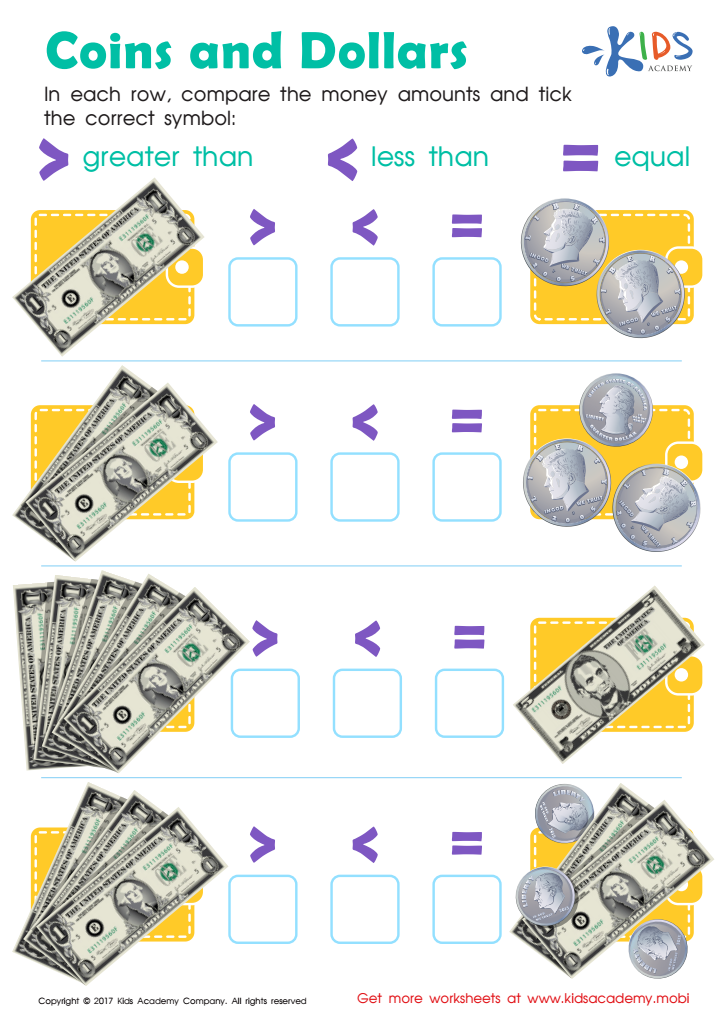
Money: Coins Dollars Printable
Motivate your kid to learn and practise essential math skills, like 'greater than' and 'less than', by introducing the importance of money! The money worksheet "Coins and Dollars" will give them a hands-on experience of counting coins and dollars, making math symbols more memorable.
 Assign to My Students
Money: Coins Dollars Printable
Worksheet
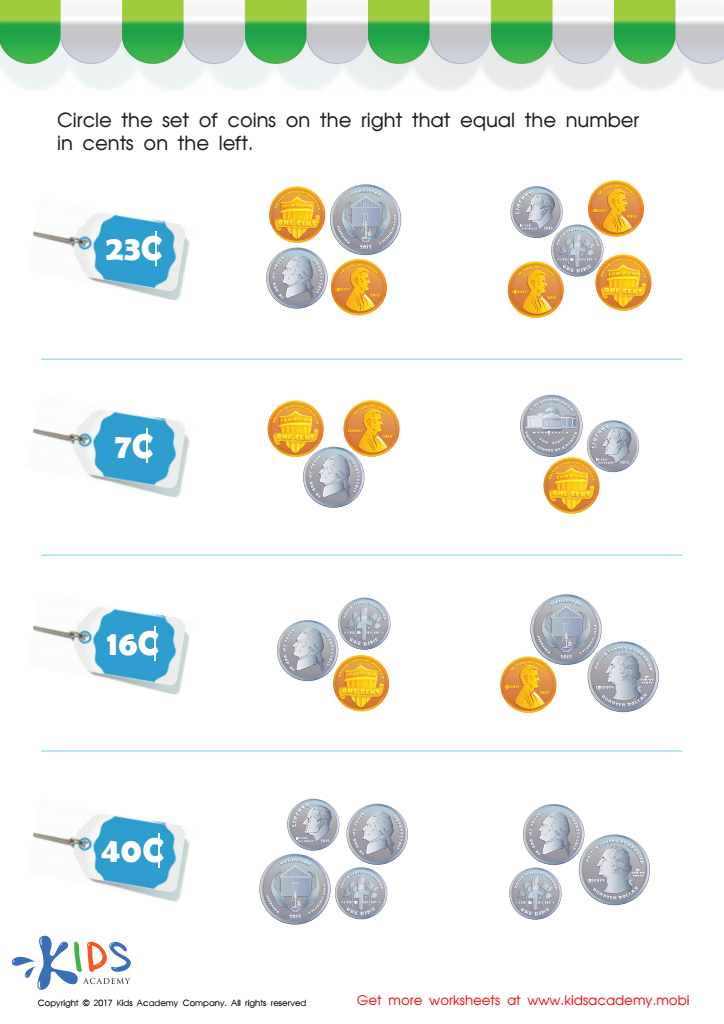
Picking the Coins You Need Money Worksheet
Let's learn to count money with Parents and Kids Academy! Investigate a real shop together: buy a globe, pencils, books, and a school bag using coins. Then, circle the coins you'll need. Visit our website for more free and fun money games for kids!
Picking the Coins You Need Money Worksheet
Worksheet
Join Kids Academy for Free
Who is primarily going to use this learning content?





.jpg)


Understanding money identification and basic math concepts related to money is crucial for ages 6-8 as it lays the foundation for essential life skills. At this developmental stage, children are highly receptive to learning new concepts; integrating money math helps in cognitive development and real-world application of math skills.
Firstly, by identifying and counting coins and bills, children enhance their recognition and comparison skills. They learn to differentiate between different denominations, instilling a sense of value and quantity. This is fundamental as money identification spans across various practical contexts—grocery shopping, saving, and even in games—which makes learning both engaging and applicable.
Secondly, learning about money ties directly with basic arithmetic—addition, subtraction, multiplication, and division. These operations underpin more complex math challenges they will face in later grades. Handling money during concrete activities like pretend play or simple transactions provides contextual practice, making abstract math concepts more tangible and understandable.
Moreover, incorporating money lessons encourages responsible financial habits from a young age. With early financial literacy, children are empowered to make informed decisions, understand the importance of saving, and appreciate the value of earning. Therefore, parents and teachers should emphasize money identification as it not only strengthens math proficiency but also equips children with practical, lifelong skills.








