Spatial awareness development Math Worksheets for Ages 6-8
3 filtered results
-
From - To
Boost your child's spatial awareness and mathematical skills with our engaging Math Worksheets for Ages 6-8. Designed to foster a solid foundation in spatial reasoning, these printable worksheets combine fun and education to help kids visualize and understand the relationships between shapes and spaces. Each activity challenges young minds through puzzles, geometric explorations, and logic games, making learning both interactive and enjoyable. Perfect for enhancing critical thinking, these worksheets support cognitive development and prepare children for more advanced math concepts. Download now from Kids Academy and watch your child’s spatial intelligence soar!
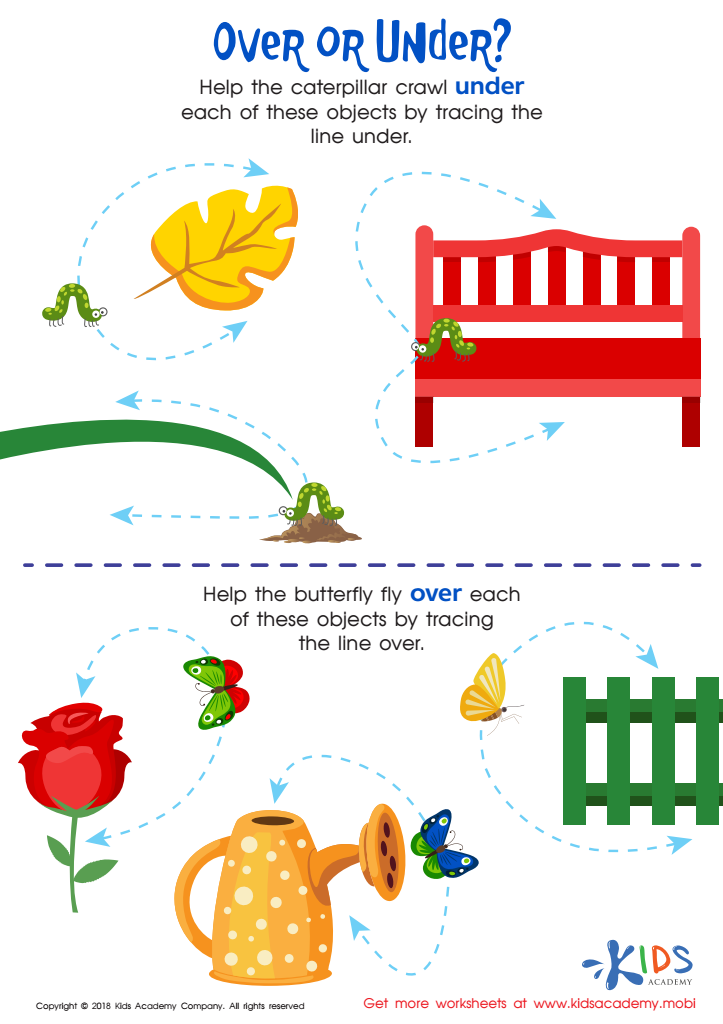
Over or Under? Worksheet
 Assign to My Students
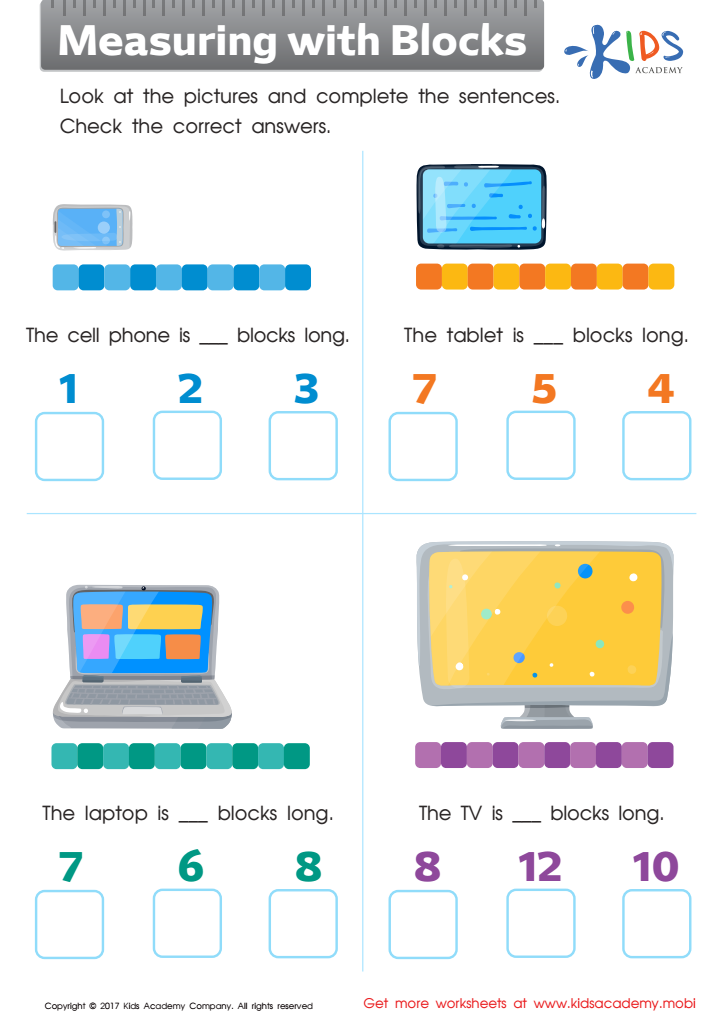
Measuring with Blocks Worksheet
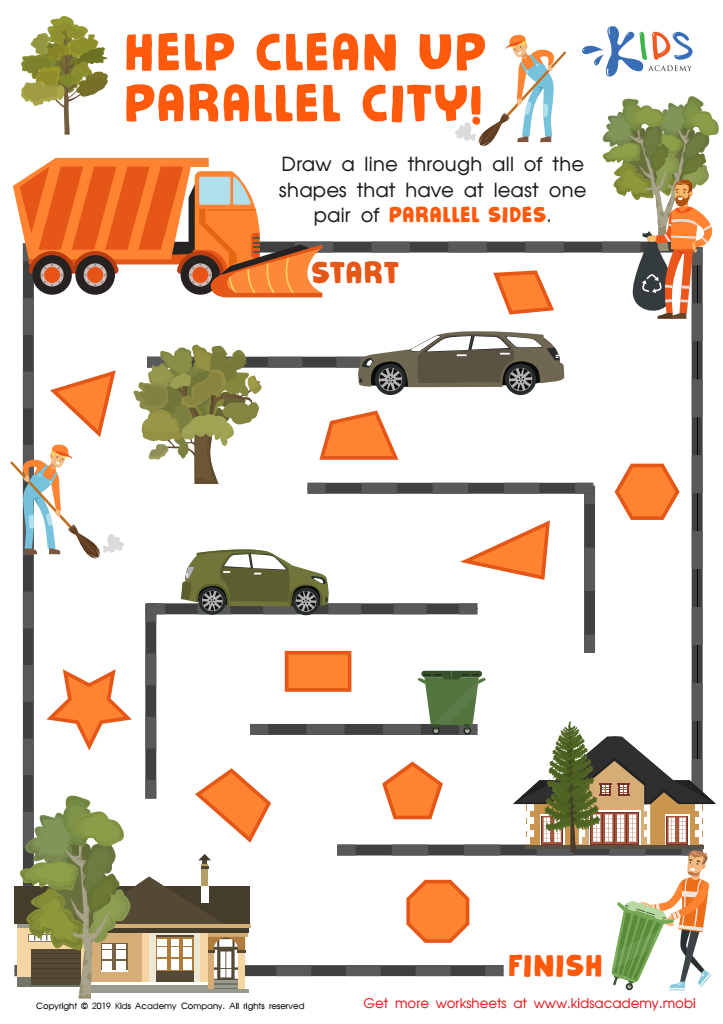
Help Clean Up Parallel City Worksheet







Spatial awareness is the ability to understand and interact with the environment in a three-dimensional space. For children aged 6-8, fostering spatial awareness is crucial because it lays a solid foundation in mathematics and essential everyday skills.
Firstly, spatial awareness is fundamentally linked to geometry, a core component of math education. When children develop this skill early, they can more easily grasp concepts like shapes, sizes, positions, directions, and movement, which are critical for problem-solving and logical thinking. This understanding helps them perform better in math classes and standardized tests later on.
Additionally, spatial skills are essential for practical life activities. For instance, children use these abilities to navigate through their surroundings, participate in sports, understand maps, and even in artistic endeavors like drawing or building with blocks.
Moreover, a child's success in fields such as engineering, architecture, and computer science—disciplines that heavily rely on spatial skills—can often be traced back to these early developmental stages. Encouraging spatial awareness fosters creativity and innovation, skills highly valuable in so many spheres of life and work.
Lastly, developing spatial skills boosts a child’s confidence and independence. When children can efficiently interact with their environment, it nurtures a sense of competence and achievement. Thus, educators and parents should prioritize and integrate spatial awareness activities into early learning for a firm academic and social foundation.








