Telling time Math Worksheets for Ages 6-8
4 filtered results
-
From - To
Our "Telling Time Math Worksheets for Ages 6-8" are designed to make learning to tell time fun and engaging for young learners. These printable worksheets help children practice reading both analog and digital clocks, understand hours and minutes, and grasp the concepts of AM and PM. Each worksheet features colorful illustrations and incremental levels of difficulty to build confidence and reinforce skills. Perfect for classroom use or at-home practice, these worksheets aim to develop foundational time-telling abilities that are crucial for everyday activities and future math proficiency. Encourage your child’s time-telling journey with these thoughtfully crafted learning tools!
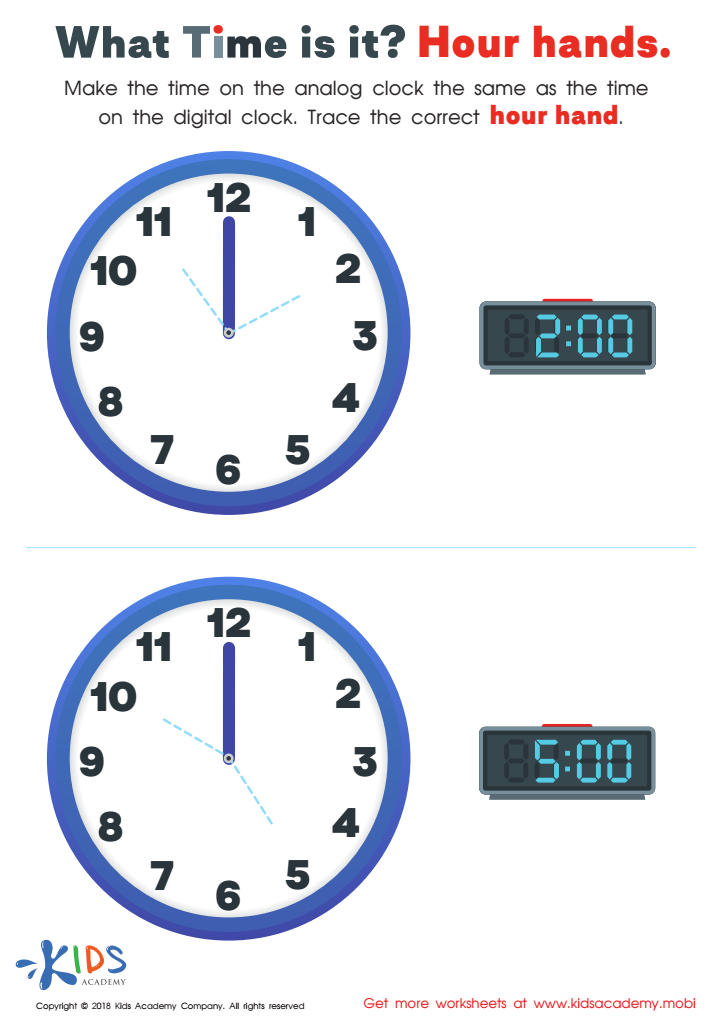
What Time Is it? Hour Hands Worksheet
 Assign to My Students








Telling time is a foundational skill for children between the ages of 6-8, offering numerous educational and practical benefits that extend beyond the classroom. Understanding time teaches kids the concepts of sequencing and time management, crucial for daily activities. This competency enables them to comprehend the passage of time, structure their day, and adhere to schedules, fostering a sense of responsibility and independence.
From an educational perspective, learning to tell time reinforces mathematical concepts. Children practice counting by fives, become familiar with the base-60 number system for minutes and seconds, and enhance their comprehension of fractions and equivalency, as time breaks down into quarter and half-hours. These skills not only build arithmetic abilities but also lay a foundation for more complex math courses later on.
Moreover, literacy skills are bolstered, as reading a clock involves interpreting symbols and correlating them to an everyday context. This fits into a broader learning spectrum that incorporates both visual and kinesthetic learning styles.
For teachers and parents, investing time in teaching children to tell time ensures that kids are poised to navigate the world confidently, equipped with the essential skills to thrive both academically and personally. It fosters greater academic aptitude and enables children to function effectively in a structured society.








