
Understanding adjectives Math Worksheets for Ages 6-8
6 filtered results
Difficulty Level
Grade
Age
-
From - To
Subject
Activity
Standards
Introduce your child to the world of adjectives with our engaging Math Worksheets designed for ages 6-8! These worksheets combine the fun of learning adjectives with essential math skills, making it perfect for young learners. Your child will explore how adjectives enhance language while directing their focus towards numbers and basic math operations. With interactive exercises and colorful illustrations, kids will not only recognize descriptive words but also apply them in mathematical contexts. These worksheets are an excellent resource that promotes creativity, critical thinking, and a love for learning in a playful, educational environment. Enhance your child's skill set today!
Favorites
With answer key
Interactive
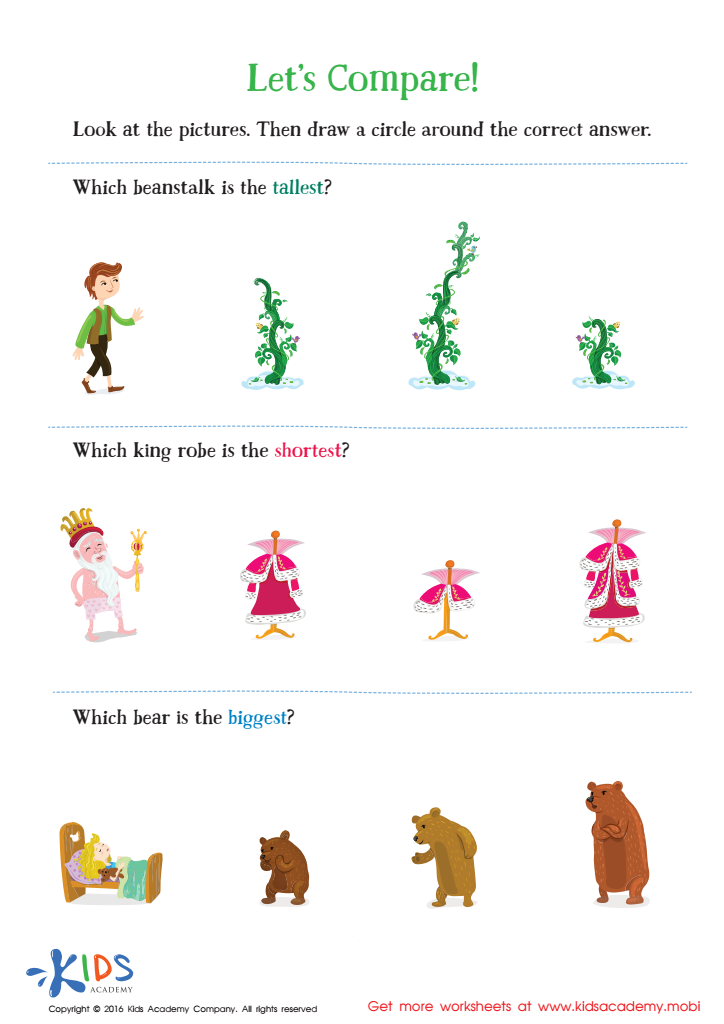
Fairy Tale Worksheet: Let's Compare
Preschoolers need to recognize different sizes of objects. This worksheet combines fun fairy tales with size practice, helping them read, problem solve, and sort through pictures. Your child will love the images and be eager to complete it. Enhance their learning by talking about the tales to build comprehension.
 Assign to My Students
Fairy Tale Worksheet: Let's Compare
Worksheet
Join Kids Academy for Free
Who is primarily going to use this learning content?






.jpg)

Teaching adjectives at an early age, particularly in the context of math, is essential for holistic learning. For children aged 6-8, understanding adjectives helps them articulate their thoughts, enhancing their communication skills. In math, adjectives can deepen their comprehension of concepts by allowing them to describe and categorize numbers, shapes, and sizes effectively. For example, when children learn to distinguish between a "large square" and a "small triangle," they’re not only identifying shapes but also developing critical observational and comparative skills.
Moreover, integrating adjectives into math lessons enriches vocabulary, making learning more engaging and giving students tools to express themselves confidently. This boosts their self-esteem and fosters a positive attitude toward learning. Furthermore, individuals who encounter language-rich environments tend to excel academically, so emphasizing descriptive words in math creates connections between language skills and other subjects.
Ultimately, educators and parents should care about teaching adjectives in math contexts, as it lays vital groundwork for analytical thinking, enhances problem-solving skills, and prepares children for more complex academic challenges ahead, fostering a love for learning that endures throughout their educational journey. Through thoughtful integration of adjectives, we empower young learners to navigate both language and logic with ease.








