
Mental math skills Multiplication Worksheets for Ages 6-8
6 filtered results
Difficulty Level
Grade
Age
-
From - To
Subject
Activity
Standards
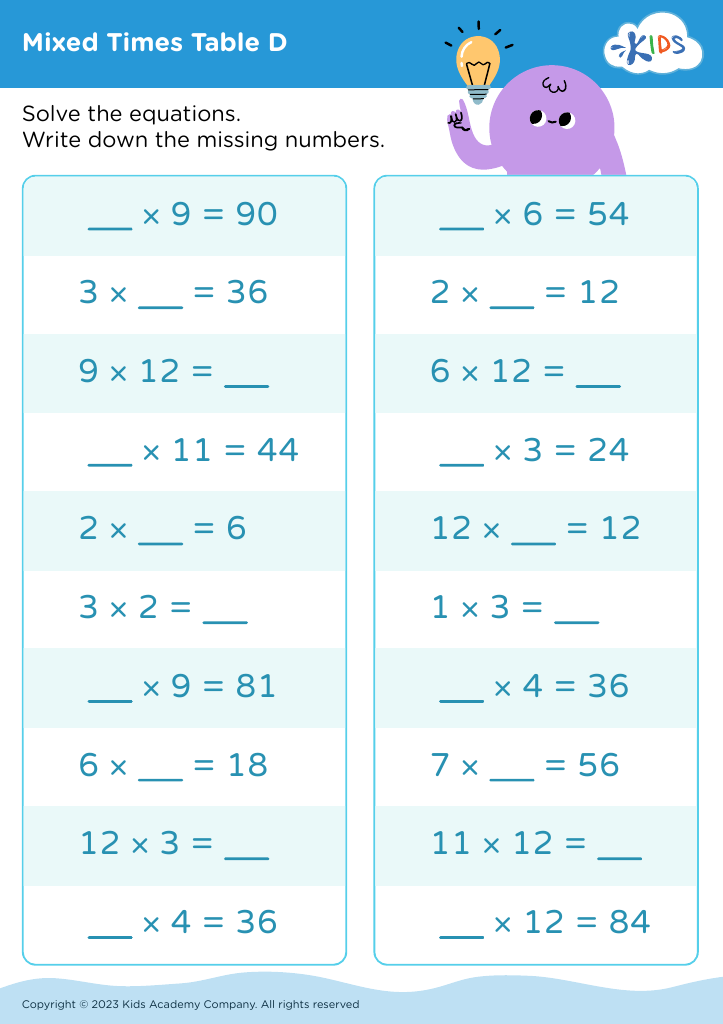
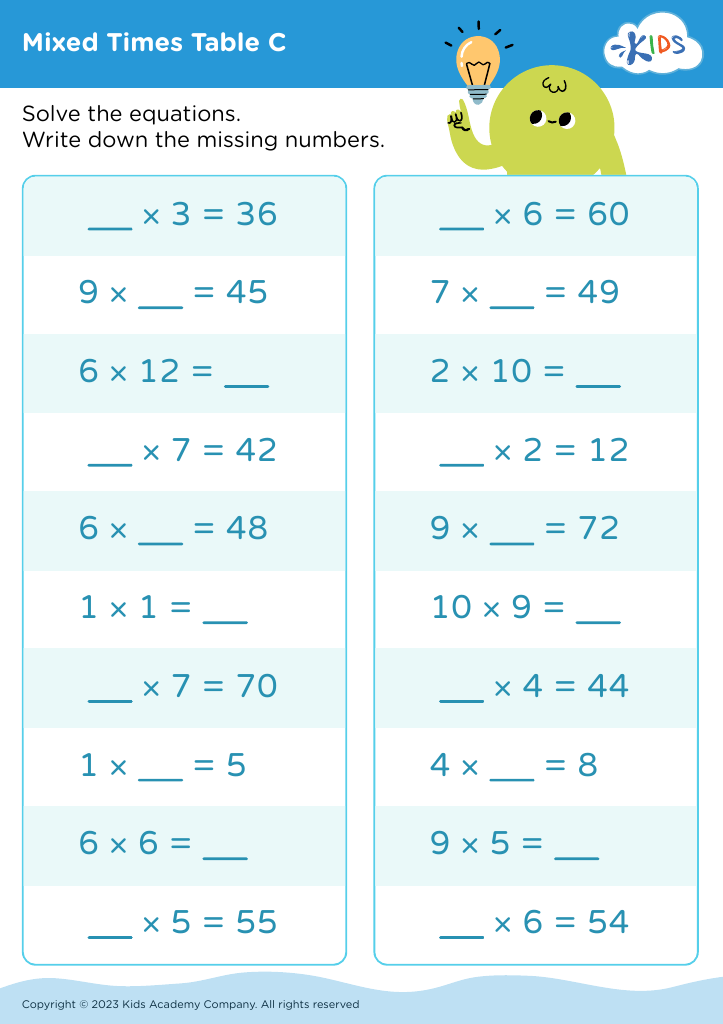
Our "Mental Math Skills Multiplication Worksheets for Ages 6-8" are designed to enhance young students' ability to perform multiplication quickly and accurately in their minds. These engaging, age-appropriate worksheets help build foundational math skills using fun and interactive methods, making learning enjoyable. With a variety of exercises, children can practice multiplying single-digit numbers, understand multiplication concepts, and develop strategies to solve problems mentally. Ideal for use at home or in the classroom, these worksheets support clearer understanding and faster calculations, nurturing confident, skilled little mathematicians ready to tackle future math challenges.
Favorites
With answer key
Interactive
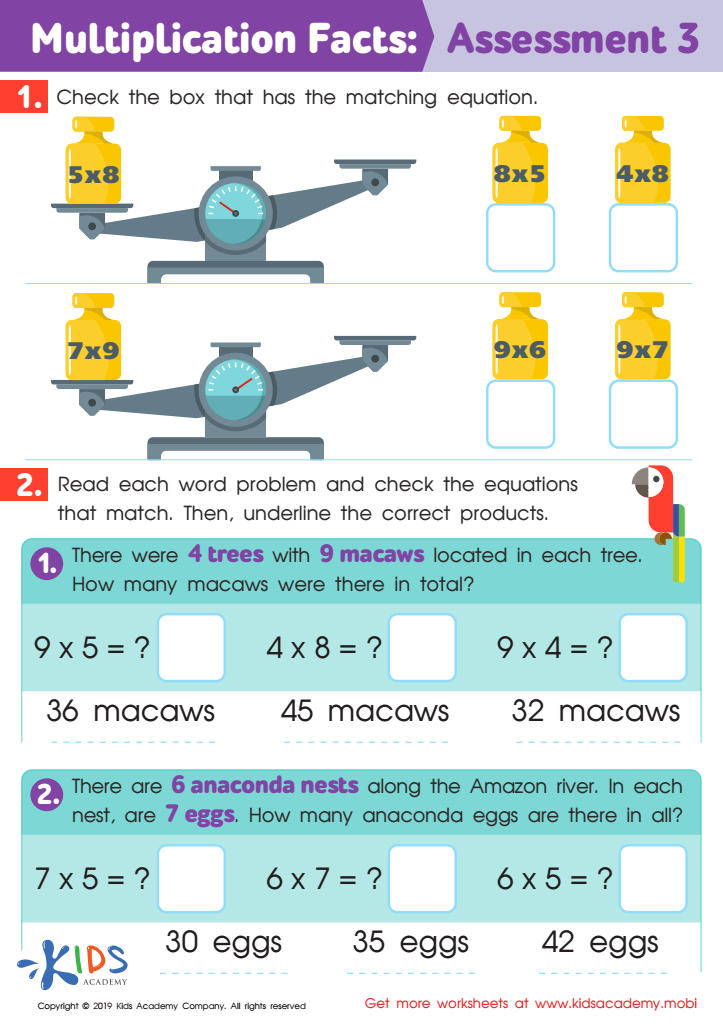
Multiplication Facts: Assessment 3 Worksheet
Test your kid's maths skills with this easy to use worksheet! Help them check the box that matches the equation in the first part, then read each word problem and underline the right answers to the second part. Assess your child's muliplication knowledge and find out where they need extra help.
 Assign to My Students
Multiplication Facts: Assessment 3 Worksheet
Worksheet
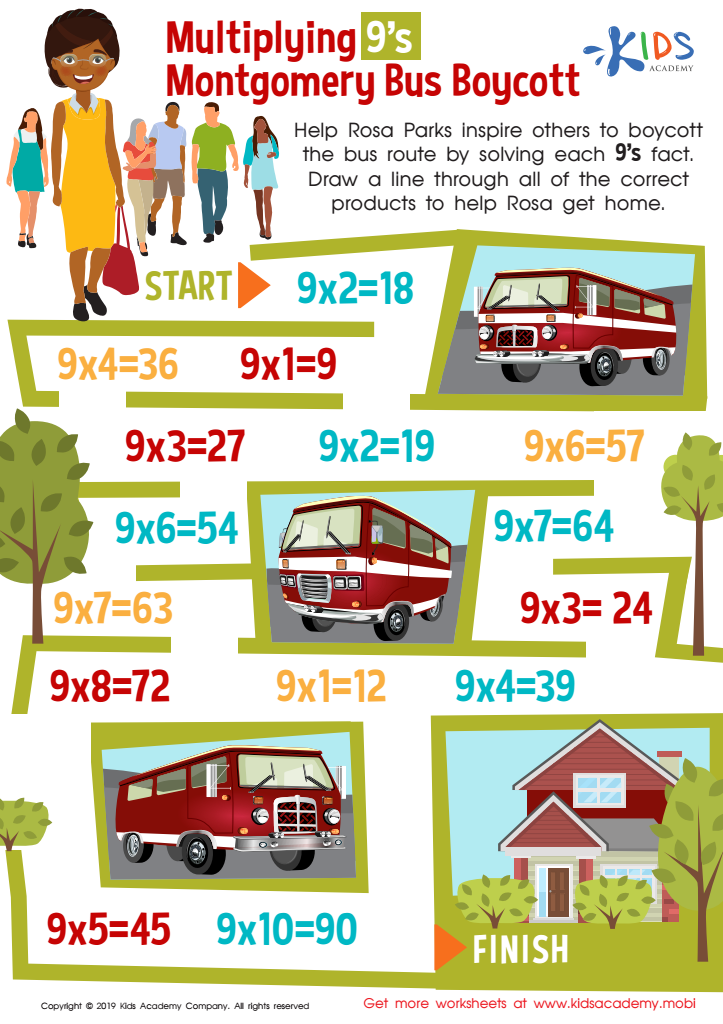
Multiplying 9’s Montgomery Bus Boycott Worksheet
As your students learn math, the numbers get bigger. This worksheet is great for learning the nine times table. Help Rosa Park get home - ask them to solve each multiplication fact, then draw a line through the correct products. Encourage your students to stand up for what's right!
Multiplying 9’s Montgomery Bus Boycott Worksheet
Worksheet
Join Kids Academy for Free
Who is primarily going to use this learning content?








Parents and teachers should care about developing mental math skills, specifically multiplication, for children ages 6-8 because these skills form the foundation for all future mathematical learning. At this formative stage, children’s brains are highly adaptable, and introducing mental multiplication can significantly strengthen their cognitive abilities, such as memory, attention, and logical reasoning.
Mental math enhances problem-solving skills by encouraging students to think quickly and efficiently. It teaches children to recognize patterns, understand number relationships, and develop strategies, which are fundamental components of mathematical proficiency. This mental agility leads to greater confidence in math class and reduces math-related anxiety by simplifying more complex problems through mental calculations.
Moreover, being fluent in mental multiplication supports academic success across all subjects. It lays the groundwork for more advanced topics like division, fractions, and algebra. When students have a solid grasp of basic multiplication facts, they can allocate their cognitive resources to higher-order thinking tasks rather than getting bogged down by simple calculations.
In real-world scenarios, mental multiplication is indispensable. It aids in effective decision-making in everyday tasks, such as managing money, planning time, and solving practical problems. Therefore, fostering these skills early prepares children not only for academic achievement but also for practical life situations. Encouraging mental math in the early years sets the stage for a lifetime of mathematical competence and confidence.








