
Shape identification Building Vocabulary Worksheets for Ages 6-8
3 filtered results
Difficulty Level
Grade
Age
-
From - To
Subject
Activity
Standards
Introduce your child to the fundamentals of geometry and vocab building with our "Shape Identification Building Vocabulary Worksheets" designed for ages 6-8. These expert-crafted worksheets blend reading comprehension with math to help young learners recognize and name various shapes like circles, squares, and triangles. By incorporating engaging illustrations and simple exercises, children enhance their vocabulary, develop critical thinking, and boost reading skills. Ideal for both classroom and home use, these worksheets are a great tool to foster early academic success and a love for learning. Join us at Kids Academy and make shape identification fun and educational!
Favorites
With answer key
Interactive
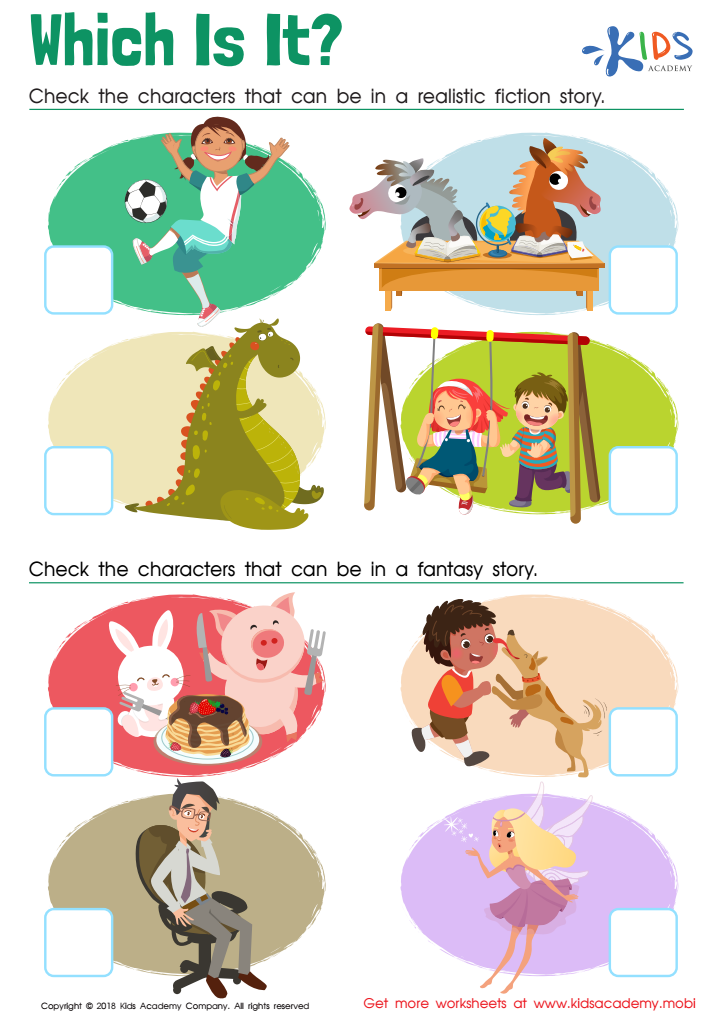
Which Is It? Worksheet
This colorful worksheet helps young readers identify elements of fact and fiction using fun picture clues. They can check off characters who exist in realistic fiction stories, which makes learning the difference between the two genres fun and engaging.
 Assign to My Students
Which Is It? Worksheet
Worksheet











Join Kids Academy for Free
Who is primarily going to use this learning content?


.jpg)





Parents and teachers should prioritize shape identification and vocabulary building for children aged 6-8 because these skills play a critical role in cognitive development and academic success. Shape recognition is a foundational aspect of early mathematics learning, fostering spatial reasoning and geometric thinking. It helps children understand and categorize the world around them, making sense of how objects relate to one another in space.
Building a robust shape vocabulary enhances communication skills, enabling children to describe and compare objects accurately and effectively. This linguistic development is integral for reading and comprehension, as recognizing shapes also underpins the ability to distinguish letters and numerals—crucial for literacy and numeracy development.
Furthermore, engaging with shapes through various activities encourages problem-solving and critical thinking. For example, recognizing that different shapes can make up a whole empowers children to approach more complex math problems, like fractions and symmetry, down the line.
Emotionally and socially, shape-related activities like puzzles and construction play promote perseverance, teamwork, and patience. When parents and teachers invest in shape identification and vocabulary exercises, they are laying a strong educational foundation, enabling holistic growth and preparing children for future academic challenges.








