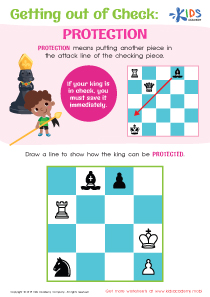
Spatial awareness Chess Worksheets for Ages 6-9
3 filtered results
Difficulty Level
Grade
Age
-
From - To
Subject
Activity
Standards
Enhance your child's spatial awareness with our engaging Chess Worksheets designed for ages 6-9. These worksheets offer fun and interactive exercises that merge the strategic thinking of chess with essential developmental skills. Children will explore concepts such as direction, distance, and position while completing captivating activities that improve their ability to visualize and manipulate objects in space. Perfect for at-home learning or as supplementary classroom material, our Spatial Awareness Chess Worksheets will empower young learners to develop critical thinking skills and boost their confidence in both chess and everyday problem-solving. Discover the exciting world of chess while fostering essential cognitive skills!
Favorites
With answer key
Interactive
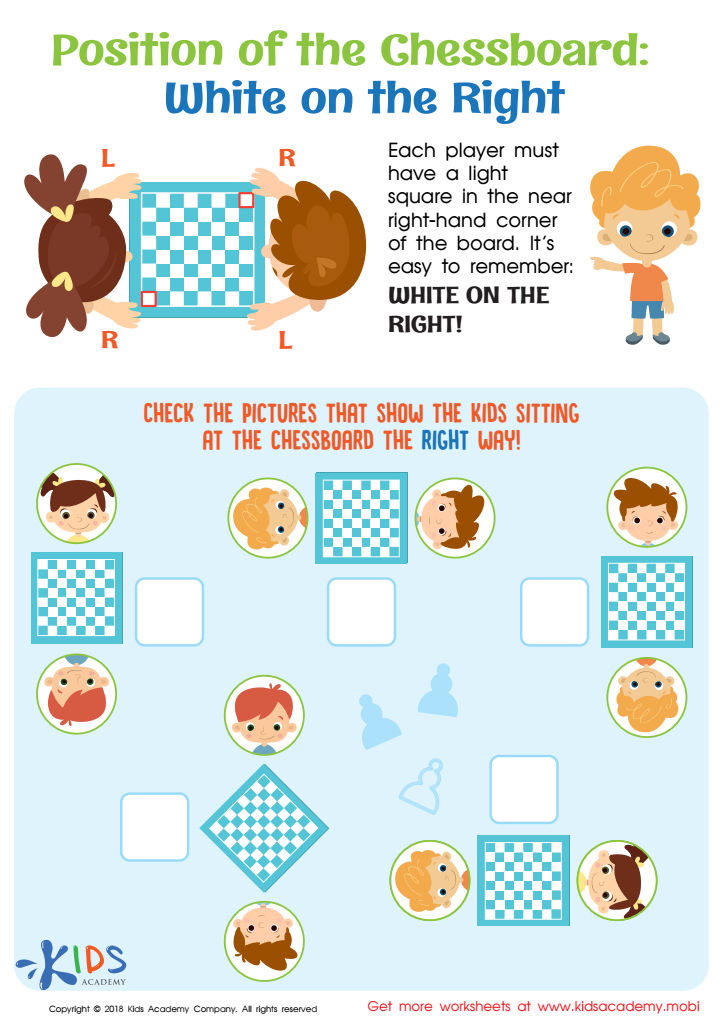
Position of the Chessboard: White on the Right Worksheet
Proper positioning of the chessboard and players is key. Before the game, make sure the white square is in the right-hand corner. A simple rhyme can help: "White on the right". Check pictures of kids at the chessboard to ensure correct positioning.
 Assign to My Students
Position of the Chessboard: White on the Right Worksheet
Worksheet
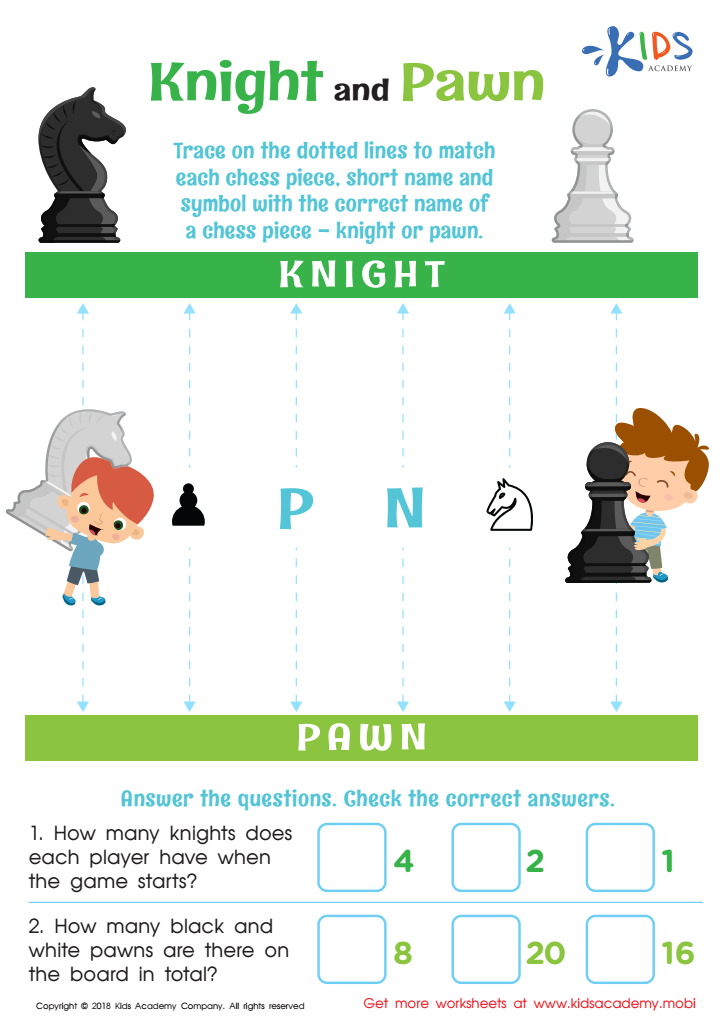
Knight and Pawn Worksheet
This tracing worksheet teaches kids about chess. They trace the dotted lines to match pieces, names and symbols to the correct chess piece. Questions at the bottom test their understanding. It's a simple exercise for a fun way to learn.
Knight and Pawn Worksheet
Worksheet
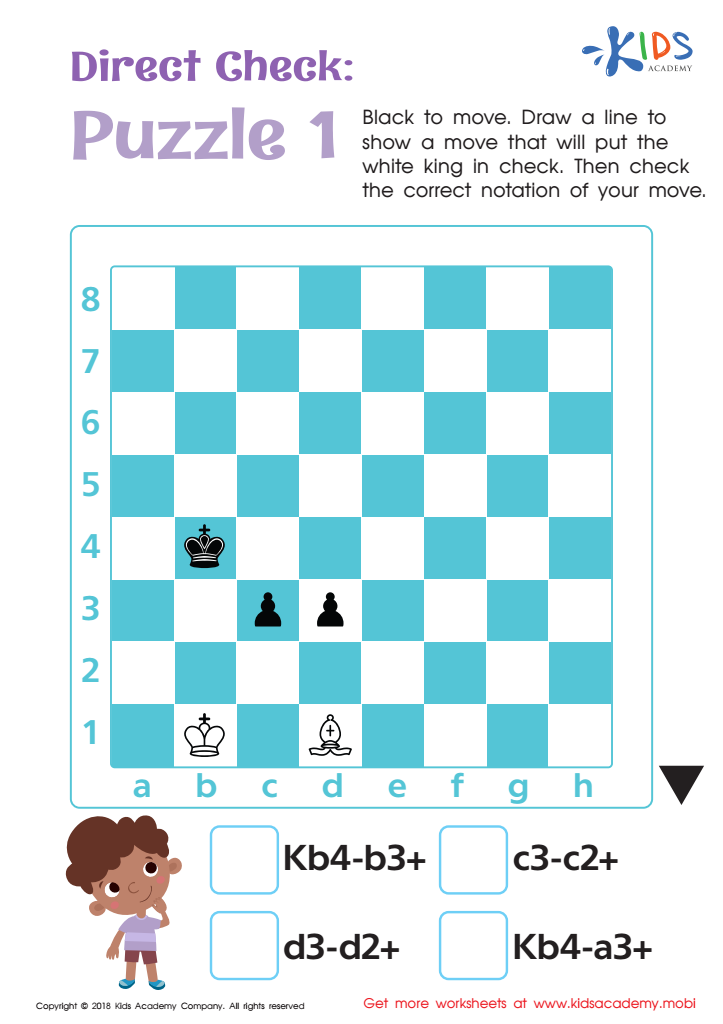
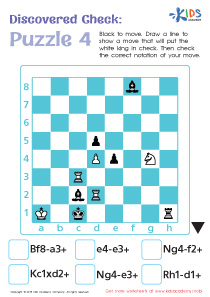
Direct Check: Puzzle 1 Worksheet
Your child can test their chess knowledge with this worksheet. If they've been taking lessons or playing regularly, they'll enjoy connecting the dots to put the white king in checkmate, then checking the correct notation. Challenge their chess skills!
Direct Check: Puzzle 1 Worksheet
Worksheet
Join Kids Academy for Free
Who is primarily going to use this learning content?


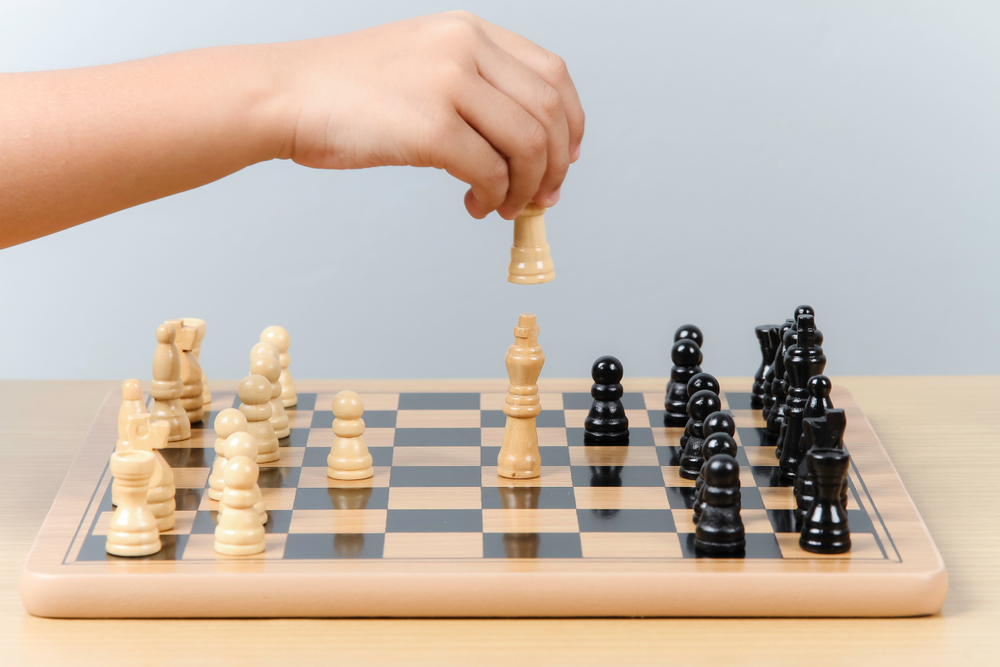


Parents and teachers should care about spatial awareness in chess for children ages 6-9 because it significantly enhances their cognitive development. Chess requires players to visualize movements, understand positioning, and anticipate opponents’ strategies. Engaging in such mental activities sharpens spatial reasoning, critical for mathematical skills, geometry, and everyday problem-solving.
Moreover, fostering spatial awareness through chess promotes concentration and patience. Young players must focus on the board’s configuration and plan their next moves, helping them develop essential skills for academic success and social situations. Additionally, playing chess can boost self-esteem and improve decision-making abilities, as children learn to evaluate the consequences of their choices.
Beyond academic benefits, chess also fosters important social skills. As children play together, they experience sportsmanship, learn to respect opponents, and develop teamwork skills. This collaborative aspect nurtures effective communication and emotional intelligence.
Finally, chess is a fun and engaging way to cultivate a nurturing environment at home or in the classroom. It encourages teamwork and respectful competition while providing lasting enjoyment. Thus, parents and teachers play a crucial role in integrating chess into children’s lives, not just as a game but as a valuable educational tool that opens doors to lifelong learning.