
Basic geometry comprehension Worksheets for Ages 6-9
3 filtered results
Difficulty Level
Grade
Age
-
From - To
Subject
Activity
Standards
Unlock your child's potential in mathematics with our Basic Geometry Comprehension Worksheets tailored for ages 6-9. These engaging and colorful worksheets are expertly designed to introduce young learners to fundamental geometric concepts. Explore shapes, lines, angles, and more through interactive activities that make learning fun and effective. Each worksheet is crafted to build confidence and improve problem-solving skills, all while aligning with educational standards. Perfect for both classroom and at-home learning, our resources ensure that geometry becomes an enjoyable adventure for kids. Ignite a passion for math today with our Basic Geometry Comprehension Worksheets!
Favorites
With answer key
Interactive
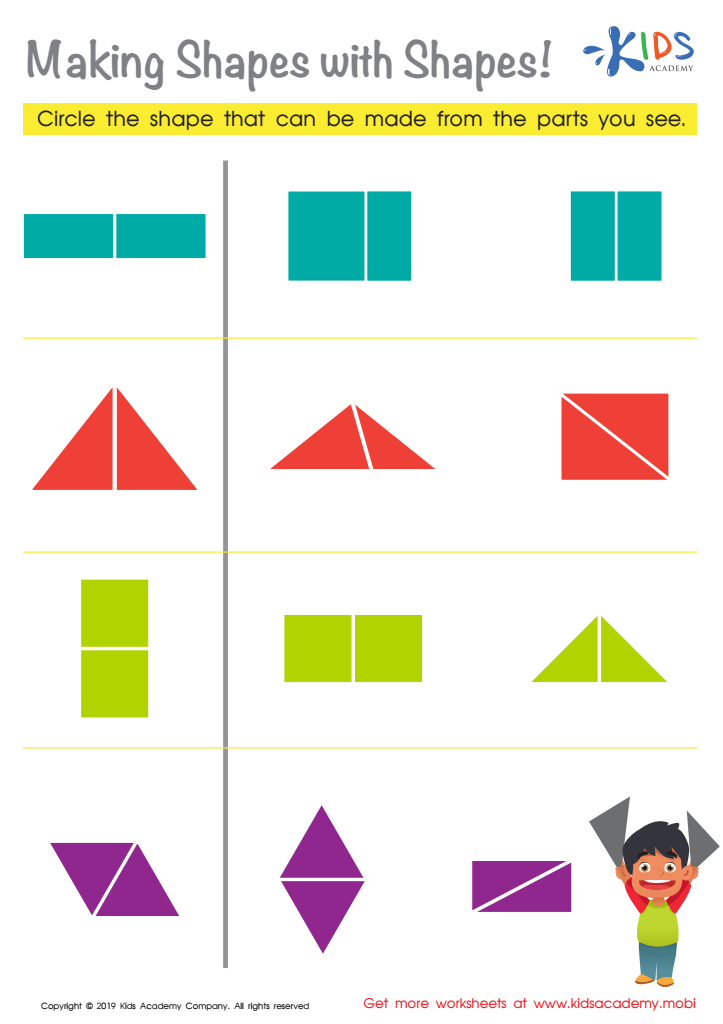
Making Shapes with Shapes Worksheet
Help your kindergartners identify shapes with this simple worksheet. Examine the shapes on the left and have them circle the one they can make from the parts in the picture. Shapes can be tricky, but this exercise will help clear up any confusion.
 Assign to My Students
Making Shapes with Shapes Worksheet
Worksheet
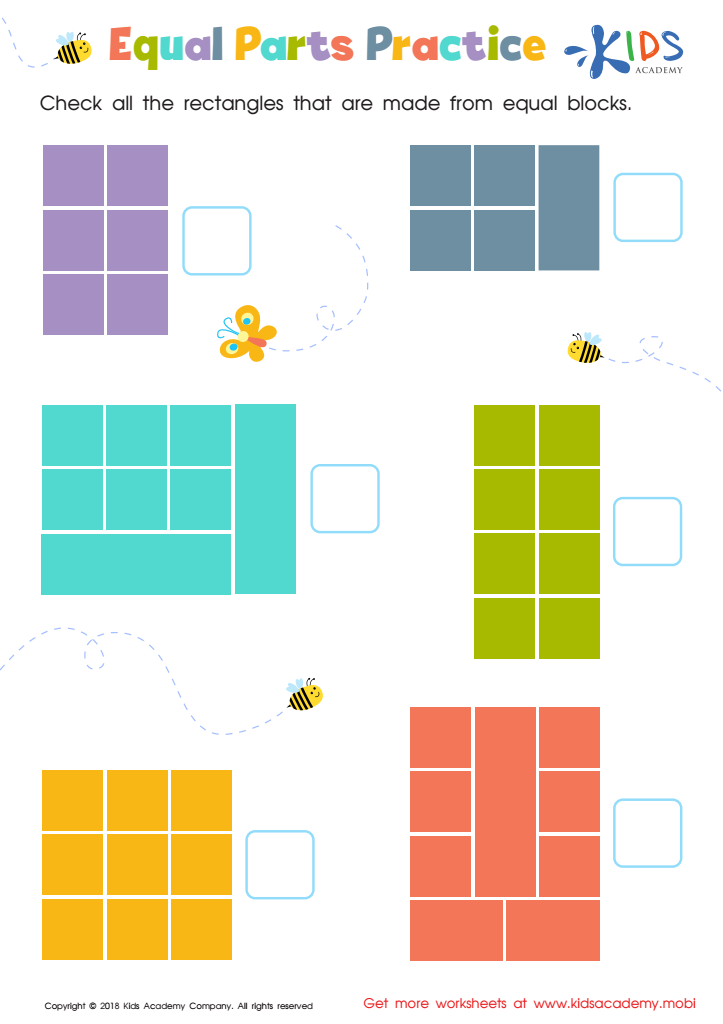
Equal Parts Practice Worksheet
This worksheet checks your child's knowledge of halves and equal pieces. Have them go through the rectangles and check those made up of equal blocks. Your kids should be able to tell which parts are equal and which are not after the exercise.
Equal Parts Practice Worksheet
Worksheet
Join Kids Academy for Free
Who is primarily going to use this learning content?







Basic geometry comprehension is crucial for children aged 6-9, forming a key part of their early mathematical development and overall cognitive growth. At this stage, understanding basic geometric concepts such as shapes, sizes, spatial reasoning, and the properties of objects helps lay the foundation for more advanced math skills. Geometry enhances visualization and analytical thinking, enabling children to interpret and interact with the world around them effectively.
For parents and teachers, fostering an environment where children can explore shapes and spatial relationships is instrumental in their educational journey. It encourages problem-solving abilities and logical reasoning, skills that are transferable across various subjects. Notably, geometry introduces essential vocabulary and concepts that are fundamental in everyday contexts – from recognizing traffic signs to understanding maps and interpreting various forms of visual information.
Moreover, engaging with geometry through activities such as building blocks, drawing, or identifying shapes in their surroundings promotes fine motor skills and hand-eye coordination. These activities make learning both fun and interactive, helping to sustain the child's interest and motivation.
Therefore, parents and teachers should prioritize basic geometry comprehension for young learners as it nurtures critical developmental skills, fosters a strong math foundation, and ultimately instills a sense of curiosity and exploration that is vital for lifelong learning.








