
Encourage attention to detail Worksheets for Ages 6-9
3 filtered results
Difficulty Level
Grade
Age
-
From - To
Subject
Activity
Standards
Our "Encourage Attention to Detail Worksheets" for ages 6-9 are designed to help children focus on fine details while learning crucial skills. These engaging worksheets cover a variety of exercises, from spotting differences to following complex patterns, fostering attention, and concentration. As young learners navigate through fun challenges, they'll enhance their observational abilities, critical thinking, and precision, building a strong foundation for future academic success. Perfect for both classroom and at-home activities, our worksheets make concentrating on details an enjoyable and beneficial experience, empowering children to excel with confidence. Download now and watch your child's skills flourish!
Favorites
With answer key
Interactive
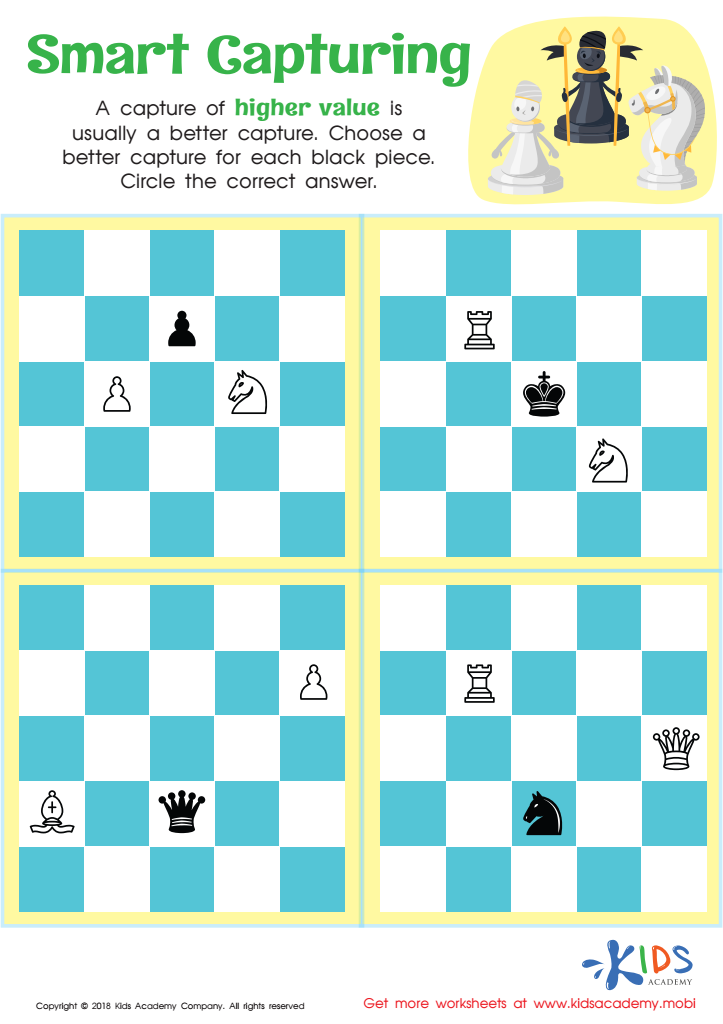
Smart Capturing Worksheet
Chess is a game of strategy and calculation. When presented with two captures, a player should always go for the one that yields the highest value. For example, taking a knight over a pawn. In this worksheet, your children will choose the best capture for each black piece. Ask them to circle the correct answers. (80 words)
 Assign to My Students
Smart Capturing Worksheet
Worksheet
Join Kids Academy for Free
Who is primarily going to use this learning content?








Encouraging attention to detail in children aged 6-9 is essential for their cognitive and developmental growth. At this formative stage, children are building foundational skills that will influence their academic success and problem-solving abilities later in life. Attention to detail enhances their ability to notice and remember important information, leading to better performance in subjects like reading, math, and science.
Fostering this skill helps young learners develop critical thinking and improves their capacity to follow instructions accurately. This translates to fewer mistakes in schoolwork and boosts overall academic confidence. Good attention to detail also promotes better organization and planning skills, essential for effective time management and project completion.
Moreover, children who are encouraged to pay attention to details can improve their social interactions. They learn to observe social cues and body language, enhancing empathy and communication skills. This can lead to more positive peer relationships and cooperation in group settings.
For teachers and parents, emphasizing attention to detail helps identify early if a child is struggling with specific academic or behavioral issues. Early intervention can then be applied to assist the child effectively. Ultimately, nurturing this skill at a young age sets children on a path towards academic achievement, better interpersonal relationships, and the ability to tackle complex tasks with confidence.








