
Identify colors Worksheets for Ages 6-9
3 filtered results
Difficulty Level
Grade
Age
-
From - To
Subject
Activity
Standards
Nurture your child’s creativity and visual skills with our "Identify Colors Worksheets for Ages 6-9". Carefully designed to suit early learners, these fun and engaging worksheets reinforce color recognition, helping your child distinguish and name different colors through interactive activities. Ideal for both classroom and at-home learning, each worksheet blends vibrant illustrations and captivating exercises to make learning an enjoyable experience. Whether sorting by colors, matching, or completing creative tasks, your child will enhance their cognitive development and artistic expression. Equip them with these essential tools for academic success and a colorful start to their educational journey!
Favorites
With answer key
Interactive
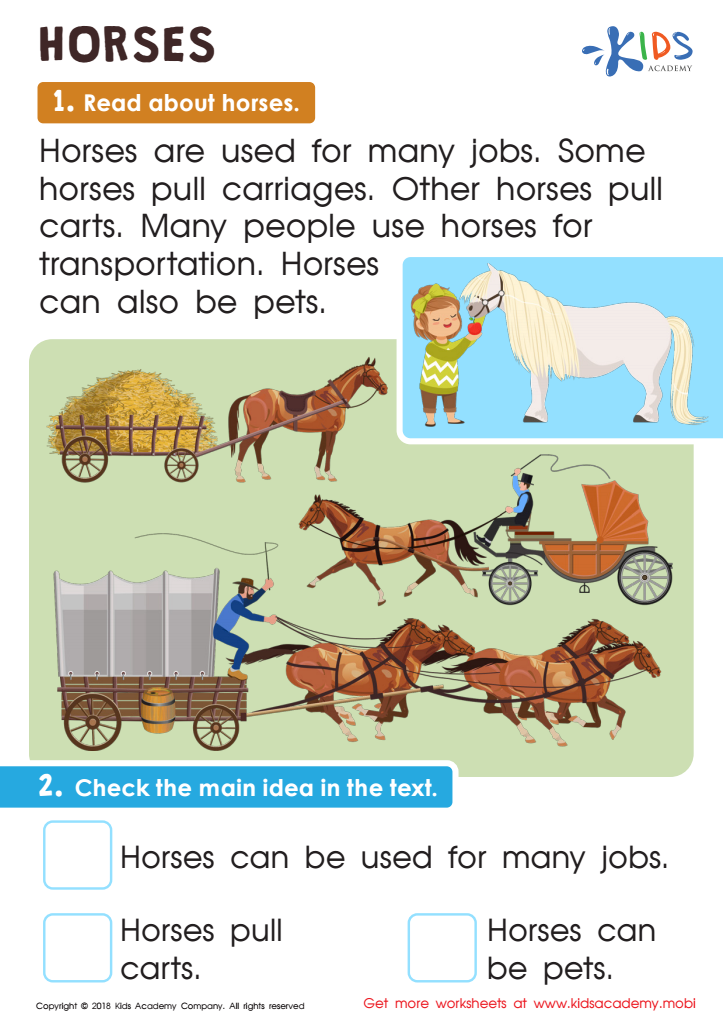
Horses Worksheet
Help your little reader differentiate between details and the main idea with this fun worksheet about horses. Kids will be excited to learn about the different roles horses play. To ensure they understand the overall concept, discuss it before having them choose the right statement at the end.
 Assign to My Students
Horses Worksheet
Worksheet
Join Kids Academy for Free
Who is primarily going to use this learning content?







Understanding colors is fundamental for children ages 6-9 because it plays a crucial role in their cognitive and developmental growth. First and foremost, learning colors enhances vocabulary and language skills. When children learn the names of colors, they expand their ability to describe the world around them, generating richer and more complex sentences. Recognizing colors also improves their memory and concentration as they learn to differentiate and identify various shades.
Color identification is tied closely to other educational aspects, such as mathematical concepts. For example, understanding patterns, sorting, and classifying objects are easier when children can differentiate by color. This foundational skill is integral to later academic success in subjects like math, science, and reading.
Socially and emotionally, discussing colors allows children to articulate their feelings and preferences, contributing to their emotional development and self-expression. For instance, children may associate colors with mood and feelings, aiding in emotional literacy.
In the practical realm, color identification is critical for safety and everyday activities, such as following traffic lights or choosing clothes. Parents and teachers should emphasize color learning as it equips children with essential skills that translate into improved academic performance, enhanced communication capabilities, and increased safety awareness. Prioritizing this aspect of early education lays a firm foundation for ongoing learning and real-world applications.








