
Learning subtraction Worksheets for Ages 6-9
4 filtered results
Difficulty Level
Grade
Age
-
From - To
Subject
Activity
Standards
Discover our engaging Learning Subtraction Worksheets designed for ages 6-9! These interactive worksheets provide students with a fun way to master subtraction concepts through a variety of exercises, including word problems, visual aids, and puzzles. Tailored to meet young learners' needs, our materials enhance mathematical understanding and boost confidence. Each worksheet reinforces critical thinking skills while offering a colorful and enjoyable experience. Perfect for home or classroom practice, these resources cater to diverse learning styles and make subtraction captivating. Explore our collection today to help your child thrive in their math journey and develop essential subtraction skills!
Favorites
With answer key
Interactive
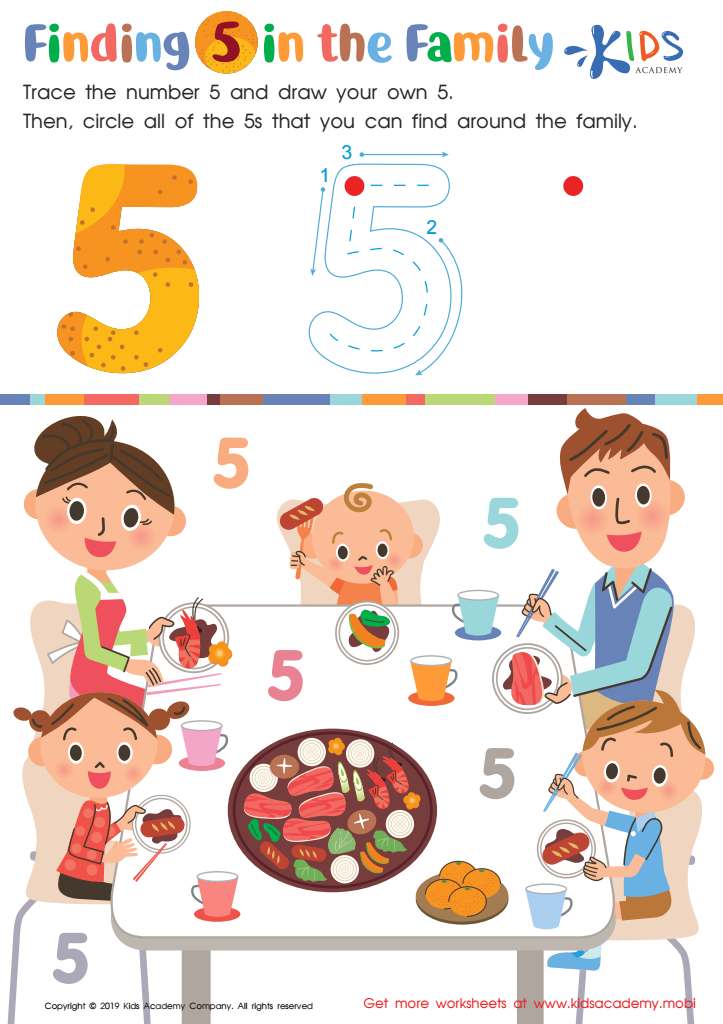
Finding 5 in the Family Worksheet
This worksheet helps kids identify and write the number 5. Ask what the family is doing and who the family members are. Help them trace and draw the 5, then have them circle all 5s in the picture.
 Assign to My Students
Finding 5 in the Family Worksheet
Worksheet
Join Kids Academy for Free
Who is primarily going to use this learning content?







Learning subtraction is a foundational skill crucial for children aged 6 to 9, as it forms the basis for advanced mathematical concepts. At this age, children's cognitive abilities grow rapidly; they are becoming more capable of logical thinking and problem-solving. Mastering subtraction not only enhances their mathematical knowledge but also develops critical thinking skills and the ability to analyze situations.
Moreover, subtraction is present in daily life—whether it’s counting change, planning activities, or measuring ingredients. Understanding this concept helps children apply mathematics to real-world scenarios, fostering independence and confidence. Parents and teachers must emphasize subtraction to prepare children for higher academic challenges.
Additionally, a strong grasp of subtraction lays the groundwork for further operations like division and understanding fractions. It empowers children to tackle more complex math, encouraging a love for learning. From a social perspective, mastering subtraction can enhance collaborative activities, where children learn from one another.
In essence, investment in subtraction learning at this age provides students with essential skills that support not only their mathematical journey but also their overall cognitive development, self-esteem, and everyday functioning. Therefore, parents and teachers should prioritize subtraction through engaging strategies suited for this pivotal age group.








