
Practicing division Worksheets for Ages 6-9
3 filtered results
Difficulty Level
Grade
Age
-
From - To
Subject
Activity
Standards
Welcome to our "Practicing Division Worksheets" designed specifically for ages 6 to 9! These engaging and interactive worksheets are perfect for helping young learners grasp the fundamentals of division. With a variety of colorful activities, including visual aids and practice problems, students will build confidence and improve their division skills in no time. Our child-friendly designs encourage fun learning while reinforcing essential mathematical concepts. Ideal for home or classroom use, these worksheets make mastering division accessible and enjoyable. Empower your child's learning journey with our comprehensive resources tailored for early learners! Start exploring our division worksheets today!
Favorites
With answer key
Interactive
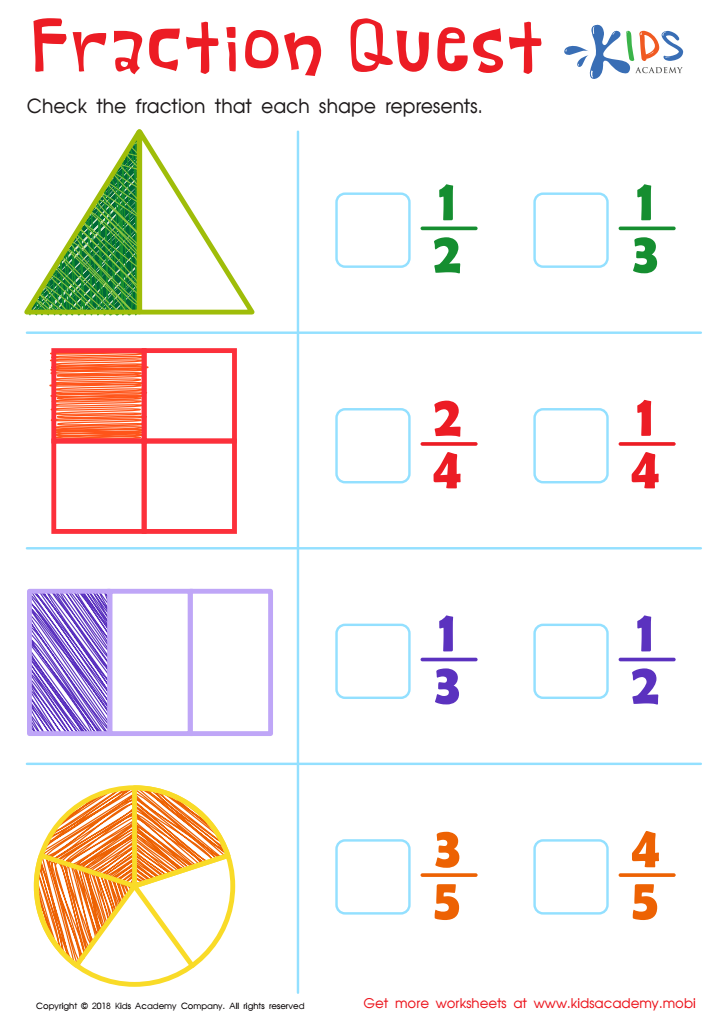
Fraction Quest Worksheet
This colorful and educative worksheet can help kids conquer their fractions struggles. Ask them to identify the four shapes, then the fractions they represent. They can then check the correct answers from the options given.
 Assign to My Students
Fraction Quest Worksheet
Worksheet
Join Kids Academy for Free
Who is primarily going to use this learning content?








Practicing division for children ages 6-9 is crucial for their cognitive development and foundational math skills. At this age, students are transitioning from basic arithmetic to understanding more complex mathematical concepts. Division, often viewed as the “sharing” or “grouping” of numbers, builds on their knowledge of addition and subtraction, fostering a deeper comprehension of relationships between numbers.
Engaging in division practice helps children develop critical problem-solving skills. It encourages them to think logically and analytically, which is essential not only in math but also in daily life scenarios. By mastering division early, children gain confidence in their abilities, setting the stage for success in higher-level math in future grades.
Moreover, division can enhance a child’s understanding of real-world applications, such as dividing a snack among friends or sharing toys. These practical contexts make learning meaningful and enjoyable, as children can see the relevance of math in their lives.
Lastly, regular division practice fosters perseverance and a growth mindset. It teaches kids that challenges can be overcome with effort, an important lesson that extends beyond math. Therefore, both parents and teachers play a pivotal role in making division an integral part of early education, benefiting children in numerous ways.








