Solve word problems Worksheets for Ages 6-9
3 filtered results
-
From - To
Unlock your child's problem-solving skills with our engaging word problems worksheets designed for ages 6-9! These carefully crafted resources encourage critical thinking and enhance mathematical abilities as children practice solving real-world scenarios. Each worksheet features age-appropriate challenges that help develop essential skills like reading comprehension, reasoning, and arithmetic operations. Explore a variety of topics, from simple addition and subtraction to fun word problems involving everyday situations. Perfect for classroom use or at-home learning, our worksheets make math enjoyable and effective. Empower your young learners to tackle problems confidently and enjoyably with these interactive, printable resources!
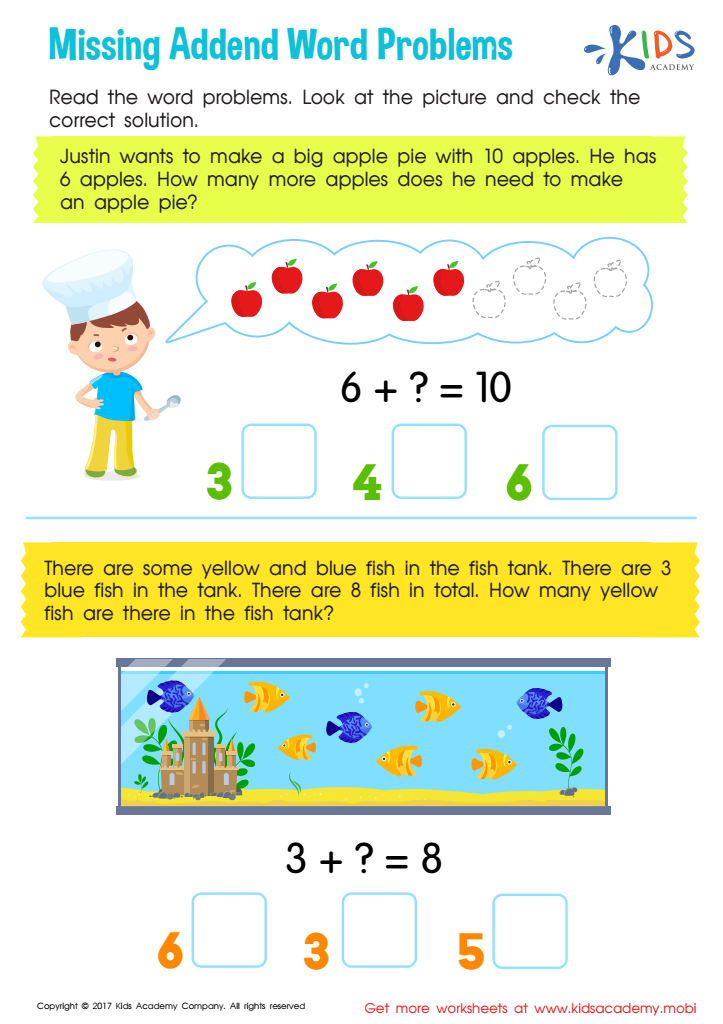
Missing Addend Word Problems Worksheet
 Assign to My Students


.jpg)





Parents and teachers should care deeply about teaching children how to solve word problems between the ages of 6-9 because these skills are fundamental to developing critical thinking and reasoning abilities. Word problems require students to comprehend language, break down complex scenarios, and connect mathematical concepts to real-life situations. This not only enhances mathematical understanding but also fosters problem-solving capabilities applicable in everyday life.
At this age, children are developing cognitive skills that require engagement with multifaceted tasks. Working with word problems encourages them to identify key information, extract relevant data, and apply various operations to arrive at a solution. Moreover, it nurtures patience and perseverance as students learn that not all problems can be solved immediately.
In addition, addressing word problems improves reading comprehension, as students must decode the language of the question while simultaneously applying math skills. This dual engagement supports both literacy and numeracy learning, ensuring a well-rounded educational foundation.
By emphasizing word problems, educators and parents can help children become confident learners who are equipped to tackle challenges, ultimately laying the groundwork for future academic success. This early investment in mathematical literacy significantly impacts their ongoing education and daily decision-making skills.








