
Word Recognition Addition & Subtraction Worksheets for Ages 6-9
5 filtered results
Difficulty Level
Grade
Age
-
From - To
Subject
Activity
Standards
Enhance your child’s math and literacy skills with our engaging Word Recognition Addition & Subtraction Worksheets, tailored for ages 6-9. Designed to seamlessly blend math practice with reading, these worksheets help young learners improve their understanding of number operations while building their vocabulary. Each worksheet includes a variety of word problems and exercises focused on addition and subtraction, ensuring a well-rounded educational experience. Perfect for classroom use or at-home practice, our worksheets promise an enjoyable and effective way to boost your child’s confidence and proficiency in both word recognition and fundamental math skills. Try them today!
Favorites
With answer key
Interactive
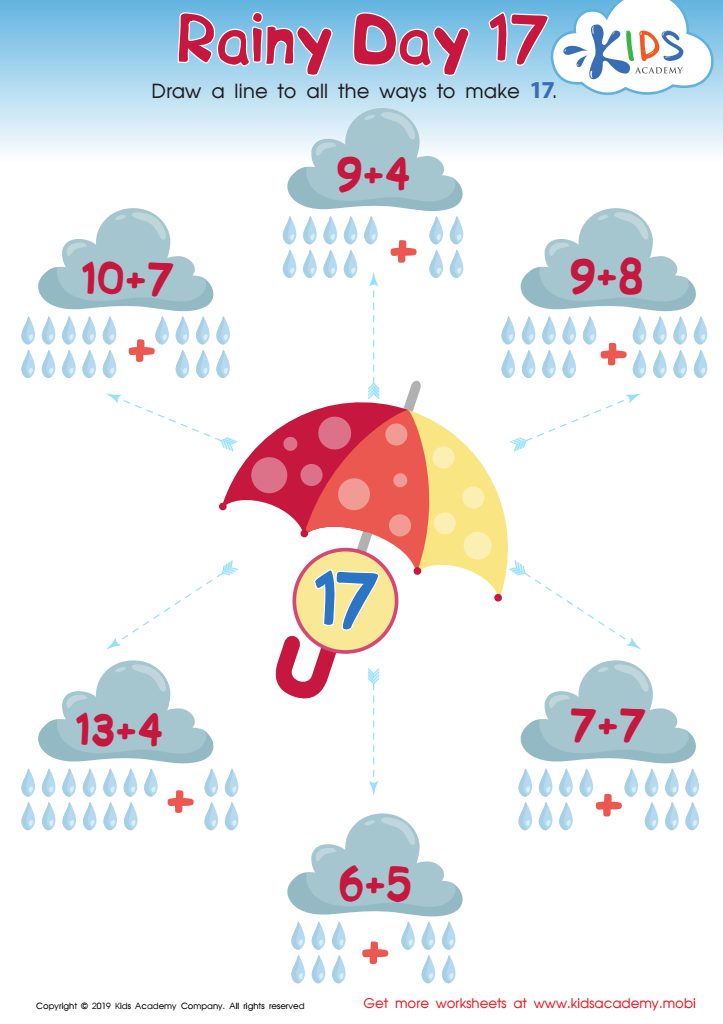
Rainy Day 17 Worksheet
Assist your kids with the 6 equations given. Each cloud displays the sum of two numbers, some of which make 17. Guide them to figure out the total of both numbers when added and draw a line to the umbrella in the center to illustrate the different ways to make 17. This activity will sharpen their addition skills.
 Assign to My Students
Rainy Day 17 Worksheet
Worksheet
Join Kids Academy for Free
Who is primarily going to use this learning content?








Word recognition in addition and subtraction is pivotal for children aged 6-9 as it bridges the realms of literacy and numerical understanding during a crucial period of cognitive development. At this age, kids are transitioning from simple decoding of text to more intricate comprehension, and integrating math-related language can greatly boost this process. When children grasp terms like "sum," "difference," "altogether," and "take away," they develop a dual foundation in both linguistic and mathematical literacy.
For parents and teachers, prioritizing this area is essential as it supports multi-faceted learning. Children who seamlessly connect math vocabulary with operations can better follow instructions in math problems, enhancing accuracy and problem-solving skills. For example, understanding the term "difference" clarifies that the problem requires subtraction rather than guessing. This early proficiency not only improves performance in math but also enhances logical thinking and reasoning.
Moreover, real-world contexts, like shopping or telling time, often merge numeracy and language skills. Hence, fostering robust word recognition in math equips children to apply their knowledge practically, boosting their confidence. Overall, investing in this skill enriches a child’s overall academic journey and prepares them for more complex concepts in higher grades.








