
Improve comprehension Addition Worksheets for Ages 6-9
3 filtered results
Difficulty Level
Grade
Age
-
From - To
Subject
Activity
Standards
Enhance your child's addition skills with our "Improve Comprehension Addition Worksheets" designed specifically for ages 6-9. These engaging worksheets offer an interactive approach to learning addition through various fun activities and puzzles. They focus on building a strong foundation in number recognition and problem-solving while promoting critical thinking skills. With a variety of exercises, including visual aids and step-by-step problems, these worksheets ensure that children grasp the concepts of addition with confidence and ease. Perfect for homework or supplemental learning, our resources foster a love for math and improve comprehension in young learners. Discover the joy of mastering addition today!
Favorites
With answer key
Interactive
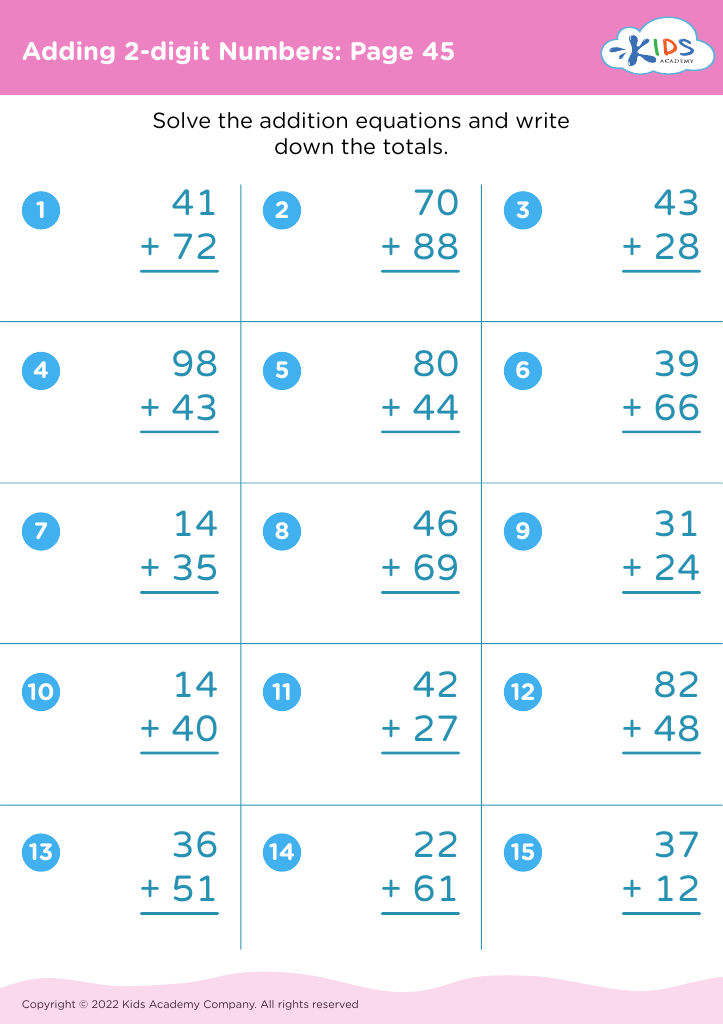
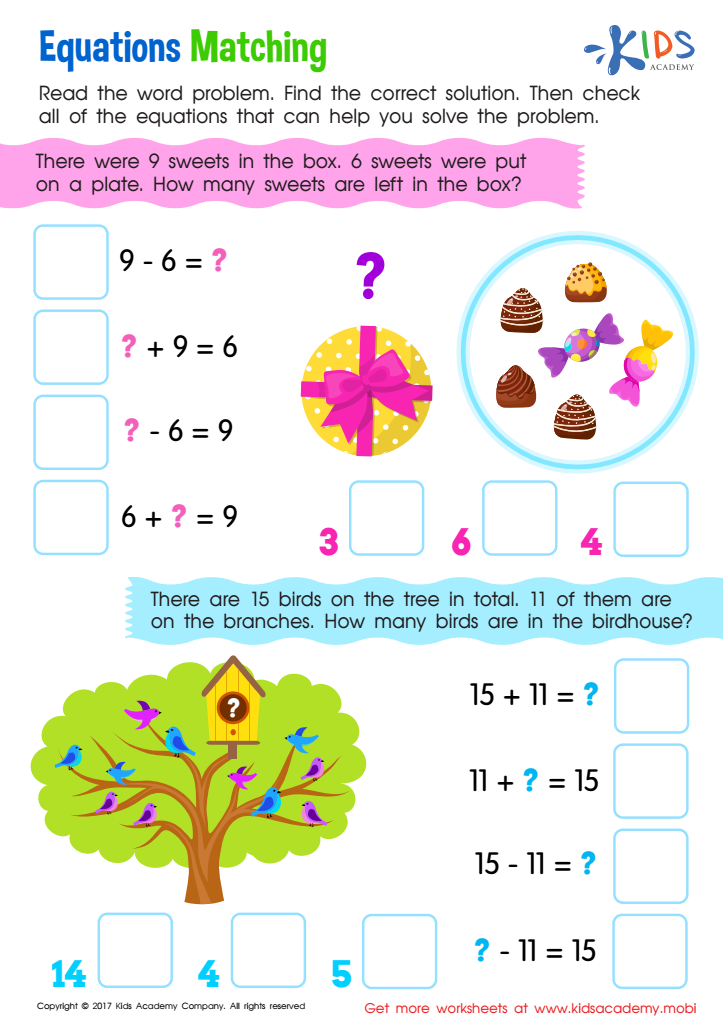
Equations Matching Word Problems Worksheet
Download this worksheet and give your young mathematician practice in solving equations using matching numbers and number family facts. They'll solve word problems, develop critical thinking and algebraic reasoning, and gain success with addition and subtraction.
 Assign to My Students
Equations Matching Word Problems Worksheet
Worksheet
Join Kids Academy for Free
Who is primarily going to use this learning content?








Improving comprehension in addition for children aged 6-9 is crucial for several reasons. First, solid foundational math skills empower students to tackle more complex concepts later in their academic journeys. At this age, children are transition phases in their cognitive development, where they start to understand not just numerical operations but also the underlying principles behind them. Enhancing their comprehension allows them to grasp the 'why' and 'how' of addition, rather than just rote memorization.
Secondly, strong comprehension skills foster confidence in students, which is essential for a positive learning experience. When children understand how to manipulate numbers easily and solve addition problems, they are more willing to engage with math, leading to better performance in the long term.
Moreover, comprehension in addition spills over into everyday life, aiding in practical situations like budgeting, cooking, or even playing games—all essential for developing critical thinking skills. For parents and teachers, focusing on comprehension reinforces a wider educational framework. It cultivates a love for learning, encourages curiosity, and helps develop problem-solving abilities, making math not just an academic task but a valuable part of a child's worldview. Ultimately, it creates a solid basis for lifelong learning and success in various disciplines.








