
Counting practice Coins Worksheets for Ages 6-9
5 filtered results
Difficulty Level
Grade
Age
-
From - To
Subject
Activity
Standards
Enhance your child's math skills with our Counting Practice Coins Worksheets designed for ages 6-9! Perfect for young learners, these worksheets help kids master the art of counting coins. By engaging in fun and interactive math activities, children will learn to recognize different coins, add their values, and grasp money concepts. Through a variety of exercises, they'll gain confidence in handling real-life scenarios involving money. Foster essential skills and make math enjoyable with our expertly crafted counting practice sheets. Ideal for classroom or at-home learning, these printables will set a strong foundation in arithmetic competency. Dive into learning and watch your child's math abilities flourish!
Favorites
With answer key
Interactive
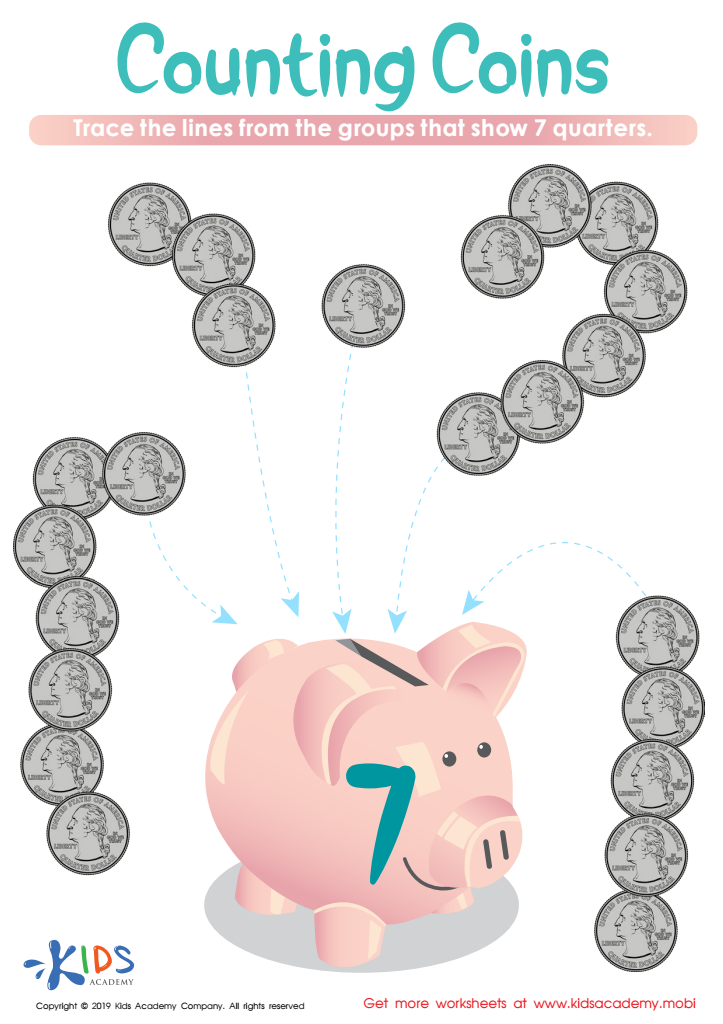
Counting Coins Worksheet
Help your students overcome their fear or aversion of counting and learning numbers with this fun worksheet! It features colorful pictures with four groups of coins. Ask the students to count each group, then trace the lines to the piggy bank. Show them it's easy to count and learn numbers!
 Assign to My Students
Counting Coins Worksheet
Worksheet
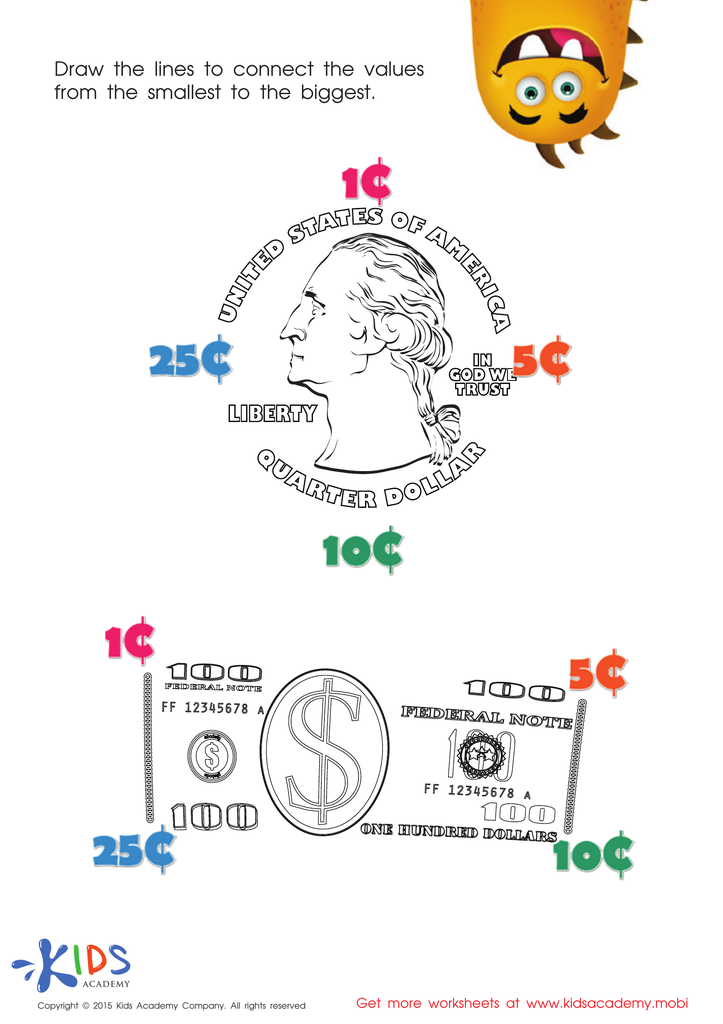
Connecting the Values Money Worksheet
Counting games are a fun way to teach kids about money and counting money. We've learnt the penny, nickel, dime and quarter - can you identify them from the pictures? Draw a line from the smallest to the biggest value and remember the order. Kids Academy has more fun and informative worksheets on counting money.
Connecting the Values Money Worksheet
Worksheet
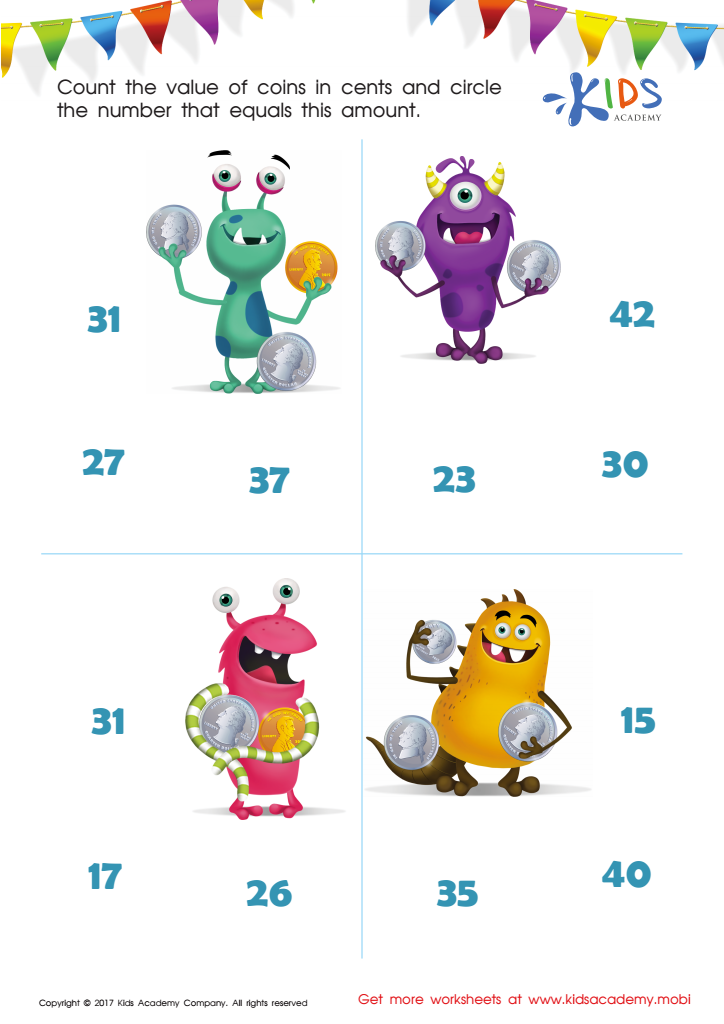
How Many Coins Money Worksheet
Have fun while counting coins: look at the monsters and count the coins in their hands. Challenge your little learners to count and write down the number of coins each one has. Enjoy the time together!
How Many Coins Money Worksheet
Worksheet
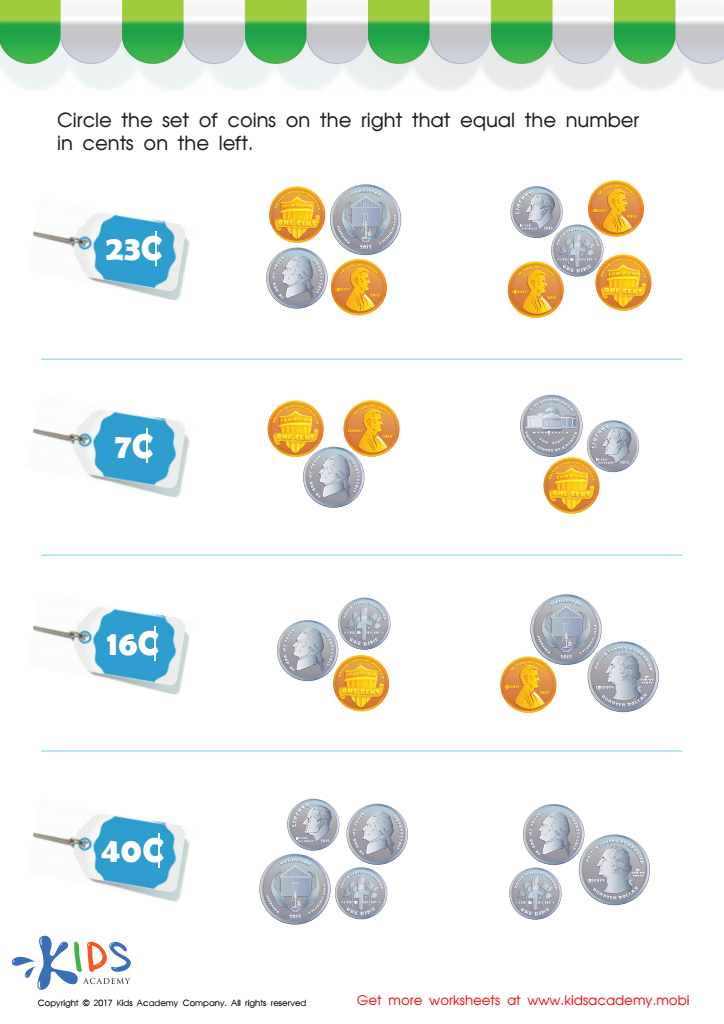
Picking the Coins You Need Money Worksheet
Let's learn to count money with Parents and Kids Academy! Investigate a real shop together: buy a globe, pencils, books, and a school bag using coins. Then, circle the coins you'll need. Visit our website for more free and fun money games for kids!
Picking the Coins You Need Money Worksheet
Worksheet
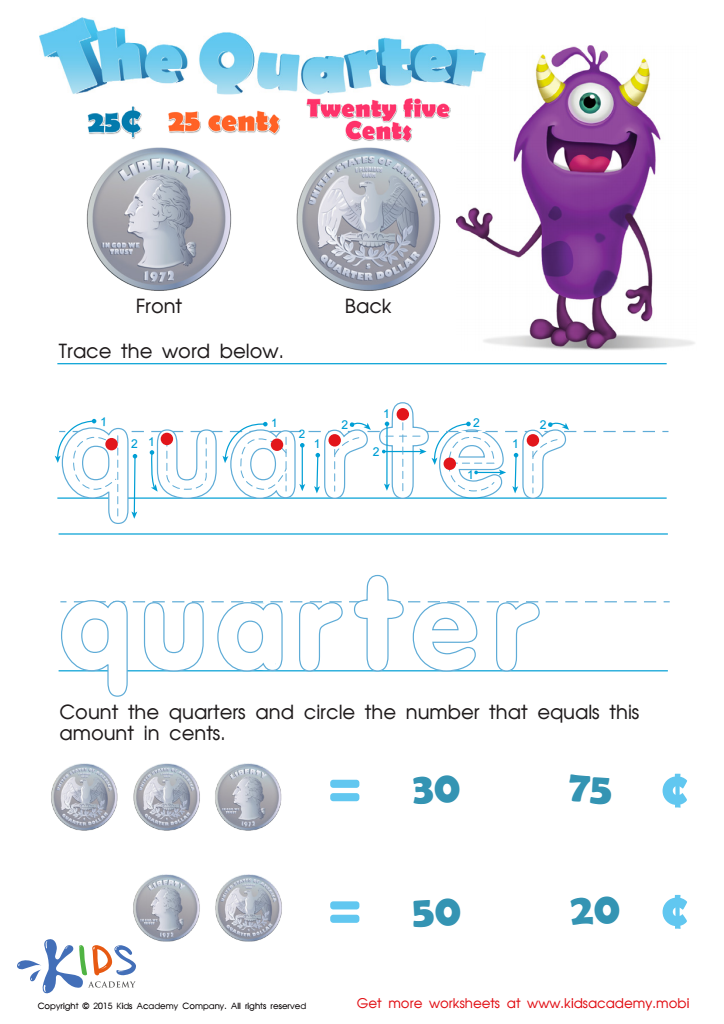
Twenty Five Cents or the Quarter Money Worksheet
Check out our new printable money games - learn to count money easily! With quarters, trace the word, count them and calculate the amount in cents. More worksheets at our website. Give it a try!
Twenty Five Cents or the Quarter Money Worksheet
Worksheet
Join Kids Academy for Free
Who is primarily going to use this learning content?







Counting practice coins for children aged 6-9 is a fundamental educational activity with far-reaching benefits. This age range is critical for developmental milestones in mathematical understanding and cognitive skills. Introducing coins into learning routines helps children grasp the concept of money, which is an essential life skill. It translates abstract numerical concepts into tangible experiences, making arithmetic more accessible and relatable.
One significant advantage is enhancing number sense. Handling coins requires recognizing different denominations and associating them with specific values. This practice reinforces counting, addition, and subtraction skills while simultaneously teaching children to classify and categorize different coins.
Another key benefit is the improvement of fine motor skills. Handling small objects like coins requires precision and coordination, which aids in developing the manual dexterity needed for writing and other tasks.
Moreover, using coins for practice introduces children to basic financial literacy. Understanding concepts such as saving, spending, and budgeting can begin with these simple activities, laying a foundation for responsible money management in the future.
For parents and teachers, investing time in counting practice coins is an investment in both a child's academic success and practical life skills. It's a fun interactive way to make maths engaging while preparing them for real-world experiences.








