
Mathematical reasoning Geometry Worksheets for Ages 6-9
3 filtered results
Difficulty Level
Grade
Age
-
From - To
Subject
Activity
Standards
Our "Mathematical Reasoning Geometry Worksheets for Ages 6-9" help young learners develop critical thinking and problem-solving skills through engaging geometric activities. Tailored for early elementary students, these worksheets cover essential topics such as shapes, patterns, symmetry, and spatial reasoning. Each exercise is designed to challenge and inspire, making geometry understandable and fun. With vibrant illustrations and step-by-step instructions, children will build a solid foundation in mathematical reasoning while boosting their confidence. Perfect for both classroom and home use, these worksheets are a valuable resource for parents and teachers aiming to enhance their students’ geometric skills.
Favorites
With answer key
Interactive
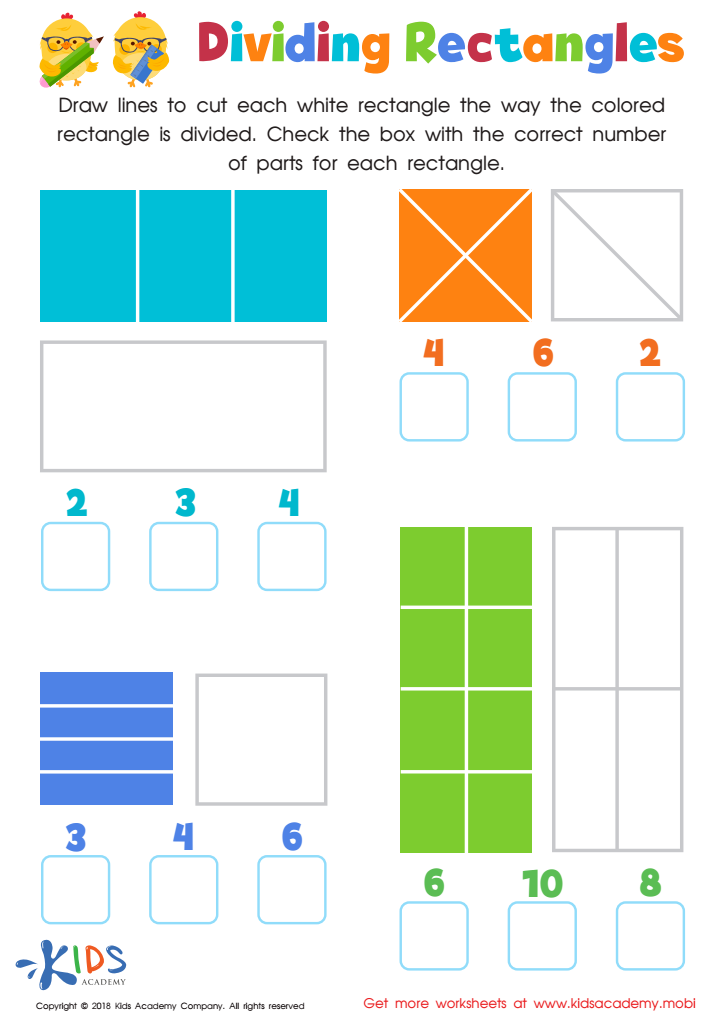
Dividing Rectangles Worksheet
Ask your child to draw lines to divide the white rectangles like the colored ones. Then, have them count the parts in each and choose the correct number. This worksheet will help them practice counting and dividing.
 Assign to My Students
Dividing Rectangles Worksheet
Worksheet











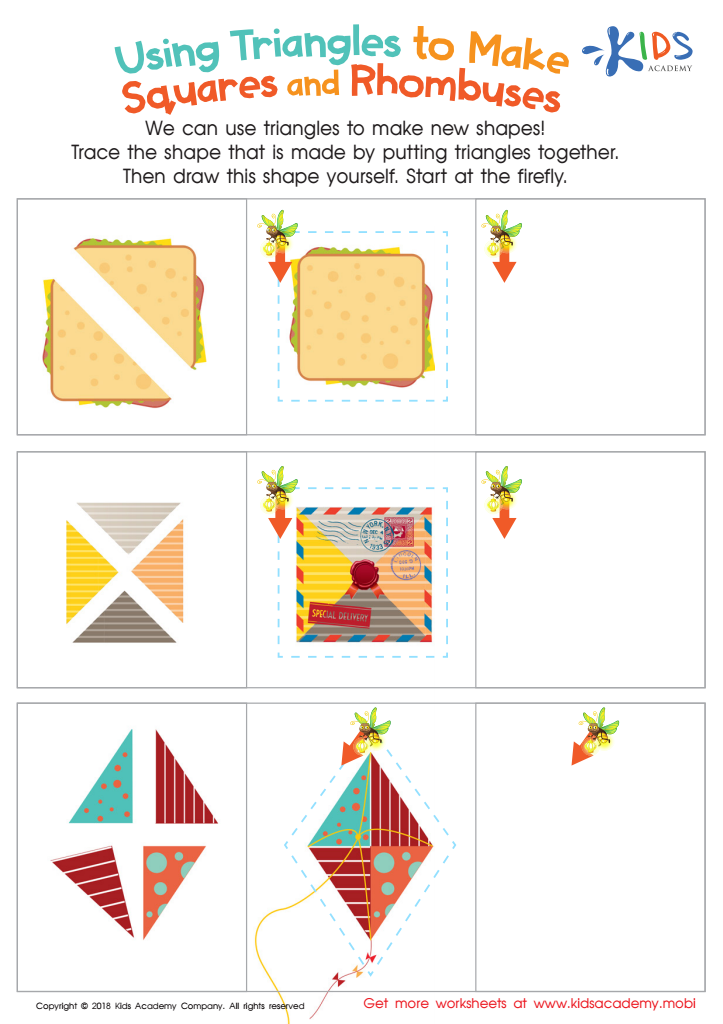
Using Triangles to Make Squares and Rhombuses Worksheet
Learning shapes is a fun way to boost spatial skills and critical thinking. This worksheet shows children how to use triangles to construct squares and rhombuses. Clear illustrations and a printout help children draw the new shape. A great activity for the math classroom! 80 words.
Using Triangles to Make Squares and Rhombuses Worksheet
Worksheet
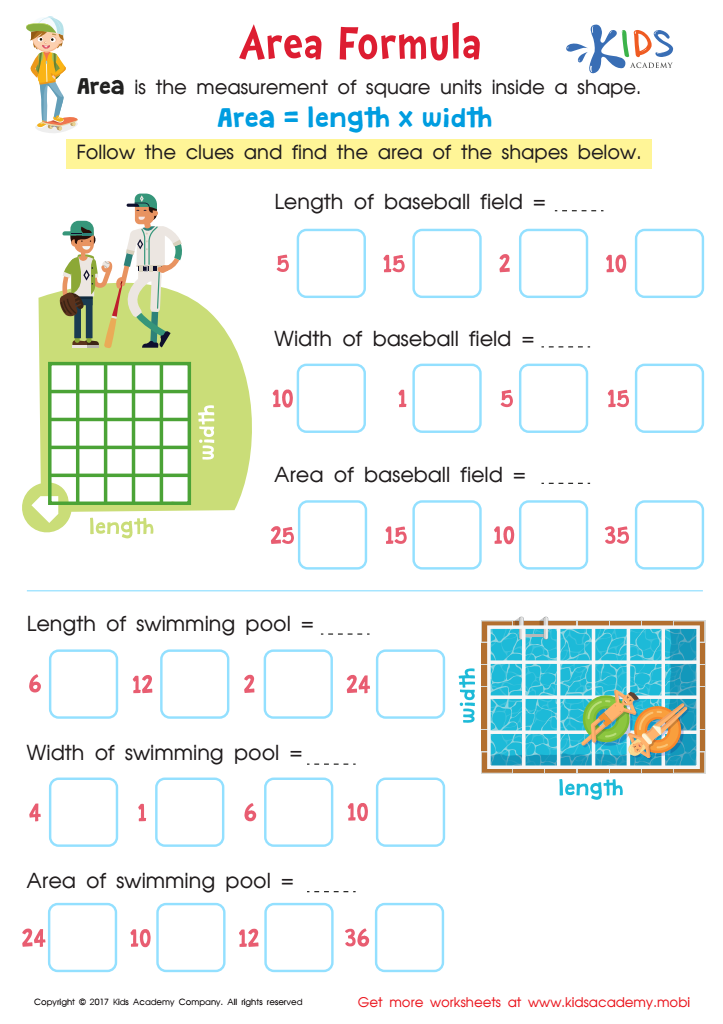
Area Formula Worksheet
This fun-filled area formula worksheet PDF helps kids learn the geometric concept of area. It breaks down the formula with easy-to-follow steps, starting with counting squares to determine the length and width, then multiplying them to get the area.
Area Formula Worksheet
Worksheet
Join Kids Academy for Free
Who is primarily going to use this learning content?








Mathematical reasoning and geometry are essential for children ages 6-9 as they lay the groundwork for advanced critical thinking and problem-solving skills. These early years are pivotal in shaping a child’s cognitive abilities, and incorporating geometry allows young learners to understand spatial relationships, patterns, and shapes, which are foundational principles in math and science.
When children engage with geometry, they learn to visualize and comprehend the world around them. Basic geometric concepts like recognizing shapes and understanding symmetry and spatial reasoning are not just math skills but are applicable in everyday life. These skills enhance their ability to navigate physical spaces, which supports activities from simple puzzle building to understanding maps and construction toys.
Further, mathematical reasoning promotes logical thinking and the ability to reason analytically. It aids children in forming connections between different concepts and solving problems step-by-step, which is crucial for their academic success across various subjects. This skillset can boost their confidence in tackling new challenges and improve their performance in other STEM areas.
Moreover, fostering a love and early understanding of geometry helps demystify math for young children, making them more likely to enjoy and excel in it later in their school careers. Therefore, integrating mathematical reasoning and geometry in early education is a vital step in ensuring well-rounded cognitive development and a lifelong appreciation for learning.








