
Fine motor skills (writing numbers) Numbers Worksheets for Ages 6-9
3 filtered results
Difficulty Level
Grade
Age
-
From - To
Subject
Activity
Standards
Enhance your child's fine motor skills with our engaging numbers worksheets, designed specifically for ages 6 to 9! These worksheets focus on writing numbers, helping young learners develop the necessary dexterity and control for effective handwriting. Our carefully crafted activities encourage practice and reinforce number recognition while making learning fun and interactive. With a variety of exercises, children will improve their pencil grip, hand-eye coordination, and overall confidence in writing. Perfect for both classroom environments and at-home learning, our fine motor skills worksheets provide a solid foundation for future academic success. Start your child's journey to great writing today!
Favorites
With answer key
Interactive
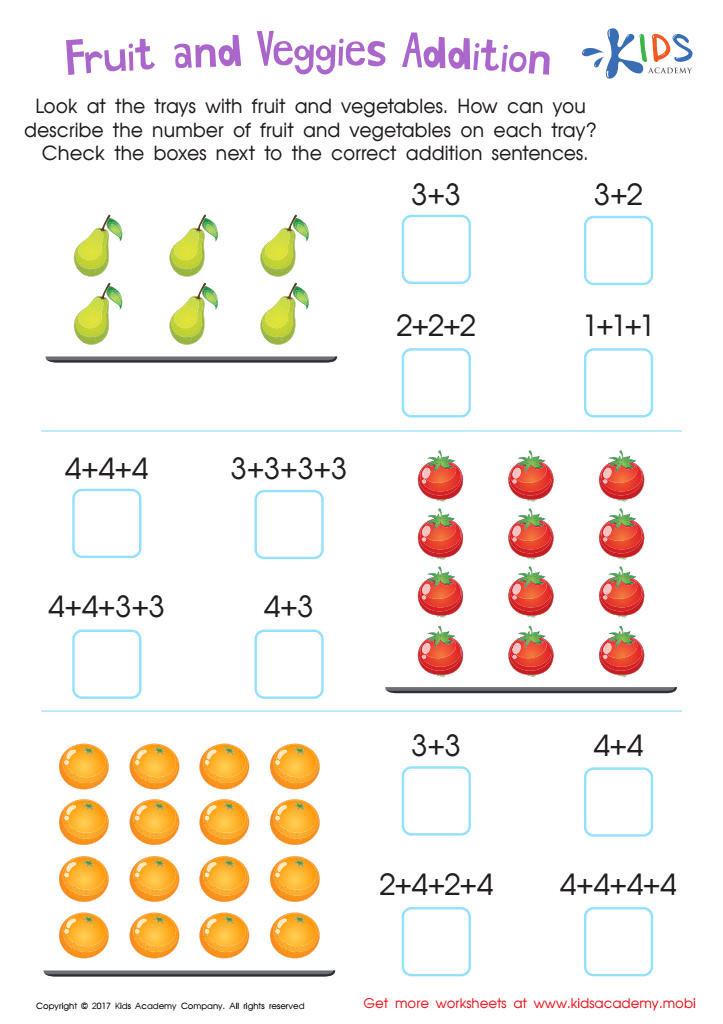
Fruit and Veggies Worksheet
It promotes problem-solving and analytical skills as kids match pictures to correct addition sentences. Help your child go beyond simple addition with this PDF worksheet!
 Assign to My Students
Fruit and Veggies Worksheet
Worksheet

A Hundred Pineapples Worksheet
Can your child count in tens? Show them how to count 100 boxes in stacks of tens. A worksheet can help them understand the concept. Ask them to count boxes of pineapples in stacks of tens and circle the truck with 100 pineapples.
A Hundred Pineapples Worksheet
Worksheet

Finding 4 in the Forest Worksheet
Before starting, have your kids count as high as they can. Ask them to identify the setting and point out the 4s. Trace 4 and draw your own. Help your kids circle all the 4s they can find in the forest. How far can they count? How well did they find the hidden 4s?
Finding 4 in the Forest Worksheet
Worksheet
Join Kids Academy for Free
Who is primarily going to use this learning content?








Fine motor skills are essential for children aged 6-9 as they form the foundation for various academic and daily life tasks. As children begin to write numbers during these formative years, the development of fine motor skills becomes crucial. Mastering the ability to write numbers accurately enhances their confidence and promotes independence in performing school-related activities.
Writing numbers correctly also contributes to overall cognitive development. It engages children in number recognition, sequencing, and the basic concepts of math, all while strengthening hand-eye coordination. Good fine motor skills aid in developing spatial awareness and the ability to control writing tools, which are essential for both math and writing tasks.
Moreover, when parents and teachers prioritize fine motor skill development, they support children's ability to express their thoughts and solve problems effectively. Caregiver involvement through activities that encourage these skills—like drawing, crafting, and play—helps create a harmonious learning environment while fostering creativity.
Finally, fine motor skills extend beyond academic settings; they will benefit children throughout their lives, from performing daily tasks to engaging in hobbies and careers. Nurturing these abilities becomes a vital part of a child's holistic growth, setting the stage for future success.








