
Enhancing comprehension Math Worksheets for Ages 6-9
3 filtered results
Difficulty Level
Grade
Age
-
From - To
Subject
Activity
Standards
Discover our "Enhancing Comprehension Math Worksheets" tailored for children aged 6-9! These engaging and interactive printable worksheets are designed to strengthen young learners' understanding of mathematical concepts. Each worksheet focuses on essential skills such as problem-solving, critical thinking, and number recognition, ensuring a well-rounded foundation in math. The diverse activities encourage students to apply their knowledge in real-world scenarios, fostering a deeper grasp of important concepts. Parents and educators will appreciate the structured approach, making learning fun and effective. Enhance your child's math comprehension today with our expertly crafted worksheets, and watch their confidence and skills grow!
Favorites
With answer key
Interactive
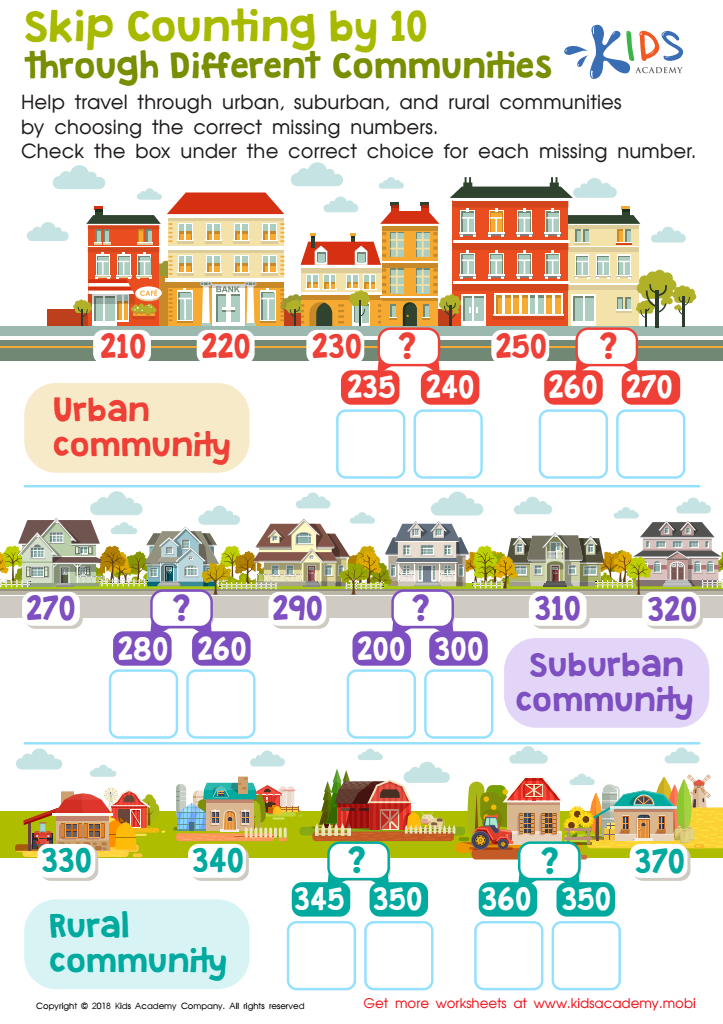
Skip Counting by 10 through Different Communities Worksheet
This free PDF worksheet helps students practice skip counting and 'making a ten', essential for math efficiency and accuracy. Students explore different types of communities (urban, suburban and rural) whilst honing their skills. A great combo of social studies and math!
 Assign to My Students
Skip Counting by 10 through Different Communities Worksheet
Worksheet
Join Kids Academy for Free
Who is primarily going to use this learning content?







Enhancing math comprehension for children aged 6-9 is crucial, as this foundational stage profoundly influences their future academic success. At this age, children develop the essential skills necessary for understanding mathematical concepts, such as addition, subtraction, and early problem-solving. Improving comprehension helps students grasp not only basic arithmetic but also sets the groundwork for more complex concepts encountered later, like multiplication, division, and fractions.
Moreover, strong math comprehension fosters confidence and a positive attitude towards learning. When children understand math, they are more likely to engage with the subject and less likely to exhibit math anxiety. This encourages a lifelong appreciation for mathematics, which is essential in an increasingly data-driven world.
For parents and teachers, promoting math comprehension involves creating a supportive learning environment filled with engaging activities. This could include fun math games, hands-on projects, or real-world applications that make math relatable. Additionally, early interventions can identify and address learning issues before they escalate, ensuring each child can thrive in mathematics. By prioritizing comprehension, caregivers play a vital role in preparing children for future academic challenges, ultimately contributing to their overall success and well-being.








