Fine motor skills (drawing lines) Math Worksheets for Ages 6-9
4 filtered results
-
From - To
Enhance your child's fine motor skills with our engaging math worksheets designed for ages 6-9! Focusing on drawing lines, these worksheets provide a fun way for young learners to practice essential motor control while developing early math concepts. Each activity features colorful designs and simple instructions that captivate children's attention and encourage creativity. As they trace and draw different shapes, children will improve their hand-eye coordination and boost their confidence in writing. Perfect for home or classroom use, our fine motor skills worksheets are a great resource to support your child's development while making learning enjoyable! Explore our collection today!

Count and Match Vegetables 1 – 7 Math Worksheet
 Assign to My Students

Counting Eggs Worksheet

Count and Match Vegetables 2 – 8 Math Worksheet
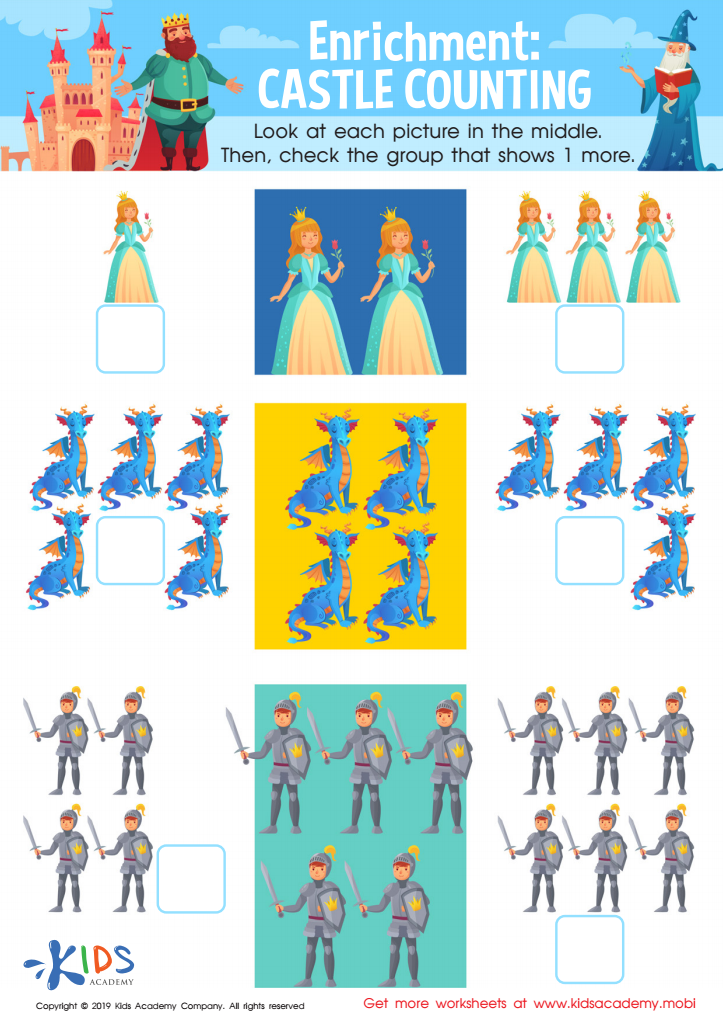
Enrichment: Castle Counting Worksheet






.jpg)

Fine motor skills are crucial for children aged 6-9, as they play a significant role in their academic and daily living tasks. Developing these skills, particularly through activities like drawing lines, is essential for three main reasons. Firstly, fine motor skills enhance a child's ability to manipulate tools such as pencils, scissors, and calculators, which are necessary for completing classroom assignments and later, more complex tasks in life.
Secondly, there is a direct correlation between fine motor skills and cognitive development, especially in math. As children learn to draw lines, create shapes, and solve problems, they also improve their spatial awareness and hand-eye coordination. This groundwork supports their understanding of mathematical concepts, such as geometry and measurement.
Finally, encouraging fine motor skills fosters patience, concentration, and perseverance, all of which are important traits for successful learning. When teachers and parents prioritize activities that strengthen fine motor skills, such as drawing, crafting, and even playing with small gadgets, they are not only supporting children's immediate academic needs but also equipping them with essential life skills. Consequently, investing in fine motor skill development becomes an invaluable strategy for promoting holistic growth in children.








