
Recognizing equivalent fractions Math Worksheets for Ages 6-9
5 filtered results
Difficulty Level
Grade
Age
-
From - To
Subject
Activity
Standards
Welcome to our "Recognizing Equivalent Fractions" math worksheets, designed specifically for children ages 6-9! These engaging worksheets help young learners understand the concept of equivalent fractions through fun visuals and interactive exercises. By illustrating how different fractions can represent the same part of a whole, children will develop essential skills in fraction recognition and comparison. Perfect for classroom use or at-home practice, our worksheets are tailored to foster confidence and mastery in math. Download now to support your child's learning journey and make mastering fractions an enjoyable experience! Explore a variety of activities that encourage critical thinking and math fluency today!
Favorites
With answer key
Interactive
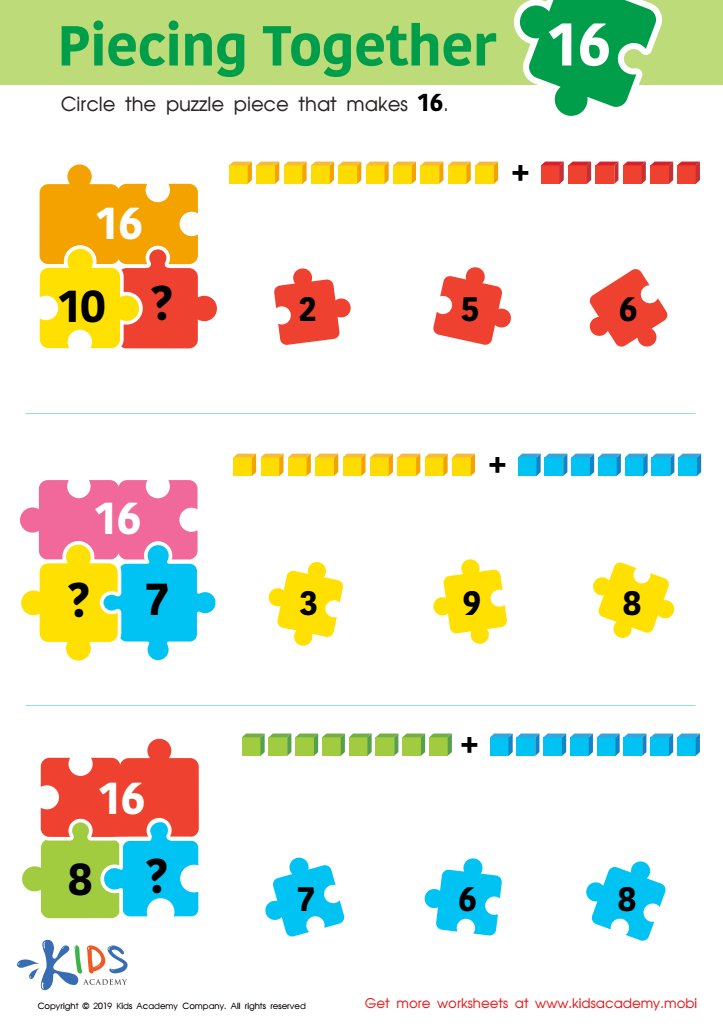
Piecing Together 16 Worksheet
Combine learning with fun using this colorful worksheet! Ask your preschoolers what they see in the picture, then help them solve the mathematical equations on the puzzle pieces. One equation is missing on each; have them circle the piece that will make the bottom puzzle piece numbers equal 16. Use puzzles and bright colors to teach - it's one of the best ways your kids can learn!
 Assign to My Students
Piecing Together 16 Worksheet
Worksheet
Join Kids Academy for Free
Who is primarily going to use this learning content?




Recognizing equivalent fractions is a foundational math skill crucial for children aged 6-9. Understanding equivalent fractions helps students develop a strong number sense, enabling them to compare, add, and subtract fractions later on. By grasping the concept that different fractions can represent the same value—such as 1/2 being equivalent to 2/4—students learn that numbers can have multiple forms, which is a valuable insight in both math and real-life applications.
Parents and teachers play a significant role in reinforcing this concept, as early mastery can lead to greater confidence and enthusiasm in math. When children identify equivalent fractions, they enhance their problem-solving skills and critical thinking abilities, paving the way for more advanced mathematical concepts down the line.
Moreover, recognizing equivalent fractions can foster collaborative learning experiences. By working together through games or visual aids, students can share ideas and strategies, enhancing their social and communication skills. Engaging activities such as using fraction bars or pie charts can make learning fun and interactive, ensuring students visualize and feel confident about fractions. Ultimately, acknowledging the importance of equivalent fractions reflects a commitment to nurturing well-rounded learners that are prepared for future academic challenges.








