
Understanding adjectives Math Worksheets for Ages 6-9
6 filtered results
Difficulty Level
Grade
Age
-
From - To
Subject
Activity
Standards
Discover the power of adjectives with our engaging math worksheets designed for children ages 6-9! These printable activities blend language skills with mathematical concepts, helping young learners enhance their descriptive vocabulary while solving problems. Each worksheet focuses on identifying and using adjectives in various contexts, reinforcing their understanding through fun exercises. Ideal for classroom or home use, our worksheets support early education by making learning enjoyable. Help your child improve their reading comprehension and creativity while mastering essential math skills. Explore our comprehensive collection of understanding adjectives math worksheets and watch your young learner thrive!
Favorites
With answer key
Interactive
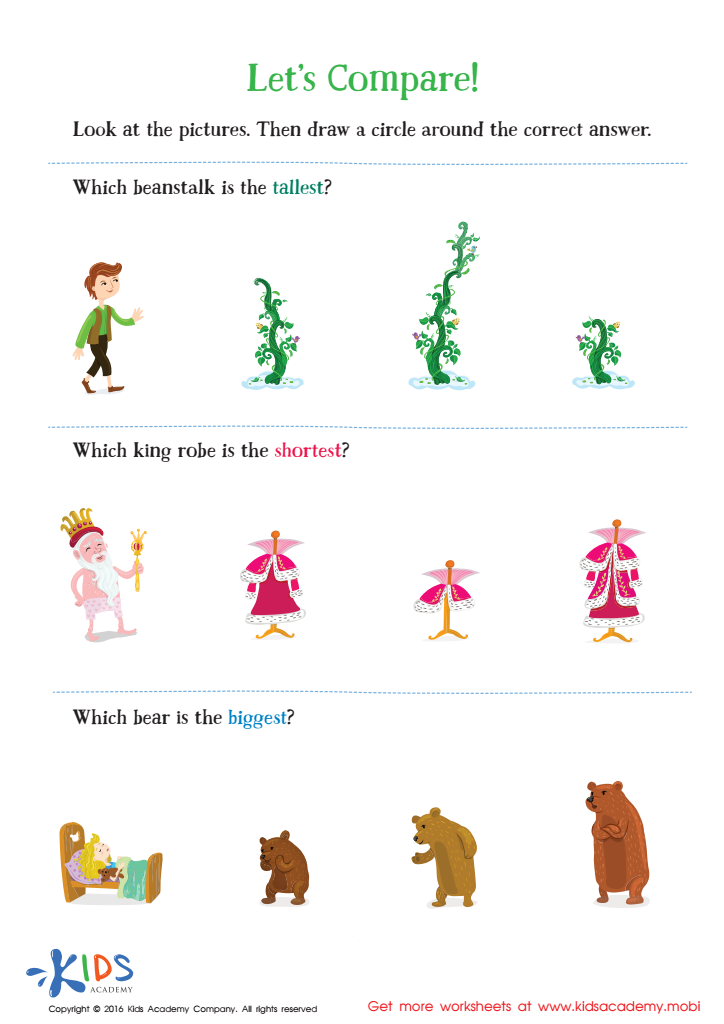
Fairy Tale Worksheet: Let's Compare
Preschoolers need to recognize different sizes of objects. This worksheet combines fun fairy tales with size practice, helping them read, problem solve, and sort through pictures. Your child will love the images and be eager to complete it. Enhance their learning by talking about the tales to build comprehension.
 Assign to My Students
Fairy Tale Worksheet: Let's Compare
Worksheet
Join Kids Academy for Free
Who is primarily going to use this learning content?








Understanding adjectives in the context of math is essential for children aged 6-9 as it helps enhance their overall comprehension and communication skills. At this stage, children are not only learning mathematical concepts but also developing their language abilities. Adjectives play a crucial role in describing numbers, shapes, sizes, and relationships among objects. For example, in geometry, terms like "large," "small," "flat," and "curved" are adjectives that help kids articulate their understanding of shapes and space.
Furthermore, using adjectives in math fosters critical thinking and enables students to describe their reasoning and problem-solving approaches more effectively. When students are comfortable using descriptive language, they engage in richer mathematical discussions, enhancing collaborative learning experiences. Parents and teachers can assess comprehension through students’ ability to describe their thought processes, ensuring that kids grasp mathematical concepts without just memorizing.
Also, incorporating adjectives into math helps to build vocabulary skills, which is vital for success across all subjects. By fostering a robust linguistic foundation alongside mathematical concepts, parents and teachers not only empower students in their current academic pursuits but also equip them with the skills necessary for future learning and effective communication. Consequently, understanding adjectives in math is an essential component of holistic education.








