
Understanding length Measurement Worksheets for Ages 6-9
3 filtered results
Difficulty Level
Grade
Age
-
From - To
Subject
Activity
Standards
Dive into our engaging "Understanding Length Measurement Worksheets for Ages 6-9." Designed specifically for young learners, these printable worksheets aim to build foundational math skills by teaching children how to measure and compare lengths accurately. Each activity stimulates critical thinking and understanding through interactive tasks involving rulers, units of measurement, and real-life objects. The variety of exercises ensures a fun and comprehensive approach, making learning both effective and enjoyable. Perfect for classroom and home-based learning, these worksheets are invaluable resources for developing essential math skills in a playful and educational way. Let's make measuring length an adventure!
Favorites
With answer key
Interactive
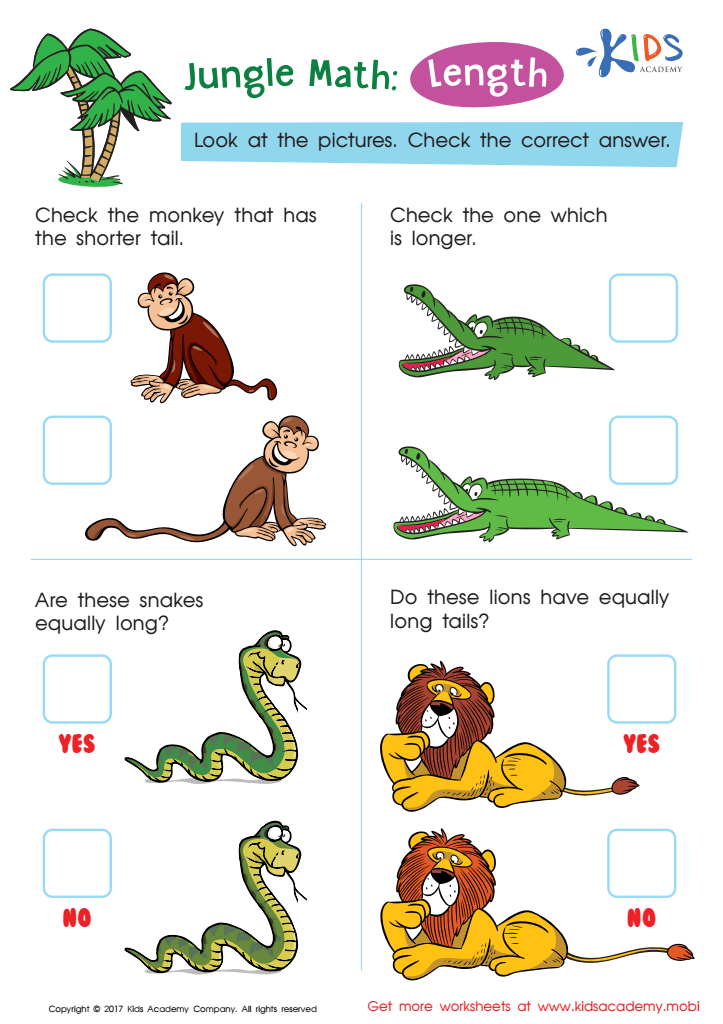
Which One Is Longer - Length Worksheet
Let's go to the jungle - kids get excited to practice math with animal-filled worksheets! This one is sure to have your pupil mastering length in no time.
 Assign to My Students
Which One Is Longer - Length Worksheet
Worksheet
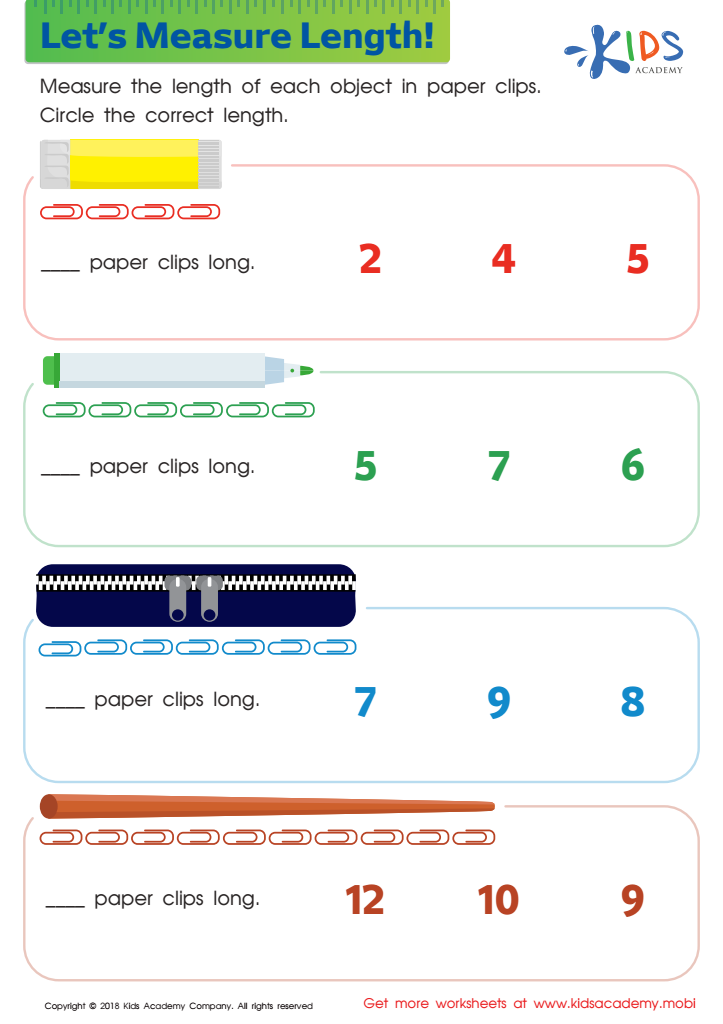
Lets Measure Length Worksheet
It's time to help your child take their measuring skills up a notch! This colorful PDF sheet from Kids Academy introduces kids to measuring with paperclips. Guide them through the page, showing them how to count the clips to measure each image. Then, circle the correct length for each to complete the sheet!
Lets Measure Length Worksheet
Worksheet
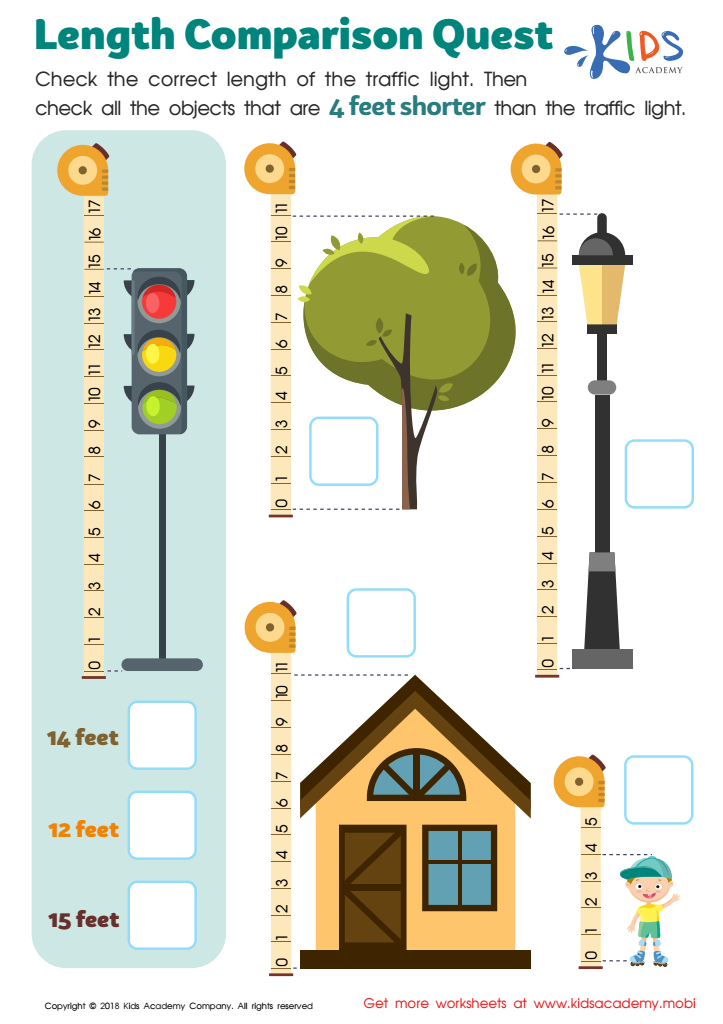
Length Comparison Quest Worksheet
Knowing measurement tools and how to use them is just the start. To be proficient, your kid must be able to accurately compare objects and their lengths. With the 'Length Comparison Quest' worksheet, they will check the correct length of the traffic light in the picture and then compare other objects to it, marking those that measure 4 feet shorter.
Length Comparison Quest Worksheet
Worksheet
Join Kids Academy for Free
Who is primarily going to use this learning content?








Parents and teachers should prioritize understanding length measurement for children aged 6-9 because it forms a foundational aspect of their cognitive and mathematical development. Learning to measure length inherently develops critical thinking and problem-solving skills. When children understand concepts such as inches, feet, centimeters, and meters, they begin to translate abstract numbers into real-world applications, fostering a practical comprehension of mathematics.
Early exposure to length measurement also enhances spatial awareness. By measuring various objects, children gain an appreciation of size differences and how objects relate spatially to one another, which is crucial for more advanced mathematical concepts, including geometry. Activities like measuring buildings, furniture, or even seeds promote active learning and are engaging ways to connect math with everyday life.
Furthermore, understanding length measurement can improve a child's ability to follow more complex instructions in tasks like art projects, science experiments, and cooking — promoting meticulousness and precision. For parents and teachers, encouraging these skills also aligns with educational standards and bolsters students' confidence, enabling them to handle academic challenges successfully. Building this foundation at an early age sets the stage for more success and increases enthusiasm for learning.








