
Time recognition Time Worksheets for Ages 6-9
3 filtered results
Difficulty Level
Grade
Age
-
From - To
Subject
Activity
Standards
Help your child master time-telling with our engaging and educational Time Recognition Time Worksheets, designed specifically for ages 6-9. These interactive worksheets cover fundamental time concepts, blending digital and analog clocks to build a solid foundation for young learners. Children will enhance their skills in recognizing hours, half-hours, and quarter-hours, while also learning to draw clock hands and understand AM/PM distinctions. Perfect for home or classroom use, these worksheets not only support math curriculum standards but make learning fun and intuitive. Set your child on the path to time-telling confidence with Kids Academy’s expert-designed tools.
Favorites
With answer key
Interactive
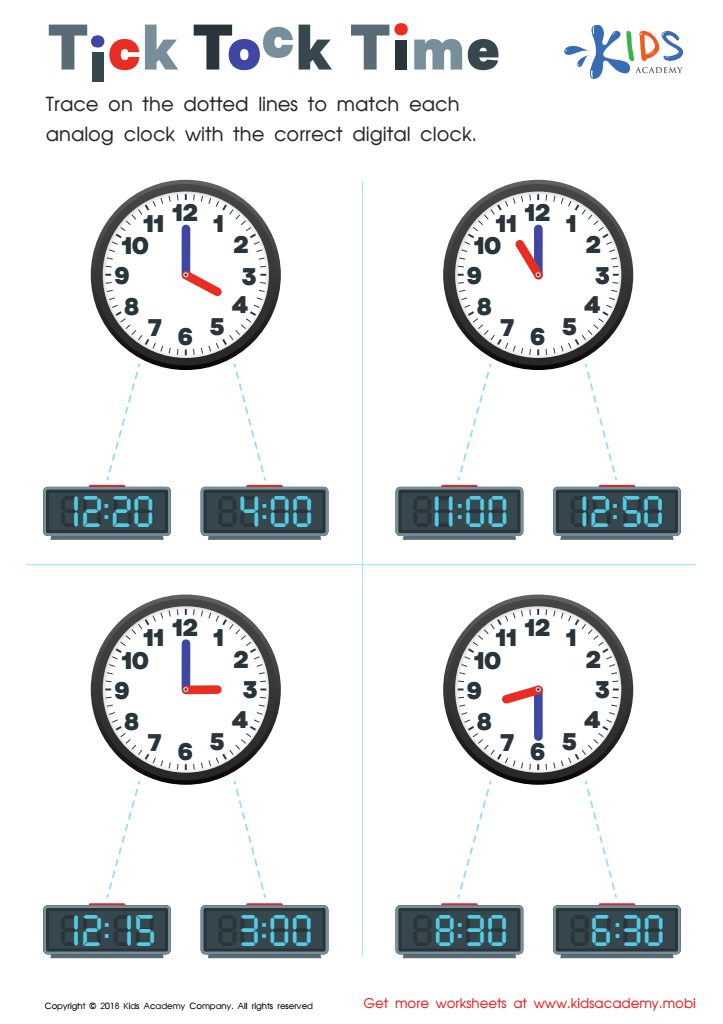
Tick Tock Time Worksheet
Trace the dotted lines on this worksheet to match analog and digital clocks! It's a great way to help your kids learn time-telling. They'll get better at converting analog to digital, and vice versa. Get your children to try it - it's a fun way to practice!
 Assign to My Students
Tick Tock Time Worksheet
Worksheet
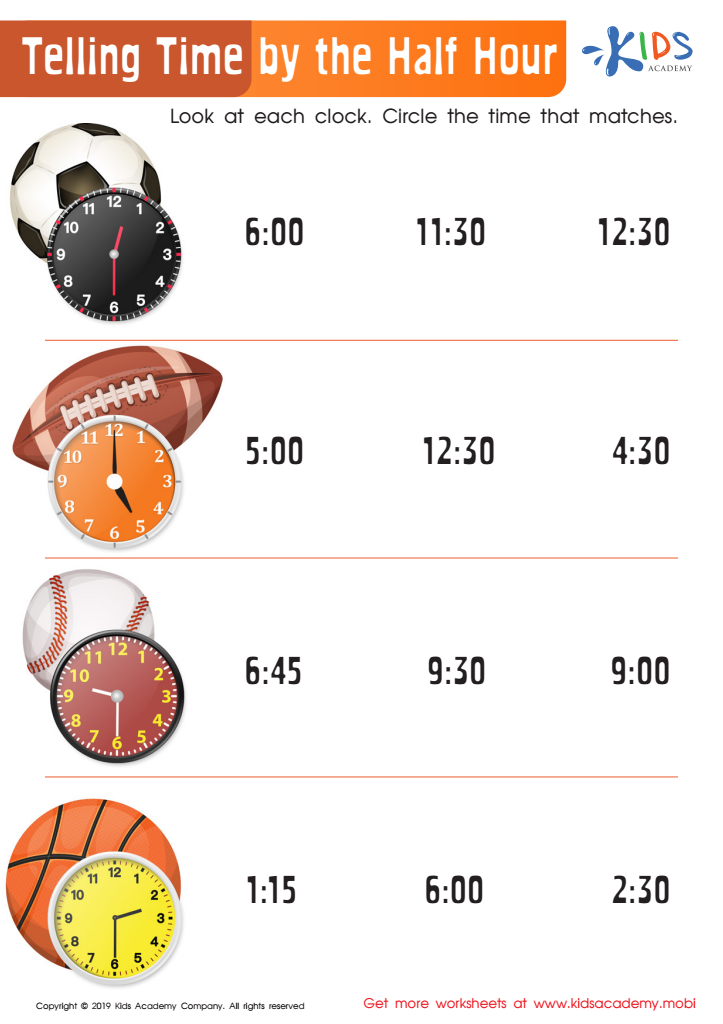
Telling Time by the Half Hour Worksheet
Teach kids to tell time with this worksheet! Four clocks are labeled with different times; help your child circle the right one. It's a great way to teach them to read analog and digital clocks, watches, and written times. Easy and fun learning!
Telling Time by the Half Hour Worksheet
Worksheet
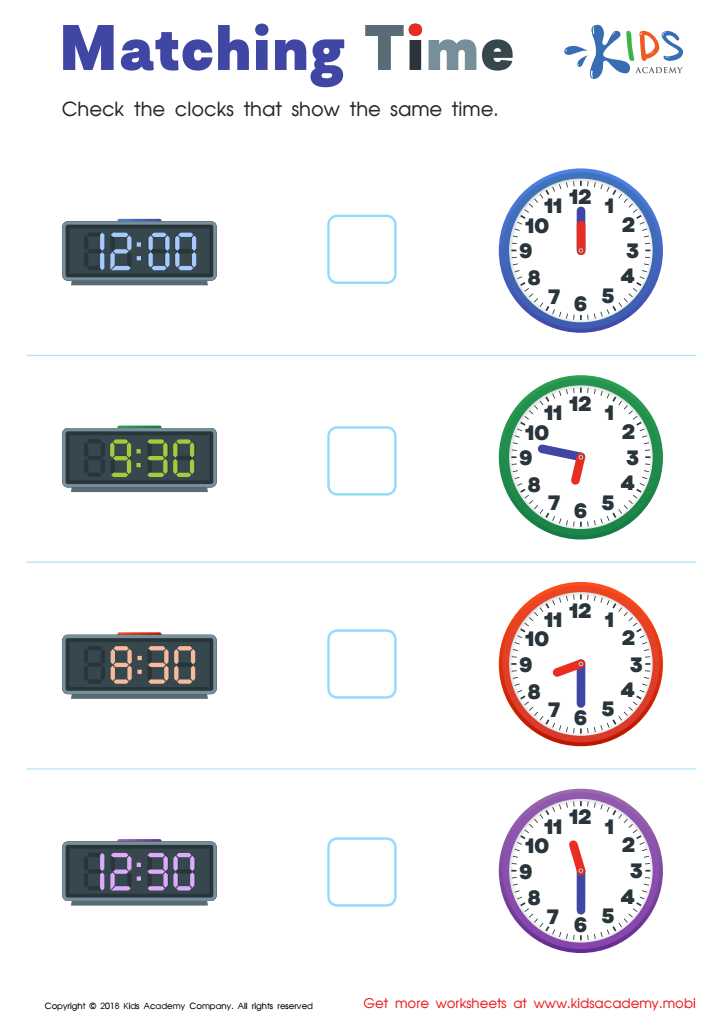
Matching Time Worksheet
Teach your child to read time in both digital and analog formats with this helpful printout. They'll identify clocks that match in both formats and check them off. Colorful and engaging, it's a great way to help your child understand the concept of time-telling.
Matching Time Worksheet
Worksheet
Join Kids Academy for Free
Who is primarily going to use this learning content?








Parents and teachers should prioritize time recognition for children aged 6-9 because it is a fundamental life skill that can significantly impact their organizational abilities, educational success, and overall development. At this age, children are beginning to grasp the concepts of sequencing, routines, and punctuality, which are crucial for daily functioning.
Learning to read analog and digital clocks helps children understand the passage of time, aiding in time management skills. This competence is essential for structuring their day, whether for school schedules, homework, or extracurricular activities. Children who can effectively manage their time are more likely to meet their responsibilities and experience less stress.
In the academic context, time recognition is intertwined with mathematics, such as understanding fractions (quarter past, half past) and practicing addition and subtraction through elapsed time problems. Therefore, mastering this skill can enhance their mathematical thinking and problem-solving capabilities.
Moreover, understanding time fosters independence and responsibility. When children know how to track time, they can take charge of tasks like getting ready in the morning or starting and completing homework, which builds confidence and autonomy. It also helps them cultivate a deeper appreciation for patience and perseverance, as they learn that activities require allocated periods to be accomplished. Consequently, developing time recognition skills in early childhood sets a foundation for lifelong success.








