Fraction simplification Reading Worksheets for Ages 6-9
14 filtered results
-
From - To
Discover our engaging Fraction Simplification Reading Worksheets designed specifically for children aged 6-9! These interactive resources make learning fractions fun and accessible, helping young learners grasp the concept of simplification through colorful illustrations and easy-to-follow instructions. The worksheets encourage children to read and analyze fraction problems, fostering both reading skills and mathematical understanding. With a variety of activities to choose from, children will enhance their critical thinking and problem-solving skills while building confidence in their abilities. Perfect for classroom use or at-home learning, our worksheets provide a solid foundation for future math success. Start exploring the world of fractions today!
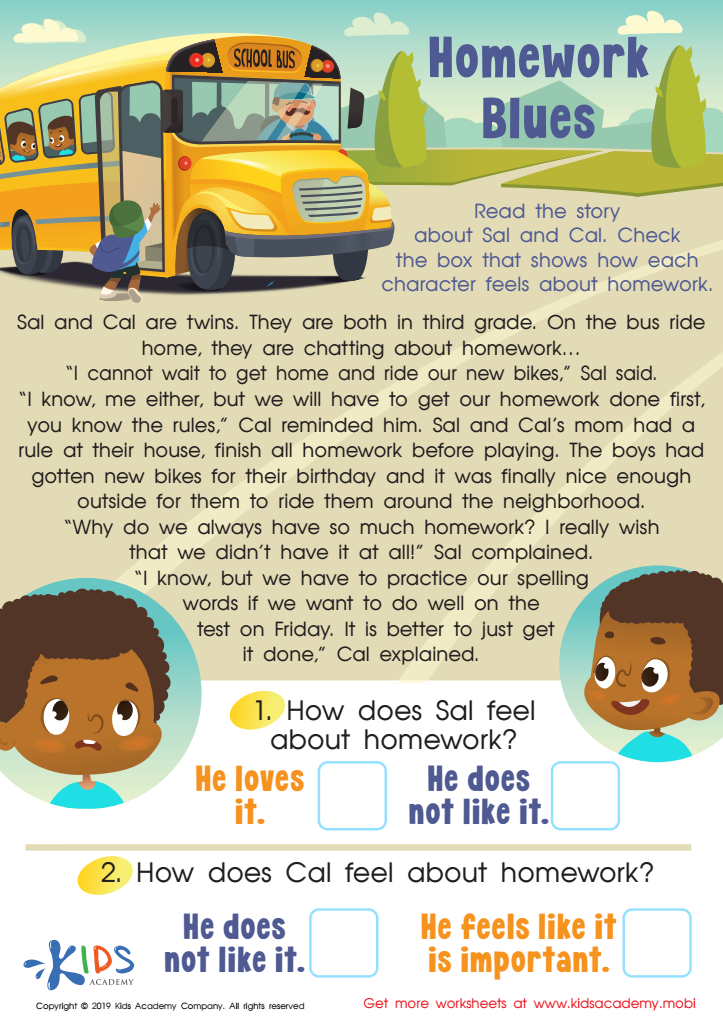
Homework Blues Worksheet
 Assign to My Students








Parents and teachers should care about fraction simplification for children aged 6-9 because it lays a crucial foundation for mathematical understanding and critical thinking skills. At this developmental stage, children are beginning to grasp the concepts of numbers and operations, and introducing them to fractions empowers them to comprehend more complex mathematical ideas later on.
Simplifying fractions teaches children the importance of equivalent values, promoting comparison and analysis of different numerical forms. These skills not only enhance their mathematical abilities but also foster problem-solving strategies that apply across various subjects. Engaging with fractions at an early age encourages logical reasoning and reinforces the idea that math is a language that can be interpreted in multiple ways.
Moreover, learning to simplify fractions helps build confidence in young learners. As they master this concept, they'll be more inclined to tackle challenging problems without fear, resulting in a positive attitude toward math. Additionally, foundational skills in mathematics connect with real-world applications, enabling children to see the relevance of their learning. Overall, investing time in fraction simplification nurtures both cognitive development and a lifelong interest in math, ultimately benefiting students in their academic journey.








