
Time recognition Time Worksheets for 6-Year-Olds
3 filtered results
Difficulty Level
Grade
Age
-
From - To
Subject
Activity
Standards
Introduce your young learner to the world of time with our engaging "Time Recognition Worksheets for 6-Year-Olds"! Perfectly designed for early grade students, these worksheets offer a fun and effective way to grasp the concept of time. Through interactive activities and colorful illustrations, children will master reading analog and digital clocks, understanding hours and minutes, and distinguishing between AM and PM. Enhance their daily routines while building essential time-telling skills. Our worksheets are an excellent resource for home or classroom use, ensuring your child gains confidence and proficiency in an important mathematical skill. Set the foundation for lifelong learning with our time-telling worksheets!
Favorites
With answer key
Interactive
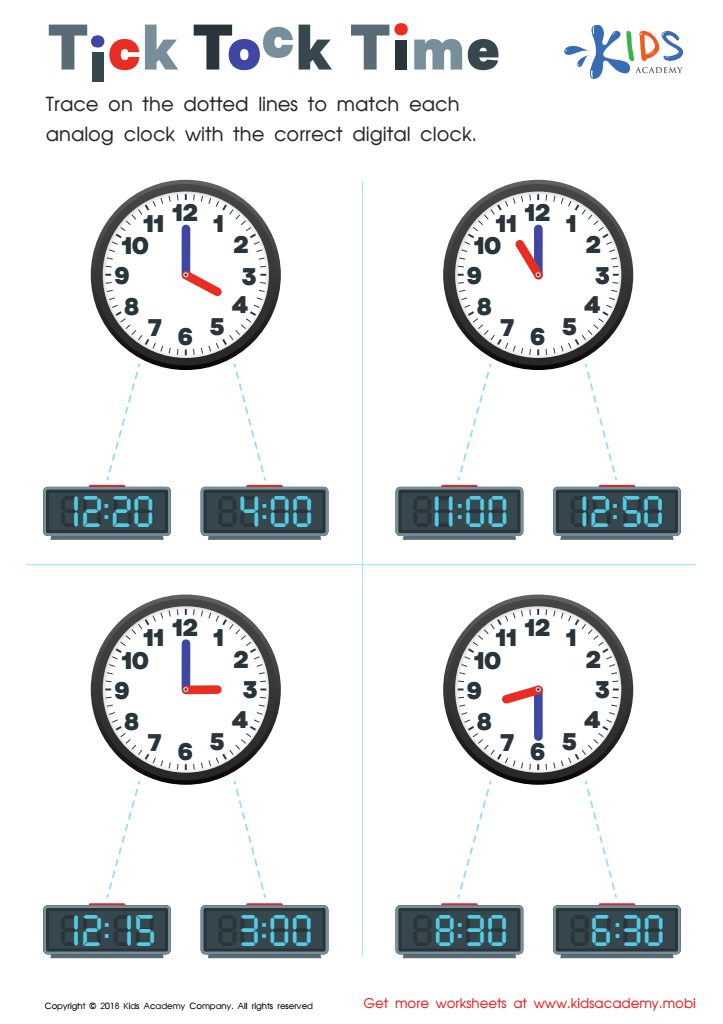
Tick Tock Time Worksheet
Trace the dotted lines on this worksheet to match analog and digital clocks! It's a great way to help your kids learn time-telling. They'll get better at converting analog to digital, and vice versa. Get your children to try it - it's a fun way to practice!
 Assign to My Students
Tick Tock Time Worksheet
Worksheet
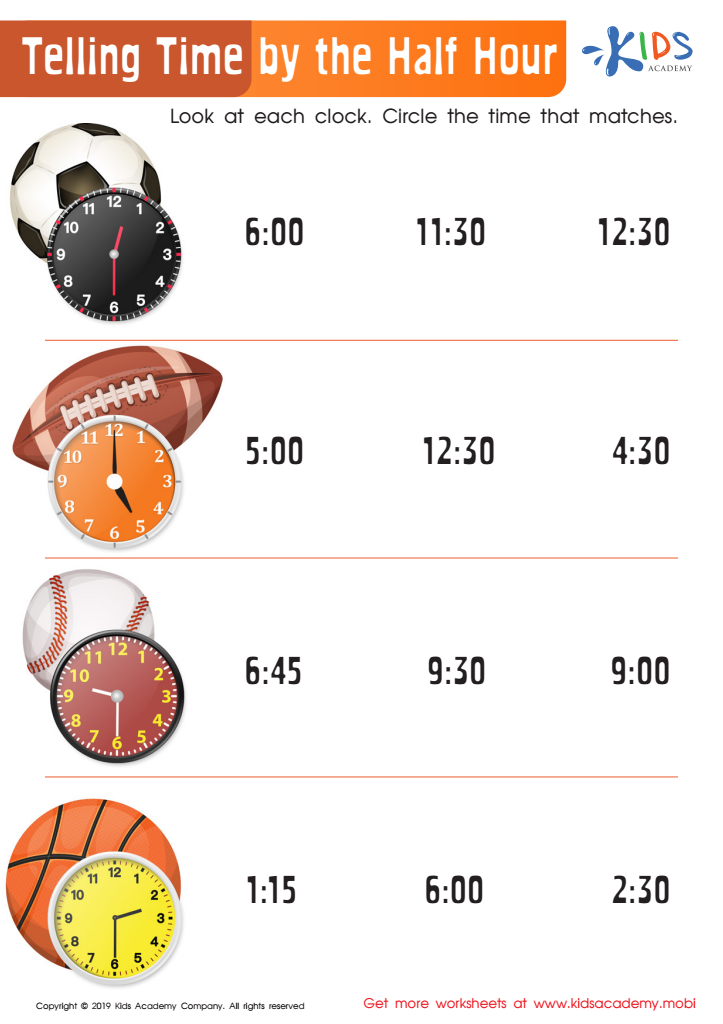
Telling Time by the Half Hour Worksheet
Teach kids to tell time with this worksheet! Four clocks are labeled with different times; help your child circle the right one. It's a great way to teach them to read analog and digital clocks, watches, and written times. Easy and fun learning!
Telling Time by the Half Hour Worksheet
Worksheet
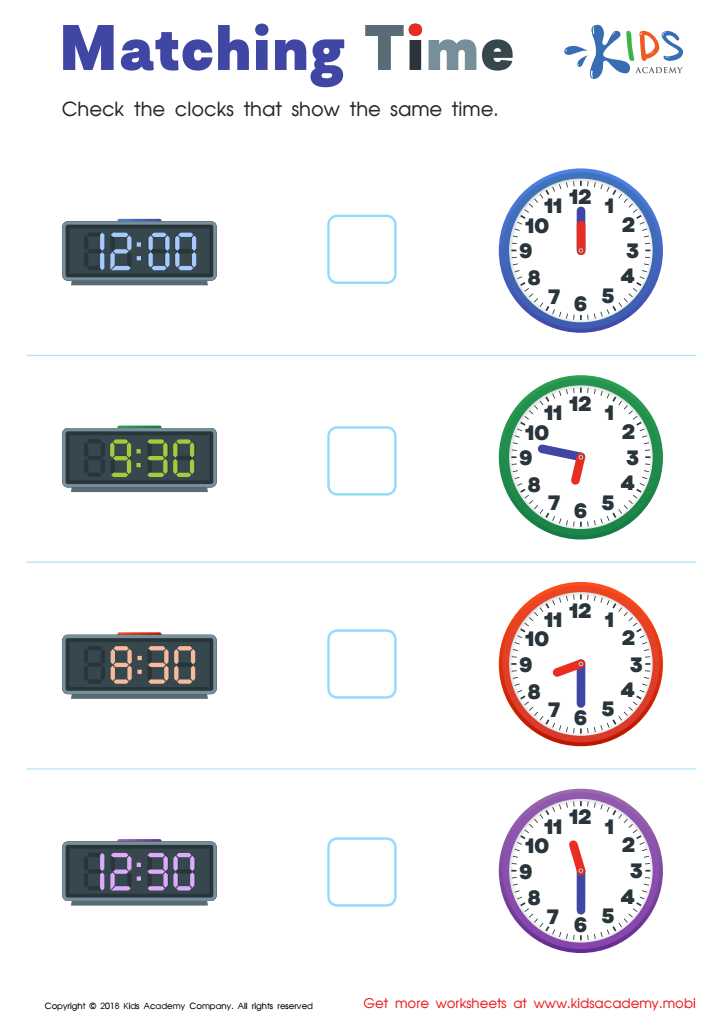
Matching Time Worksheet
Teach your child to read time in both digital and analog formats with this helpful printout. They'll identify clocks that match in both formats and check them off. Colorful and engaging, it's a great way to help your child understand the concept of time-telling.
Matching Time Worksheet
Worksheet
Join Kids Academy for Free
Who is primarily going to use this learning content?








Helping six-year-olds learn to tell time is essential for their overall development and daily functioning. First, understanding time strengthens mathematical skills—recognizing numbers, sequences, and durations aids in comprehension of more complex math concepts later on. Next, time-telling fosters a sense of responsibility and independence. Children who can read clocks and schedules are better equipped to manage their own activities, transitions, and routines without constant adult intervention.
Additionally, time recognition improves organizational skills. For instance, knowing how long it takes to perform various tasks helps children plan and structure their day effectively. It reduces anxiety and enhances predictability, as they can anticipate daily events such as meals, playtime, and bedtime. Time-telling also encourages social competence, aiding punctuality and teaching respect for others' time in social and academic settings.
Furthermore, mastering this skill boosts self-esteem. Successfully learning to tell time gives children a sense of accomplishment and encourages further learning. Finally, early time recognition is a critical life skill that remains relevant throughout life— being late for school, appointments, or forgetting deadlines can have significant consequences as they grow older. Therefore, investing in this essential skill lays a foundation for various academic, social, and personal competencies.








