Counting money Worksheets for Ages 7-8
3 filtered results
-
From - To
Enhance your child's financial literacy with our Counting Money Worksheets tailored for ages 7-8. Our engaging activities help young learners master coin and bill recognition, addition, and subtraction skills in real-world scenarios. Specially crafted by educators, these printable worksheets make mathematics fun and interactive, strengthening essential life skills. Embrace the journey of learning with vibrant visuals and practical exercises that cater to second to third-grade standards. Whether at home or in the classroom, our resources provide the foundation for confident money handling. Turn counting money into an enjoyable adventure with Kids Academy!
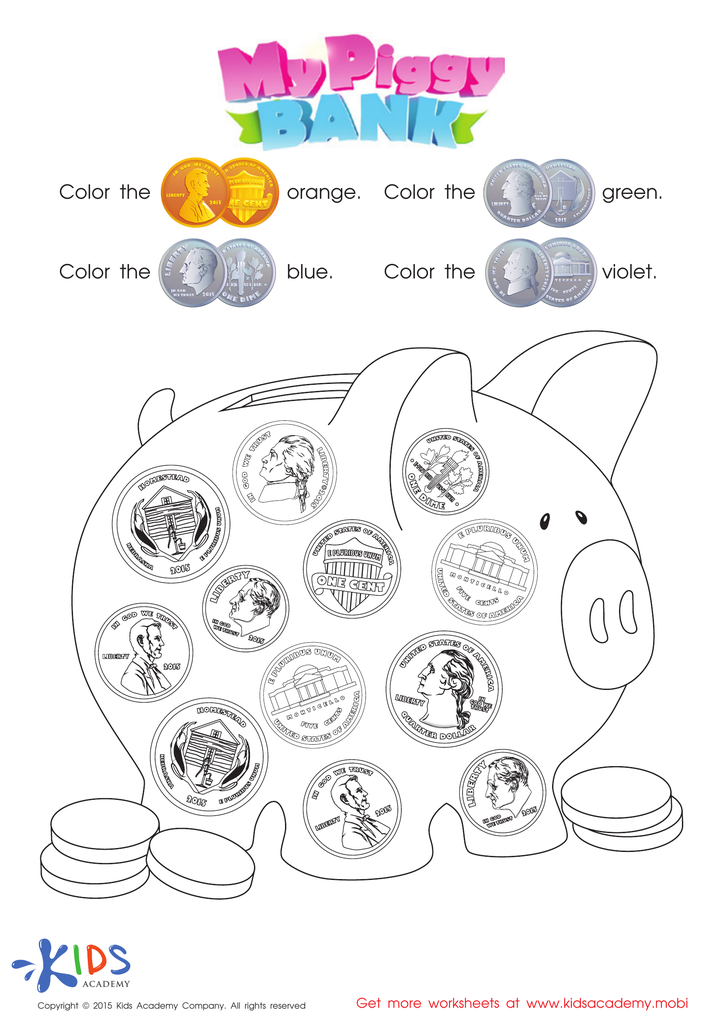
Recognizing Money Money Worksheet
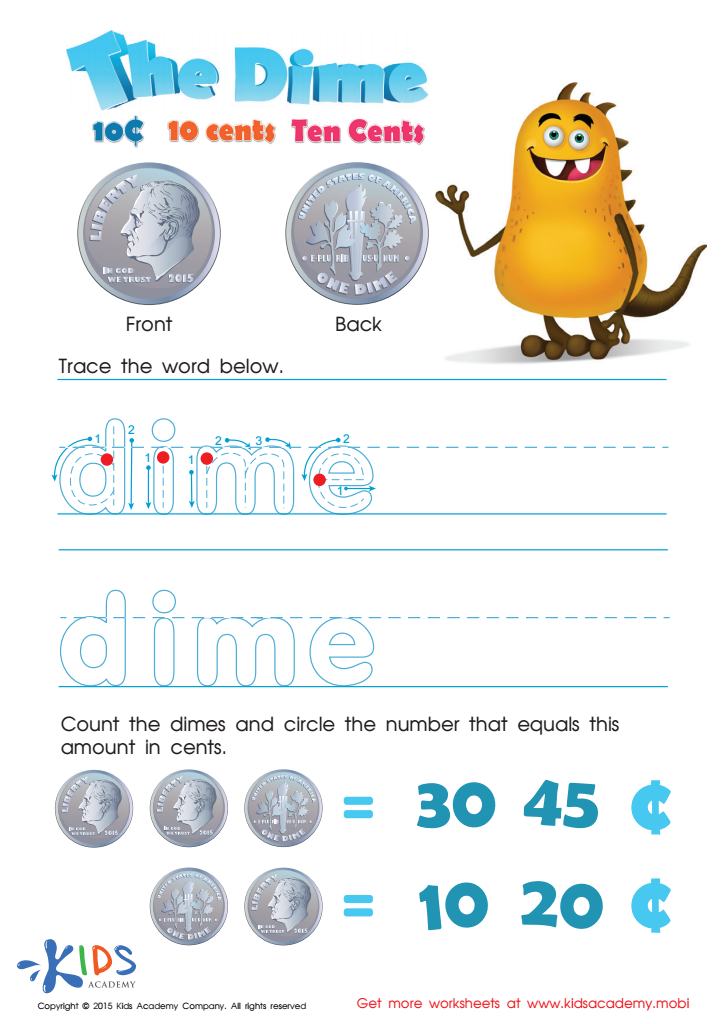
Ten Cents or the Dime Money Worksheet
 Assign to My Students







Teaching children aged 7-8 to count money is crucial for several developmental and educational reasons. Firstly, it enhances their mathematical skills. Children practice basic arithmetic such as addition, subtraction, and even multiplication and division when they handle coins and bills. This hands-on learning solidifies their understanding of numerical concepts and improves their problem-solving abilities.
Secondly, learning to count money fosters practical life skills. Knowing how to count, save, and spend money responsibly is an essential skill they will use throughout life. It teaches financial literacy at an early age, helping them understand the value of money, budgeting, and making informed purchasing decisions.
Thirdly, counting money promotes cognitive development. Handling different denominations requires critical thinking and cognitive flexibility, improving their capacity for abstract thought and decision-making.
Additionally, counting money can be a confidence booster. As children become more adept at handling money, they feel a sense of achievement and independence. This confidence extends to other areas of learning and daily life.
Finally, involving children in activities like counting money creates opportunities for social and interactive learning. Whether through role-play games like 'store' or helping with small transactions, children learn to communicate, cooperate, and grasp real-world applications of their classroom learning.
In conclusion, understanding the importance of counting money provides a strong foundation for children's mathematical, practical, cognitive, and social skills.








