Identifying fractions Worksheets for Ages 7-8
6 filtered results
-
From - To
Explore Kids Academy's engaging "Identifying Fractions Worksheets for Ages 7-8" designed to make learning fractions fun and intuitive! These printable exercises help young learners master fractions through colorful visuals and interactive activities. Ideal for second graders, the worksheets focus on fundamental skills, like recognizing and comparing fractions, understanding numerators and denominators, and visual fraction representations. Perfect for classroom or at-home practice, our worksheets build a strong math foundation, boost confidence, and enhance problem-solving abilities. Unlock a world of learning with Kids Academy, where discovering fractions becomes a delightful adventure for every child!
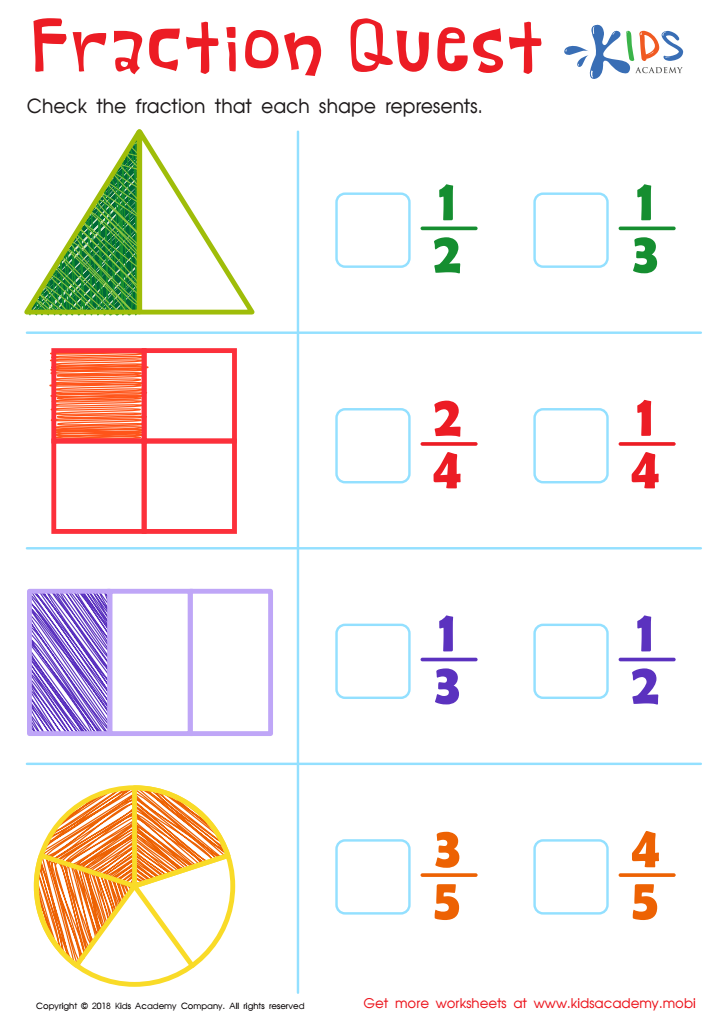
Fraction Quest Worksheet
 Assign to My Students








Identifying fractions at ages 7-8 plays a crucial role in a child's mathematical foundation and overall cognitive development. At this developmental stage, children arrive at a more advanced understanding of numbers and how they can be divided and represented in parts. Teaching fractions fosters critical thinking and problem-solving skills, allowing children to approach more complex math concepts with confidence in later grades.
Fractions are not only critical in academic pursuits but also essential in daily life. Children frequently encounter fractions in situations such as sharing food, dividing allowances, or understanding time. Learning to identify and manipulate fractions helps them make practical and equitable decisions in these everyday contexts.
Early mastery of fractions also instills a sense of accomplishment and builds a positive attitude toward math. Struggling with fractions later on can cause anxiety and hinder academic progress in mathematics, as well as in subjects that require quantitative analysis, such as science and economics.
Moreover, a strong grounding in fractions supports the development of proportional reasoning, measurement concepts, and algebraic thinking—key components of numeracy that are vital for future educational success. By investing time and effort to ensure children grasp these concepts, parents and teachers can lay a robust groundwork for a child's academic and life-long competence in mathematics.








