
Money calculation skills Worksheets for Ages 7-8
3 filtered results
Difficulty Level
Grade
Age
-
From - To
Subject
Activity
Standards
Our "Money Calculation Skills Worksheets for Ages 7-8" are designed to make learning about money both engaging and educational. These expertly crafted worksheets help children grasp fundamental concepts of addition, subtraction, and the value of different coins and bills. Through fun, interactive activities, kids develop crucial money calculation skills, setting a strong foundation for financial literacy. Perfect for classroom use or at-home practice, our worksheets cater to various learning styles, ensuring every child progresses confidently. Equip your child with essential math skills and an understanding of money management with our comprehensive worksheet collection.
Favorites
With answer key
Interactive
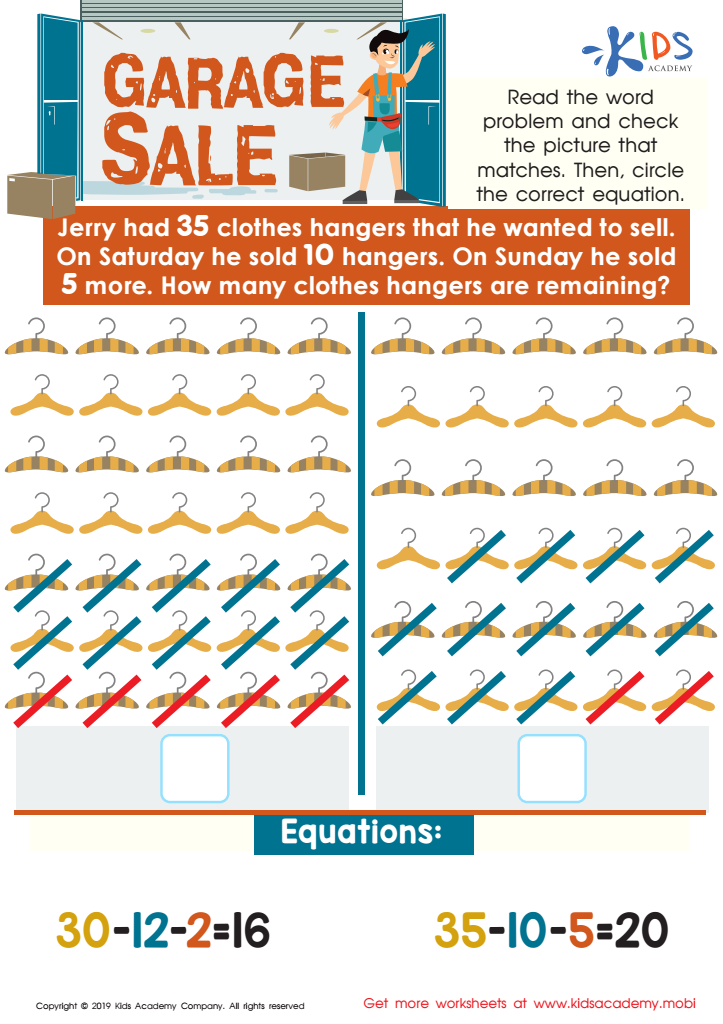
Garage Sale Worksheet
Help Jerry at his garage sale! With this worksheet, your child can practice subtraction word problems with multiple subtrahends. They'll read the problem, identify important info, circle the equation and solve it. Let your little math star have fun while helping Jerry out!
 Assign to My Students
Garage Sale Worksheet
Worksheet
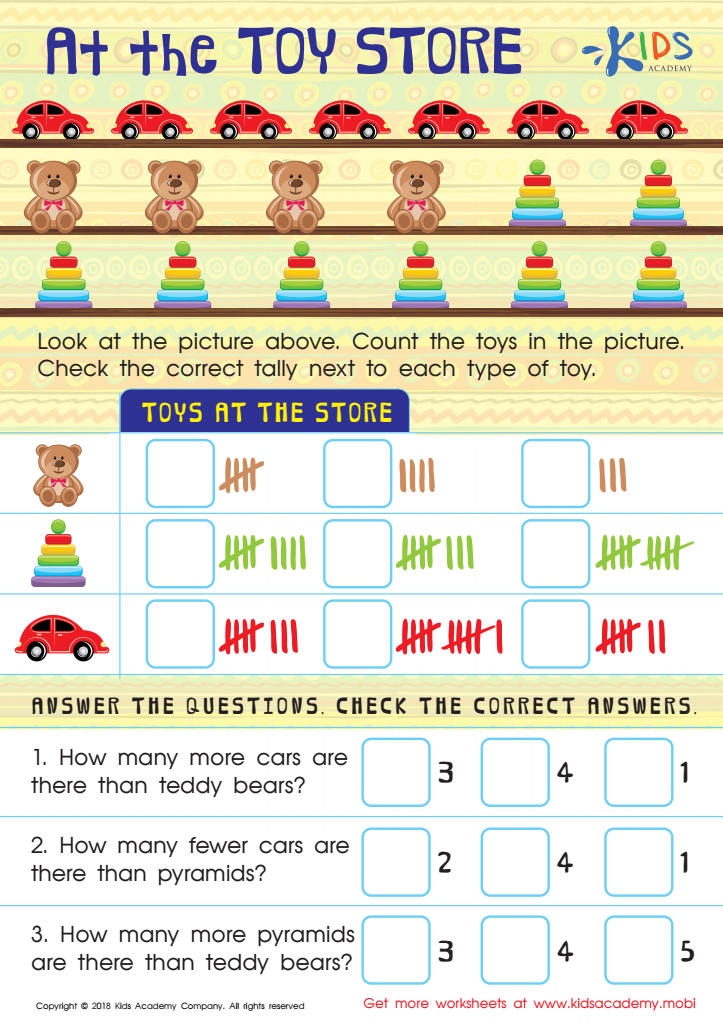
Tally Chart: At the Toy Store Worksheet
Kids Academy has a fun worksheet to help kids practice counting and using tally marks! They can think about the number of toys and compare them. At the bottom, help them answer the questions about the toys on this math page. It's an easy way to learn that one tally mark equals one item.
Tally Chart: At the Toy Store Worksheet
Worksheet
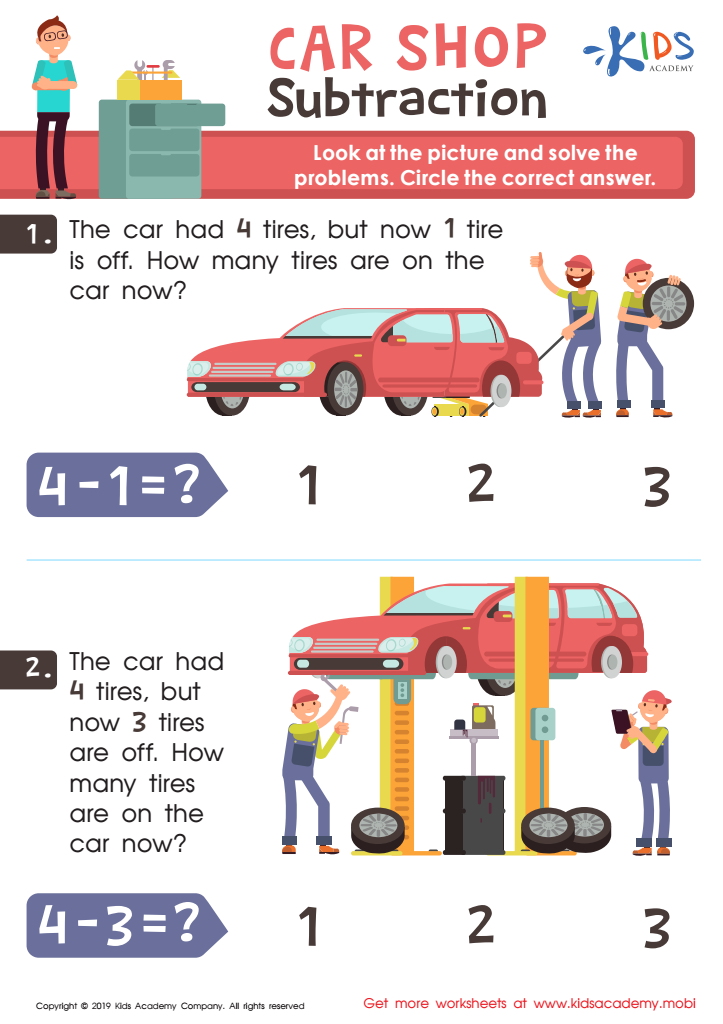
Car Shop Subtraction Worksheet
Encourage your kids to practice addition and subtraction with this worksheet. Read the word problems aloud, help them solve and check the answer from the provided options. With enough exercises and guidance, this task should be fairly easy.
Car Shop Subtraction Worksheet
Worksheet
Join Kids Academy for Free
Who is primarily going to use this learning content?







Parents and teachers should prioritize teaching money calculation skills to children aged 7-8 because it establishes foundational skills crucial for financial literacy. At this developmental stage, children are more adept at grasping basic arithmetic, and integrating these skills with practical applications like money handling reinforces their mathematical learning.
Moreover, understanding how to count, save, and spend money teaches children the value of currency and budgeting, which are critical life skills. For example, a child who learns to calculate the total cost of items or the correct change is less likely to be confused in real-world transactions, fostering independence and confidence.
Practical money skills also lay the groundwork for responsible financial behavior. Early familiarity with concepts like saving pocket money for a desired toy encourages patience and planning. This habit can lead to more advanced financial understanding as they grow, including managing allowances, making informed spending decisions, and eventually comprehending more complex financial instruments.
Additionally, real-life math skills can make abstract concepts more tangible, thereby enhancing overall academic performance. By contextualizing math in everyday scenarios, children find more engagement and see the relevance of what they learn, thereby deepening their interest and understanding. Overall, early money calculation education is an investment in a child’s future capability to manage personal finances effectively and make sound financial decisions.








