
Money identification Worksheets for Ages 7-8
4 filtered results
Difficulty Level
Grade
Age
-
From - To
Subject
Activity
Standards
Our Money Identification Worksheets for ages 7-8 offer an engaging and educational way for young learners to master recognizing and understanding different coins and bills. These printable resources help children practice identifying U.S. currency, enhancing their mathematical skills and financial literacy. Ideal for both classroom and home settings, the worksheets incorporate fun exercises and visual aids to reinforce learning. With various activities, such as matching, sorting, and simple addition involving money, these worksheets make learning about money both enjoyable and effective. Equip your child with essential life skills through these comprehensive, easy-to-use resources.
Favorites
With answer key
Interactive
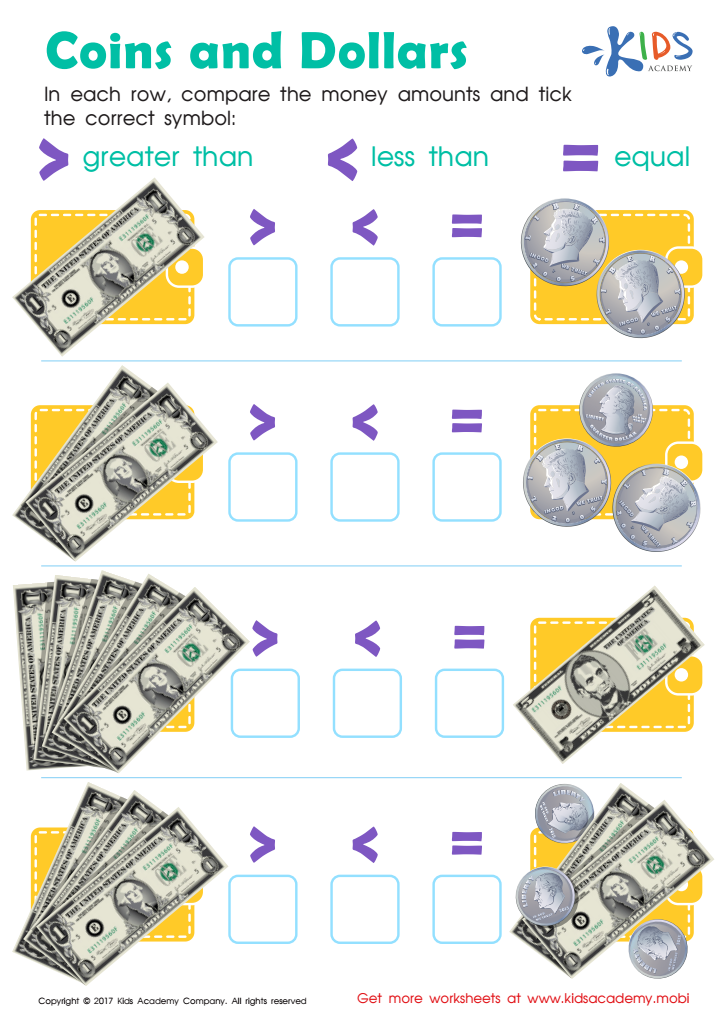
Money: Coins Dollars Printable
Motivate your kid to learn and practise essential math skills, like 'greater than' and 'less than', by introducing the importance of money! The money worksheet "Coins and Dollars" will give them a hands-on experience of counting coins and dollars, making math symbols more memorable.
 Assign to My Students
Money: Coins Dollars Printable
Worksheet
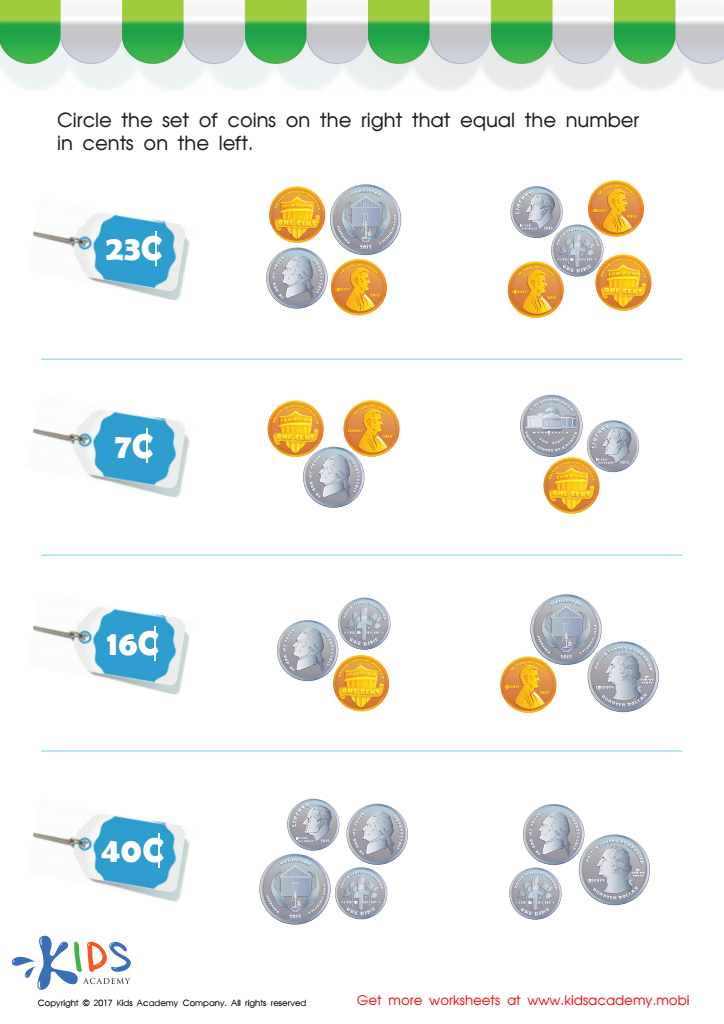
Picking the Coins You Need Money Worksheet
Let's learn to count money with Parents and Kids Academy! Investigate a real shop together: buy a globe, pencils, books, and a school bag using coins. Then, circle the coins you'll need. Visit our website for more free and fun money games for kids!
Picking the Coins You Need Money Worksheet
Worksheet
Join Kids Academy for Free
Who is primarily going to use this learning content?







Understanding money identification at ages 7-8 is crucial for a child's overall development. Teaching children to recognize and understand money, including coins and bills, helps build a strong foundation for essential life skills. At this age, cognitive abilities are developing rapidly, making it an ideal time to introduce basic financial principles.
First, money identification encourages mathematical skills. Children practice counting, addition, and subtraction, enhancing their number sense. Recognizing different denominations and understanding their values extends math learning beyond the classroom, fostering real-world application.
Second, it instills a sense of responsibility and decision-making. Children become more aware of the value of money, which aids in developing budgeting skills. Simple activities like identifying and sorting money or playing "store" games create engaging and practical learning experiences.
Third, early money identification promotes confidence and independence. Being able to handle money for small transactions, like buying a snack, gives children a sense of accomplishment and autonomy.
Lastly, introducing financial literacy at a young age sets the stage for future financial competence. As children grow, they will avoid financial pitfalls and be better prepared to make informed financial choices.
Therefore, parents and teachers should prioritize money identification to nurture well-rounded, financially savvy individuals from an early age.








