Basic Math Skills Adding up to 100 Without Regrouping Worksheets for Ages 7-8
4 filtered results
-
From - To
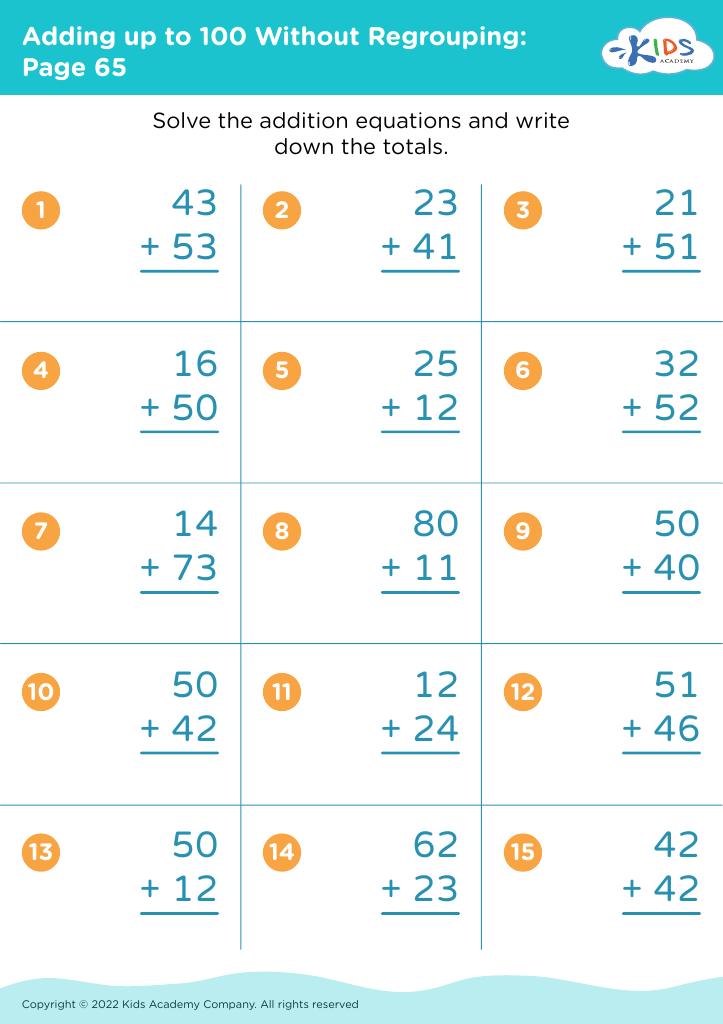
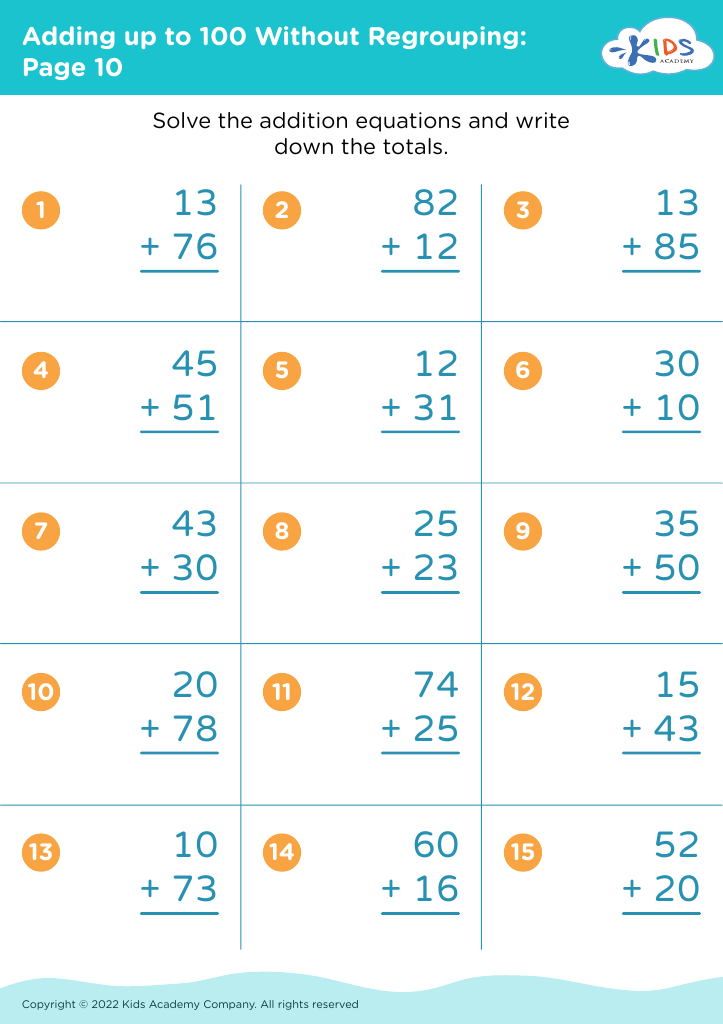
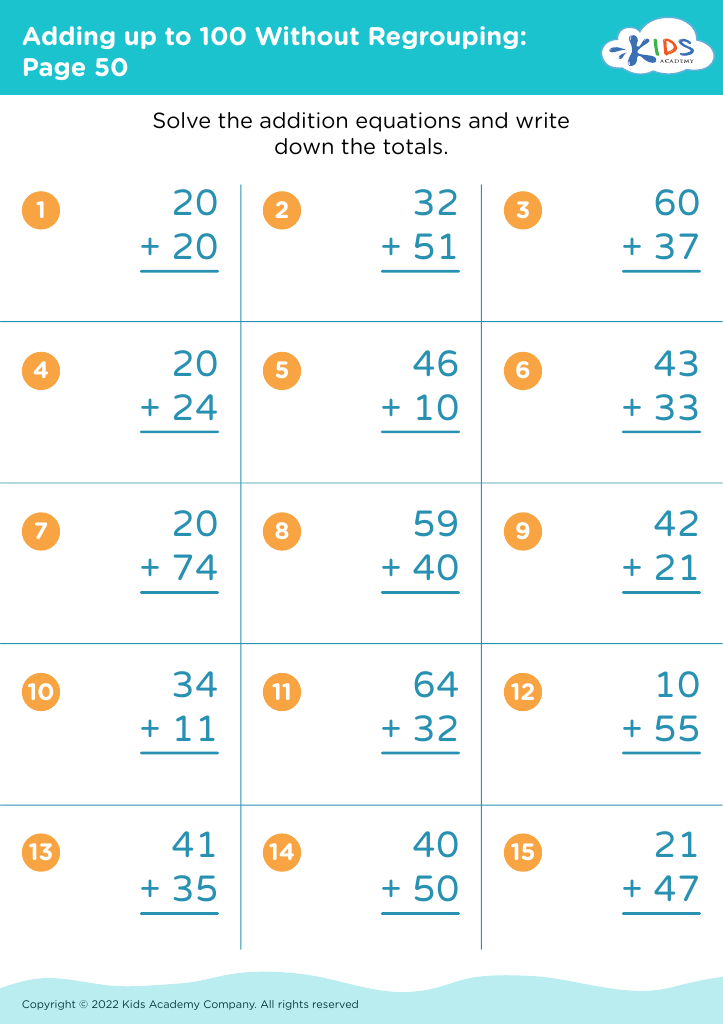
Enhance your child's numeracy with our "Basic Math Skills: Adding up to 100 Without Regrouping Worksheets" designed for ages 7-8. These engaging worksheets help students practice addition without regrouping, fostering confidence and proficiency in arithmetic. Perfect for at-home learning or classroom use, each sheet offers a mixture of problems in a fun and educational format. Kids will improve their ability to sum two-digit numbers logically and accurately. Ideal for supplementing schoolwork, our worksheets ensure your child develops a solid math foundation. Visit our page to download and start boosting your child's arithmetic skills today!
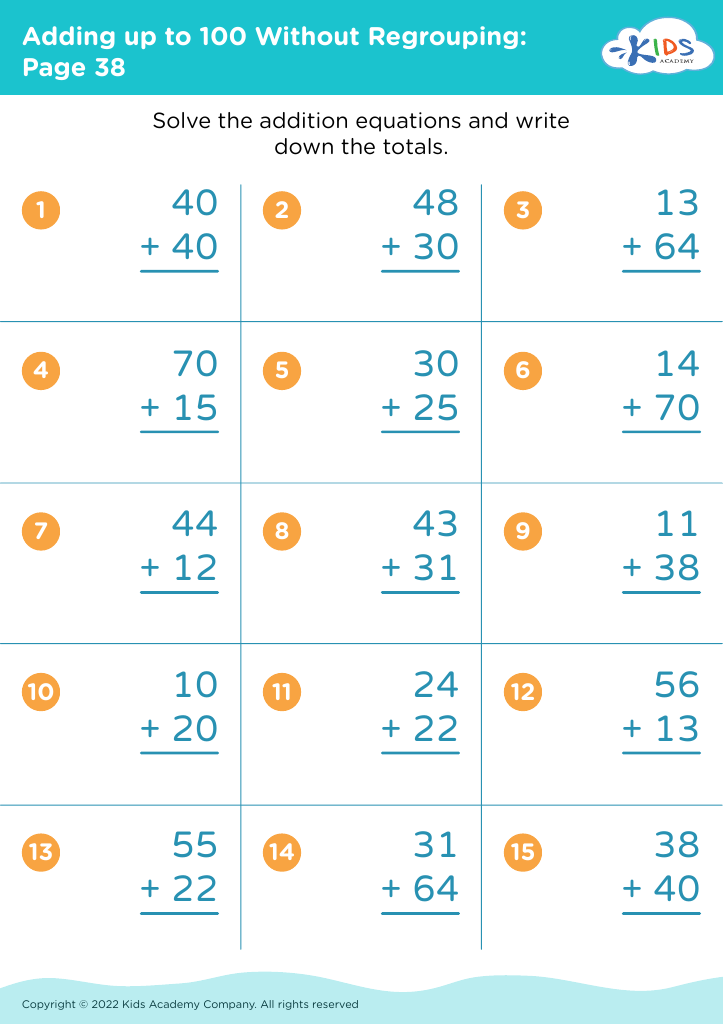




Parents and teachers have a critical role in nurturing basic math skills in children aged 7-8, particularly learning to add up to 100 without regrouping. This foundational skill is essential because it lays the groundwork for more advanced mathematical concepts and everyday calculations. At this age, children are beginning to develop a better grasp of numbers and their relationships, making it the perfect time to solidify these skills.
Mastering addition up to 100 helps kids build confidence in their mathematical abilities. It fosters a sense of accomplishment and motivates them to tackle more complex problems. Additionally, this skill is pertinent in real-life scenarios, such as calculating change when shopping or adding up scores in games, thereby making math relatable and practical.
Furthermore, a strong understanding of addition without regrouping enhances mental math capabilities and improves number fluency. As children become more adept, they can more easily transition to challenges like addition with regrouping, subtraction, and later, multiplication and division. Ignoring such fundamental skills can lead to gaps in knowledge that might hinder academic progress.
In conclusion, by prioritizing basic math skills, parents and teachers support the development of their student's critical thinking, problem-solving abilities, and overall confidence in mathematics, setting them up for long-term success.