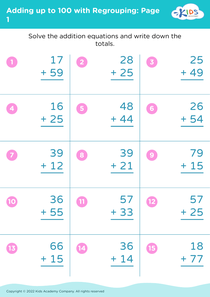
Improve counting skills Adding up to 100 Without Regrouping Worksheets for Ages 7-8
3 filtered results
-
From - To
Boost your child's math abilities with our "Improve Counting Skills Adding up to 100 Without Regrouping" worksheets, designed for ages 7-8. These printable worksheets focus on enhancing counting skills by practicing addition within 100 without the need for regrouping. Perfect for young learners, they provide a structured approach to mastering addition fundamentals, helping to build their confidence in math. Through engaging activities and clear instructions, your child will gain a solid understanding of crucial math concepts, ensuring a strong numerical foundation. Ideal for both classroom and home use, these worksheets are an excellent tool for fostering math proficiency.
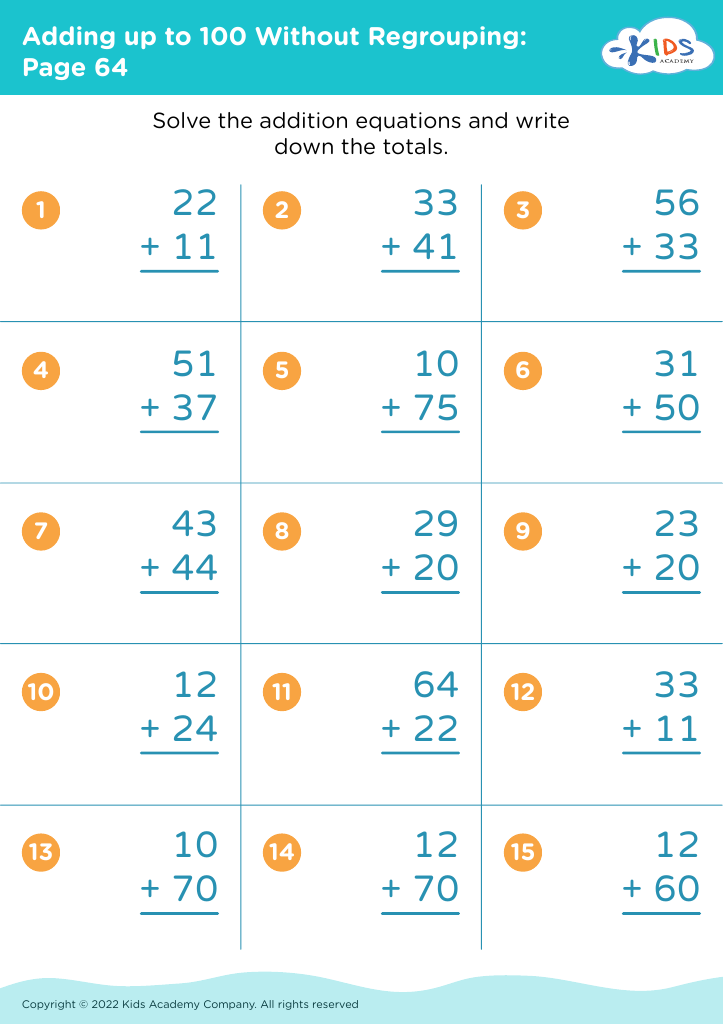
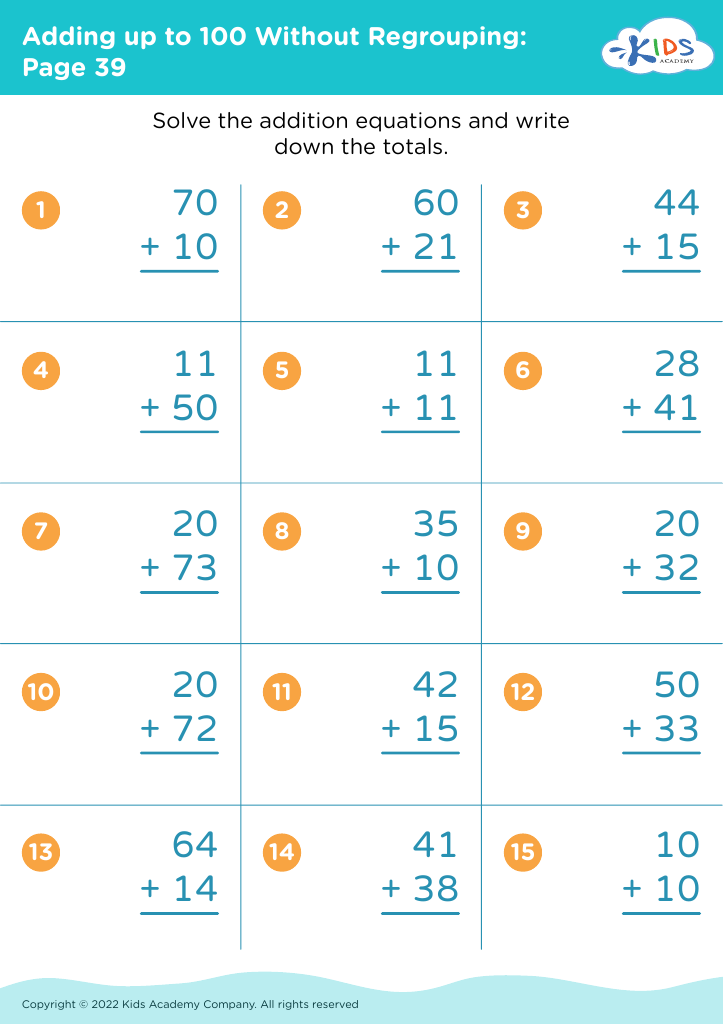
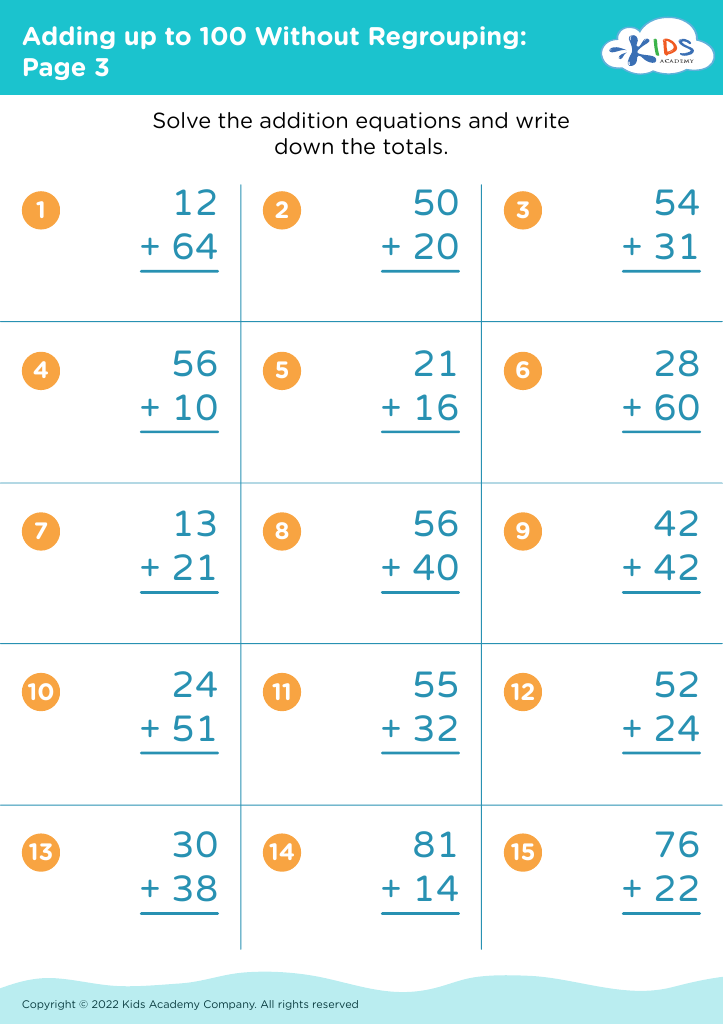




Developing counting skills up to 100 without regrouping for children ages 7-8 is a foundational aspect of early mathematics education. For parents and teachers, nurturing these skills is vital for several reasons. First, it lays a crucial groundwork for more advanced mathematical concepts such as addition and subtraction with regrouping, multiplication, and division. Mastery in counting enhances numerical fluency, making complex math problems less intimidating.
Second, counting up to 100 boosts confidence and fosters a positive attitude towards math in young learners. When children see their progress and understand numbers better, their self-esteem improves, making them more inclined to tackle new and challenging topics.
Moreover, proficiency in counting is not just about numbers; it translates to real-life skills. Children apply counting in everyday situations, whether it's determining the amount of money in their piggy bank, distributing snacks evenly, or understanding time. Therefore, counting up to 100 without regrouping encourages practical problem-solving and critical thinking.
Lastly, early mastery of math skills can close future educational gaps, ensuring that children are on par with their peers as they advance to higher grades. By valuing these skills, parents and teachers provide a stable and confident foundation for lifelong learning in mathematics and beyond.