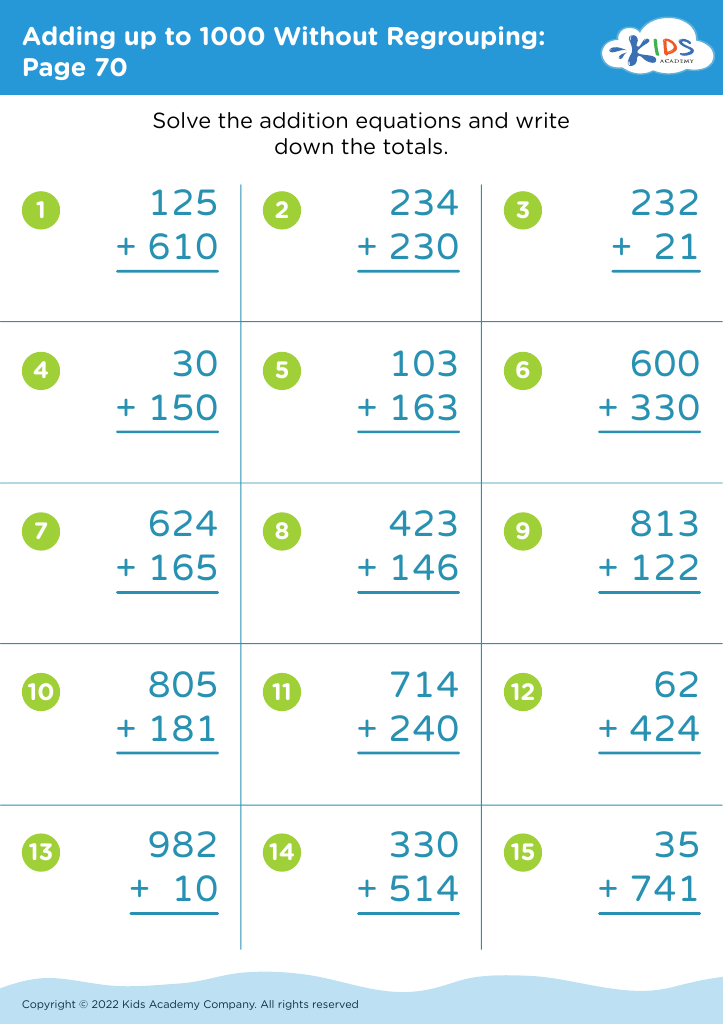








Critical thinking in addition and subtraction for ages 7-8 is vital for children’s cognitive development. At this age, students are moving beyond basic rote memorization of math facts to developing their understanding of numbers and relationships, preparing them for more complex problem-solving. Encouraging critical thinking helps children analyze problems, reason logically, and recognize patterns, ensuring they don't just arrive at the correct answer but comprehend how they got there.
Furthermore, strong foundational skills in mathematics can enhance overall academic performance. By focusing on critical thinking, teachers and parents can foster a growth mindset, where children learn to embrace challenges and understand that making mistakes is part of the learning process. This mindset promotes resilience and independent thinking, traits essential in today's rapidly changing world.
Moreover, critical thinking skills in mathematics can translate into real-life decision-making scenarios, where children will apply their understanding to everyday problems. Engaging with critical addition and subtraction exercises also aids in enhancing communication and collaboration skills, as children often work together to solve math problems. Ultimately, fostering a love for critical thinking in these foundational areas sets the stage for a lifetime of curious inquiry and effective problem-solving skills.








