
Improve counting Addition & Subtraction Worksheets for Ages 7-8
3 filtered results
Difficulty Level
Grade
Age
-
From - To
Subject
Activity
Standards
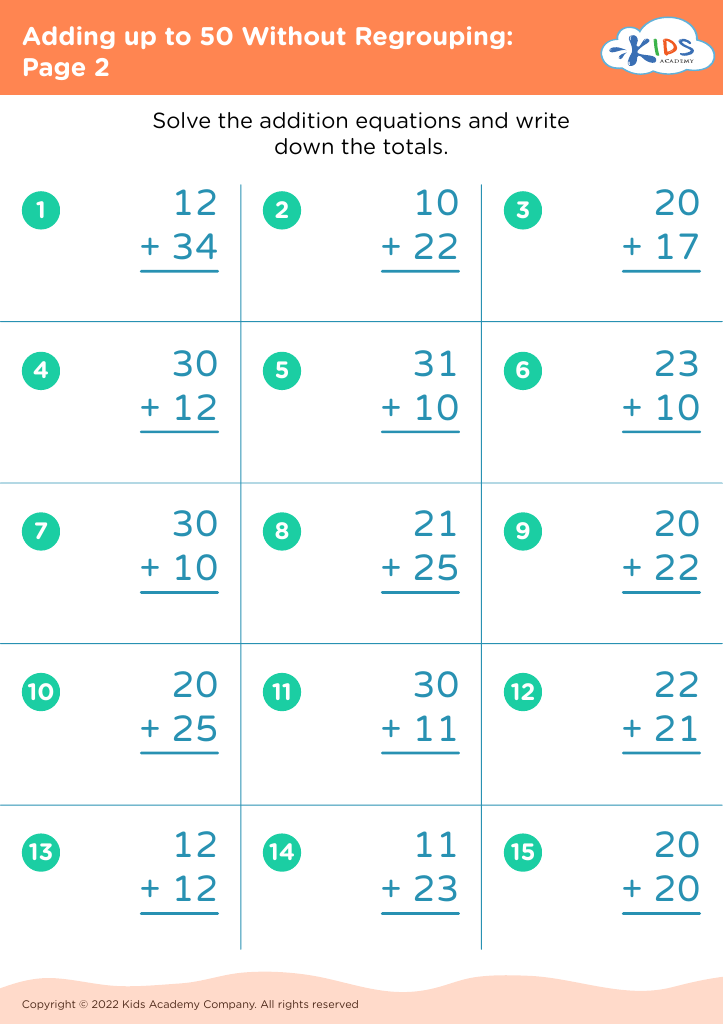
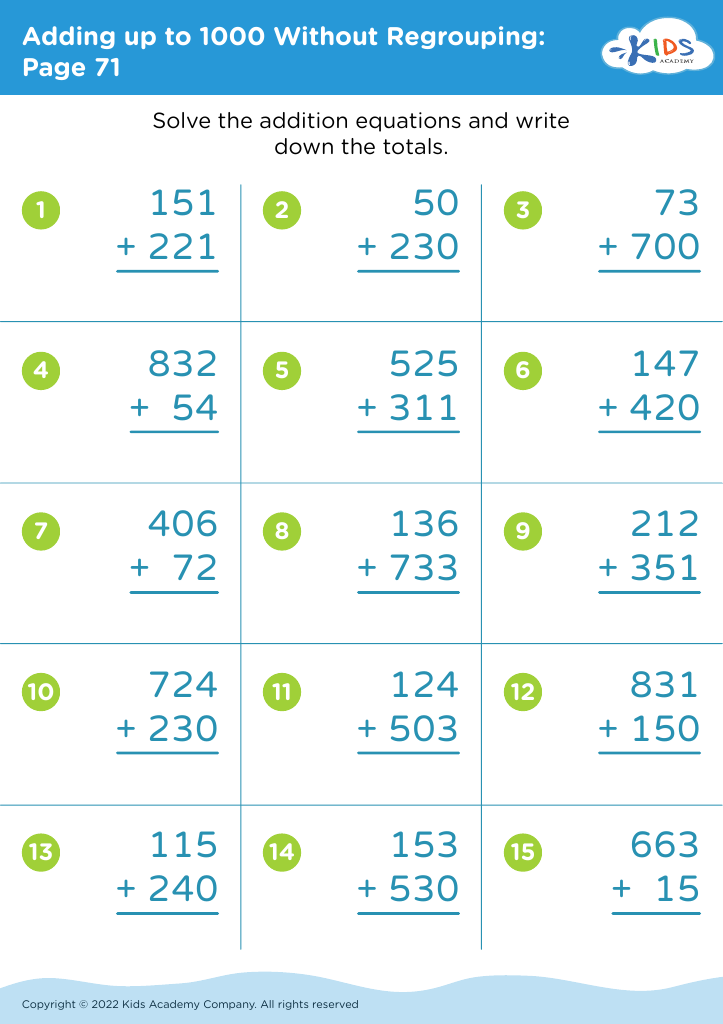
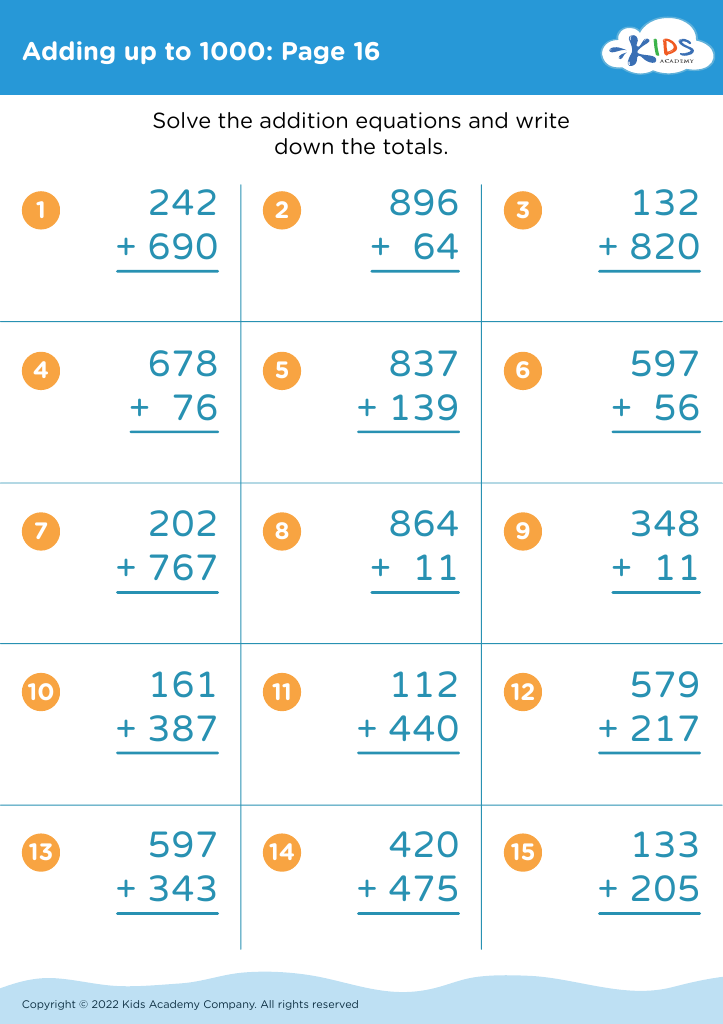
Enhance your child's math skills with our specially designed Improve Counting Addition & Subtraction Worksheets for ages 7-8. These engaging worksheets are created to strengthen foundational counting along with addition and subtraction abilities. Each activity is crafted to be both fun and educational, promoting effective learning and confidence in math. Perfect for classroom or at-home practice, our materials are aligned with key curriculum standards. Support your child's educational journey with tools designed to boost their accuracy and speed in solving math problems, ensuring a solid grasp of essential arithmetic skills. Begin your math adventure today!
Favorites
With answer key
Interactive
Join Kids Academy for Free
Who is primarily going to use this learning content?








Ensuring that children aged 7-8 improve their skills in counting, addition, and subtraction is crucial for their future mathematical development and overall academic success. At this age, children are building the foundational blocks of numeracy that will support more complex mathematical concepts in later years. Mastery of these basic skills helps enhance their problem-solving abilities, critical thinking, and logical reasoning.
Parents and teachers should care because a strong grasp of addition and subtraction not only builds confidence but also empowers children to face academic challenges more effectively. These fundamental skills are integrated into everyday activities, from telling time to managing simple financial transactions, thus making them essential for real-world scenarios.
Moreover, achieving proficiency in these areas often translates to better performance across various subjects. For instance, understanding mathematical principles aids in grasping scientific concepts that require measurements and calculations. It also develops perseverance as children learn to tackle problems with multiple steps.
Furthermore, early numeracy skills are a predictor of later academic achievement. By actively supporting children in improving counting and basic arithmetic, parents and teachers foster a positive attitude towards learning. This nurturing approach helps instill a love for mathematics and encourages lifelong learning habits. Overall, focusing on these foundational skills equips children with the tools they need for a successful academic journey and beyond.








