
Observational skills Addition & Subtraction Worksheets for Ages 7-8
3 filtered results
Difficulty Level
Grade
Age
-
From - To
Subject
Activity
Standards
Enhance your child’s arithmetic abilities with our Observational Skills Addition & Subtraction Worksheets designed specifically for ages 7-8. These engaging resources combine essential math concepts with critical observational skill development. By analyzing visual patterns, identifying relevant information, and solving problems, children will not only master addition and subtraction but also improve their attention to detail. Perfect for home or classroom use, our worksheets foster a fun learning environment while providing practice that reinforces key mathematical concepts. Help your child build confidence and analytical thinking in mathematics with our thoughtfully crafted worksheets today!
Favorites
With answer key
Interactive
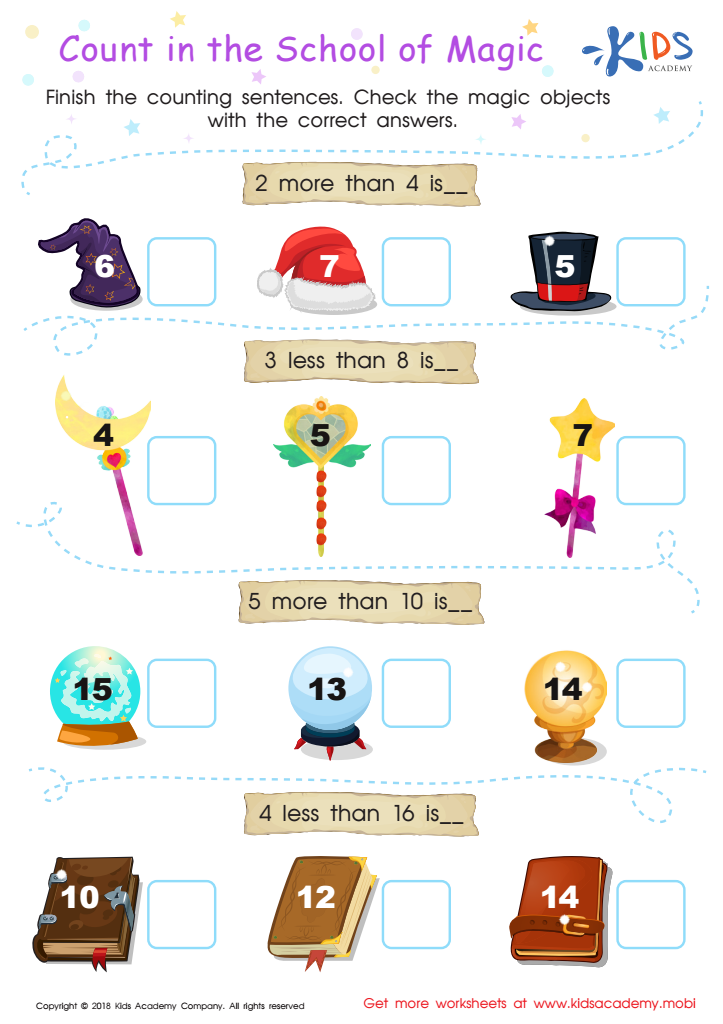
Count in the School of Magic Worksheet
Your math learners can explore the School of Magic with this worksheet. They'll read equations with addition and subtraction numbers under 20, count back and forth to find the answer, then complete the counting sentences. Fun pictures and easy accuracy make it an enjoyable and successful learning experience.
 Assign to My Students
Count in the School of Magic Worksheet
Worksheet
Join Kids Academy for Free
Who is primarily going to use this learning content?








Observational skills in addition and subtraction are crucial for children aged 7-8, as they form the foundation for mathematical comprehension and problem-solving abilities. At this developmental stage, children begin to transition from concrete manipulation of objects to more abstract thinking. Enhanced observational skills enable them to notice patterns and relationships between numbers, which are pivotal in understanding mathematical operations.
For parents and teachers, fostering these skills helps to equip children with the tools they need to tackle more complex concepts in mathematics later on. Through guided observation, children can learn to identify how quantities interact, recognize equivalencies, and notice changes that occur during addition and subtraction. This engages their critical thinking and boosts their confidence in their mathematical abilities.
Moreover, strengthening observational skills promotes a deeper understanding of the real-world applications of math, as children become adept at assessing situations that require basic calculations. Encouraging discussion and reflection about their observations fosters a growth mindset, supporting resilience in learning. Therefore, investing time in developing these skills benefits not only academic performance but also nurtures a lifelong appreciation for math in everyday life.








