Understanding number sequence Addition & Subtraction Worksheets for Ages 7-8
4 filtered results
-
From - To
Welcome to our "Understanding Number Sequence: Addition & Subtraction Worksheets" designed specifically for children aged 7-8! These engaging worksheets help young learners grasp essential math concepts through fun and interactive exercises. By practicing number sequences, students will enhance their addition and subtraction skills, building a strong foundation for future math challenges. Each worksheet features a variety of problems that encourage critical thinking and problem-solving abilities. Ideal for classroom use or at-home practice, our resources will captivate your child's interest while fostering a love for learning. Dive into the world of numbers and watch your child's confidence soar!
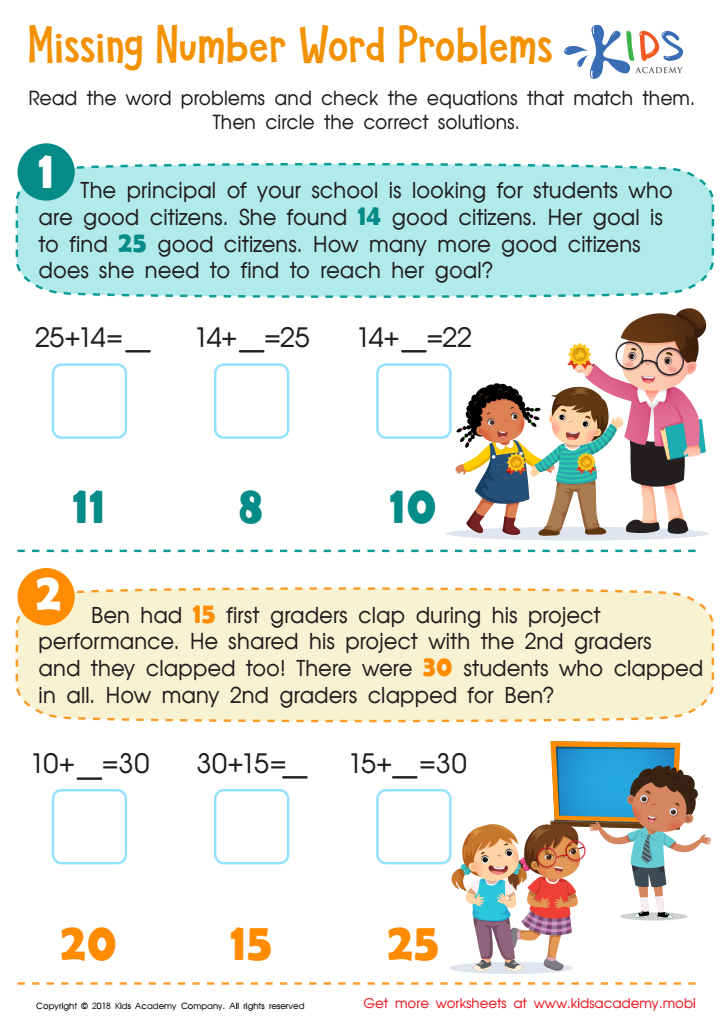
Missing Number Word Problems Worksheet
 Assign to My Students








Understanding number sequences in addition and subtraction is crucial for children aged 7-8, as it lays the foundation for more complex mathematical concepts. At this age, students begin to develop a more intuitive grasp of numbers and their relationships, which are essential skills for everyday problem-solving.
Firstly, mastering number sequences helps students recognize patterns, improving their ability to predict outcomes in math and beyond. This skill fosters confidence in their mathematical abilities, making them more willing to engage with challenging problems.
Secondly, addition and subtraction sequences are integral to early algebraic thinking. Grasping these concepts enables children to solve word problems and tackle equations systematically. Teachers and parents can nurture these skills through personalized activities, like number line games or oral calculations that spark their interest and curiosity.
Additionally, these foundational skills are critical as children move into higher grades. A strong understanding of number sequences supports successful transitions to multiplication, division, and fractions, helping to prevent future learning gaps. When parents and educators ensure children master addition and subtraction sequences, they empower them with the skills necessary for academic achievement and lifelong mathematical competence. Consequently, fostering this understanding should be a priority in early education.








