Cognitive Development Addition Worksheets for Ages 7-8
13 filtered results
-
From - To
Unlock your child’s potential with our engaging Cognitive Development Addition Worksheets designed for ages 7-8! These thoughtfully crafted worksheets not only enhance addition skills but also promote critical thinking and problem-solving abilities. Tailored to spark curiosity and foster a love for learning, our activities encourage children to explore mathematical concepts through fun, interactive tasks. Perfect for home or classroom use, these worksheets help develop essential cognitive skills while reinforcing fundamental math principles. Watch your child’s confidence grow as they progress through various levels of challenges, ensuring a strong foundation in mathematics. Start their cognitive journey today and make learning a joyful experience!



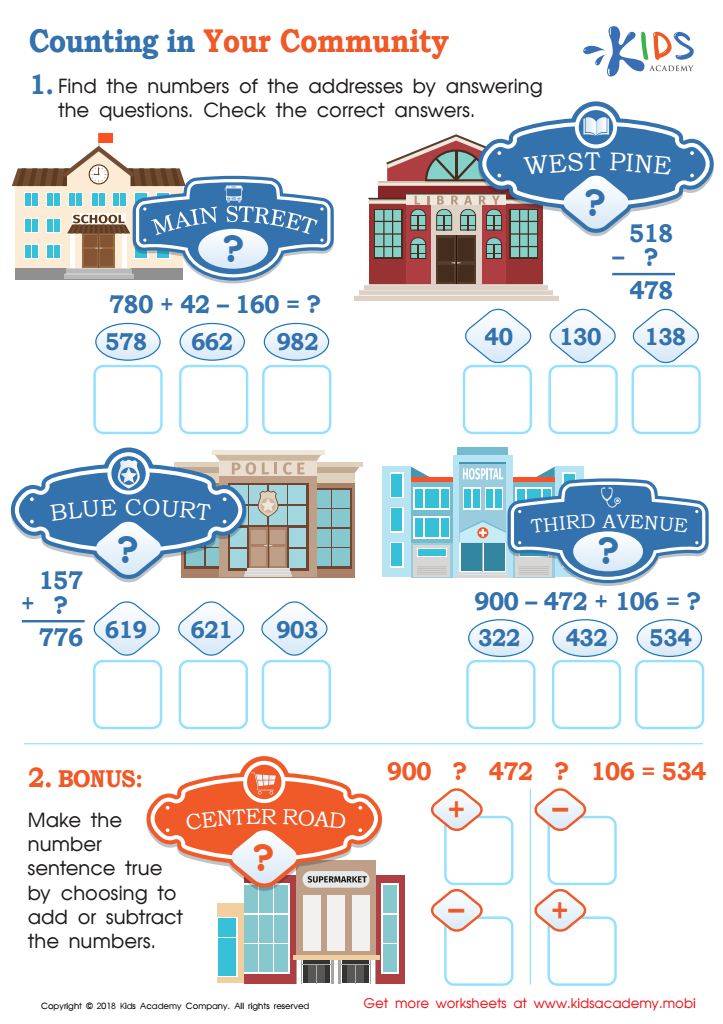
Counting in Your Community Worksheet
 Assign to My Students

















Cognitive development in children aged 7-8 is crucial as it lays the foundation for their future learning and problem-solving abilities. At this stage, children begin to think more logically, develop critical thinking skills, and start to grasp more complex concepts. This is particularly evident in mathematics, where the ability to understand addition sets the stage for mastering more advanced arithmetic and overall mathematical understanding.
Parents and teachers should care about enhancing children’s cognitive development in addition because it supports their academic performance and builds confidence. Proficient addition skills allow children to tackle real-world problems, enhancing their ability to engage in strategic thinking and decision-making. Moreover, mastery of this fundamental skill can lead to increased motivation and engagement in learning, as children experience success in their academic pursuits.
Encouraging cognitive development in addition also fosters interpersonal skills. Group activities and collaborative problem-solving exercises not only strengthen their arithmetic skills but also promote teamwork and communication. Investing time in cognitive development at this age equips children with essential skills for lifelong learning, helping them to navigate both academic challenges and everyday situations with ease and competence. Thus, promoting cognitive development in addition is vital for children's holistic growth and future success.








