Enhancing problem-solving skills Addition Worksheets for Ages 7-8
5 filtered results
-
From - To
Discover a fun and engaging way to enhance problem-solving skills with our Addition Worksheets for Ages 7-8! Designed specifically for young learners, these worksheets provide a variety of challenges that blend addition practice with critical thinking tasks. Each worksheet encourages children to apply their math knowledge in real-world scenarios, helping them to develop essential problem-solving strategies. From word problems to visual puzzles, our resources stimulate curiosity and promote a love for math. Ideal for at-home learning or classroom activities, these worksheets ensure students build confidence while mastering addition concepts. Start empowering your child’s math journey today!
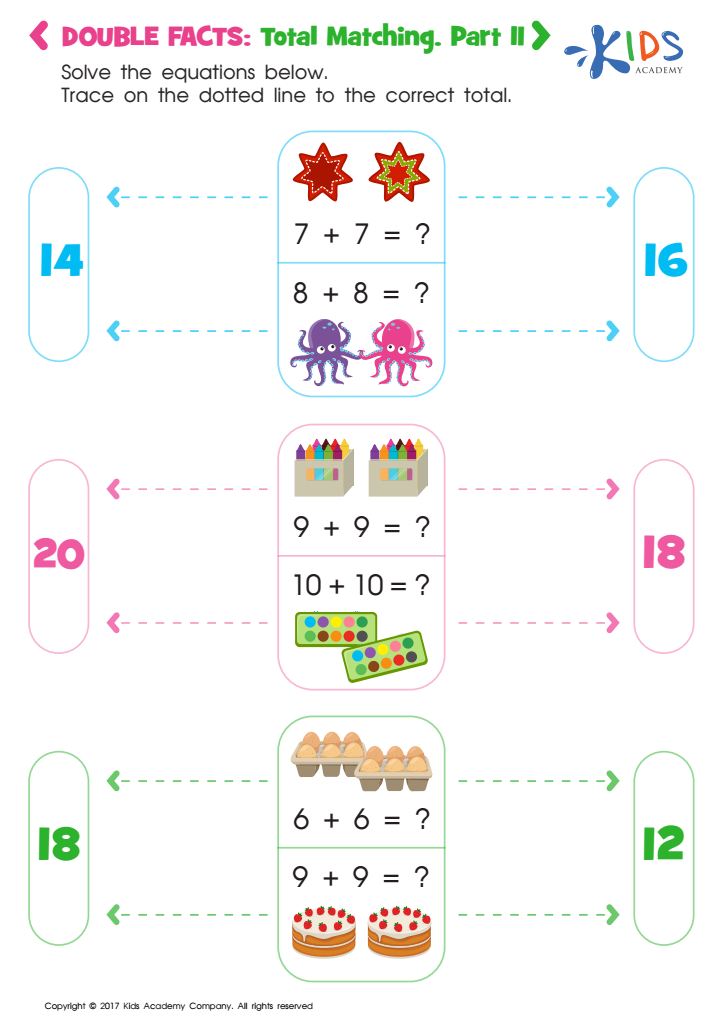
Double Facts: Total Matching 2 Worksheet
 Assign to My Students








Enhancing problem-solving skills in addition for children aged 7-8 is crucial for several reasons. At this age, children are transitioning from basic arithmetic to more complex mathematical concepts, making it essential to develop strong foundational skills. Moreover, problem-solving fosters critical thinking, enabling children to analyze situations, evaluate different approaches, and arrive at solutions independently.
Improving addition proficiency within this framework allows children to apply math in real-life contexts, such as budgeting, shopping, and time management, laying the groundwork for financial literacy. Additionally, when children tackle problem-solving tasks, they learn resilience and perseverance as they navigate challenges, understand errors, and develop a growth mindset.
This age is also pivotal for social development; collaborative problem-solving activities can improve communication skills and teamwork, essential qualities for future academic and professional success. With strong addition problem-solving skills, students will excel in math, which is linked to overall academic achievement and confidence.
Ultimately, investing time in enhancing problem-solving skills in addition not only equips children for success in math but also prepares them for diverse life challenges, fostering lifelong learners who can adapt and thrive in various situations. It’s a step towards comprehensive education that values both cognitive and emotional development.








