Improve comprehension Addition Worksheets for Ages 7-8
3 filtered results
-
From - To
Enhance your child’s math skills with our "Improve Comprehension Addition Worksheets" tailored specifically for ages 7-8. These worksheets are designed to help young learners grasp addition concepts while strengthening their comprehension abilities. Each engaging worksheet focuses on various addition strategies, including visualization, word problems, and critical thinking exercises, making math both fun and educational. With our clear instructions and interactive tasks, children can build their confidence in solving addition problems. Download these printable worksheets today and watch your child flourish as they develop vital math skills, paving the way for future academic success! Perfect for home practice or classroom use.
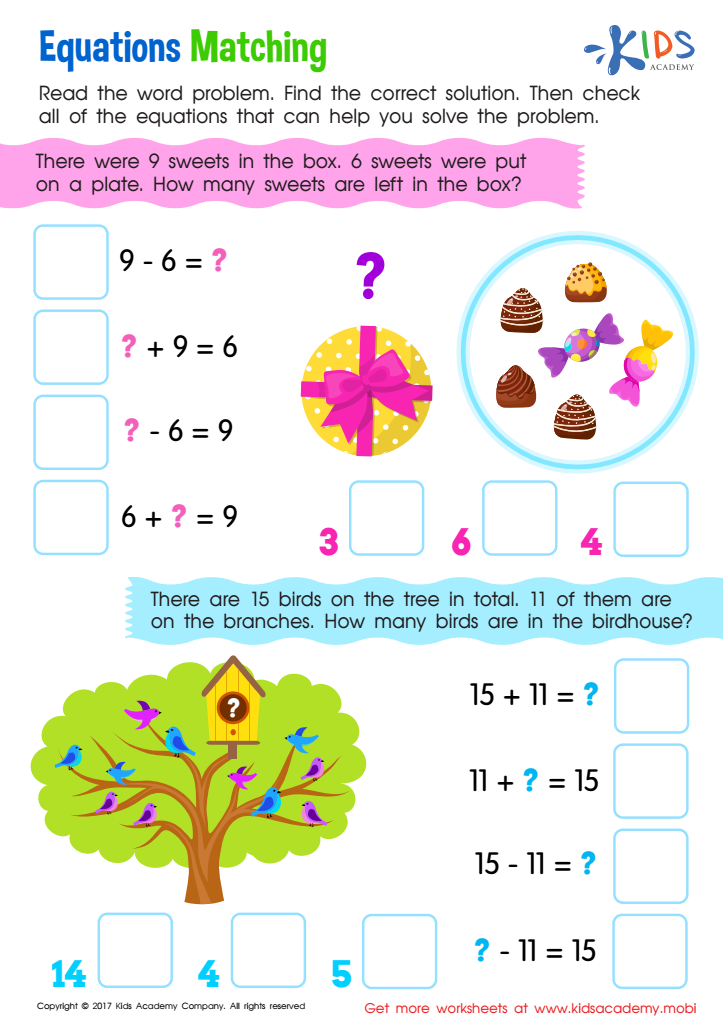
Equations Matching Word Problems Worksheet
 Assign to My Students








Improving comprehension in addition for children aged 7-8 is crucial for several reasons. Firstly, this foundational skill is vital for their overall mathematical development. At this age, children are transitioning from basic arithmetic to more complex problem-solving, and strong comprehension aids in understanding concepts such as carrying over and multi-digit addition.
Moreover, proficient comprehension in addition enhances a child's confidence in math, reducing anxiety around the subject. When children can grasp addition with ease, they are more likely to engage and participate in class. This positive attitude towards math can extend into higher grades, fostering a lifelong appreciation for the subject.
Additionally, strong comprehension skills in addition contribute to other academic areas. For example, many scientific and financial principles rely on basic math capabilities. Lastly, as partners in their children's learning journey, parents and teachers can work collaboratively to strengthen these skills. Engaging activities and consistent practice at home reinforces what is learned in school, creating a comprehensive support system. By prioritizing improved comprehension in addition, parents and teachers play a foundational role in building strong mathematical skills, empowering children for future success in academics and beyond.








