
Observational skills Numbers Worksheets for Ages 7-8
3 filtered results
Difficulty Level
Grade
Age
-
From - To
Subject
Activity
Standards
Enhance your child's learning experience with our "Observational Skills Numbers Worksheets" designed specifically for ages 7-8. These engaging worksheets foster critical thinking and observation through fun activities that encourage children to identify, compare, and analyze numbers in a variety of contexts. Each worksheet is crafted to stimulate curiosity and promote a deeper understanding of mathematical concepts, making learning both enjoyable and effective. With colorful visuals and interactive exercises, your child will develop essential observational skills that lay the groundwork for more advanced mathematical learning. Discover the joy of learning numbers in a creative way today!
Favorites
With answer key
Interactive
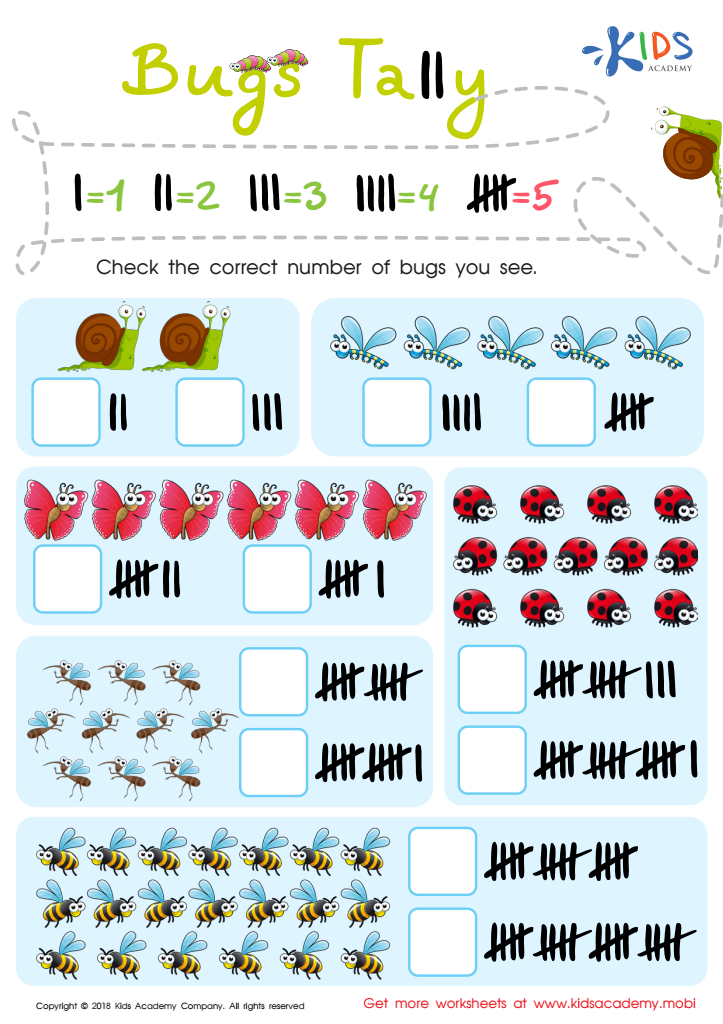
Bugs Tally Worksheet
This fun worksheet uses friendly bugs to help young mathematicians learn numbers and tally marks. They'll gain real-world skills to help with adding, subtracting and counting. Representations will solidify number reasoning, aiding with game playing and more.
 Assign to My Students
Bugs Tally Worksheet
Worksheet
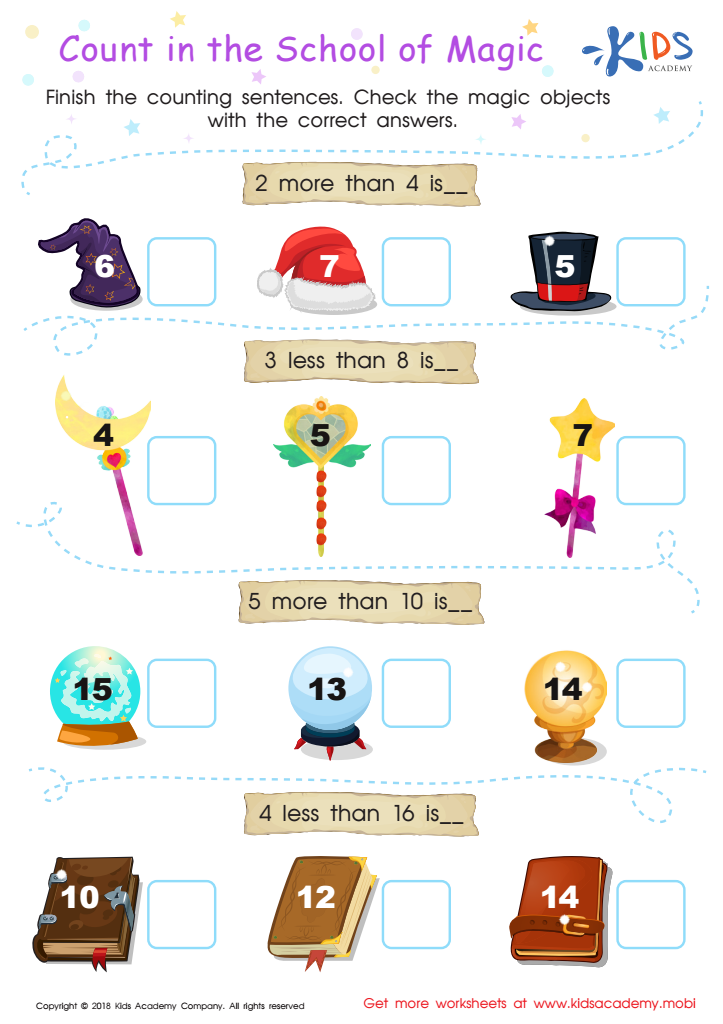
Count in the School of Magic Worksheet
Your math learners can explore the School of Magic with this worksheet. They'll read equations with addition and subtraction numbers under 20, count back and forth to find the answer, then complete the counting sentences. Fun pictures and easy accuracy make it an enjoyable and successful learning experience.
Count in the School of Magic Worksheet
Worksheet
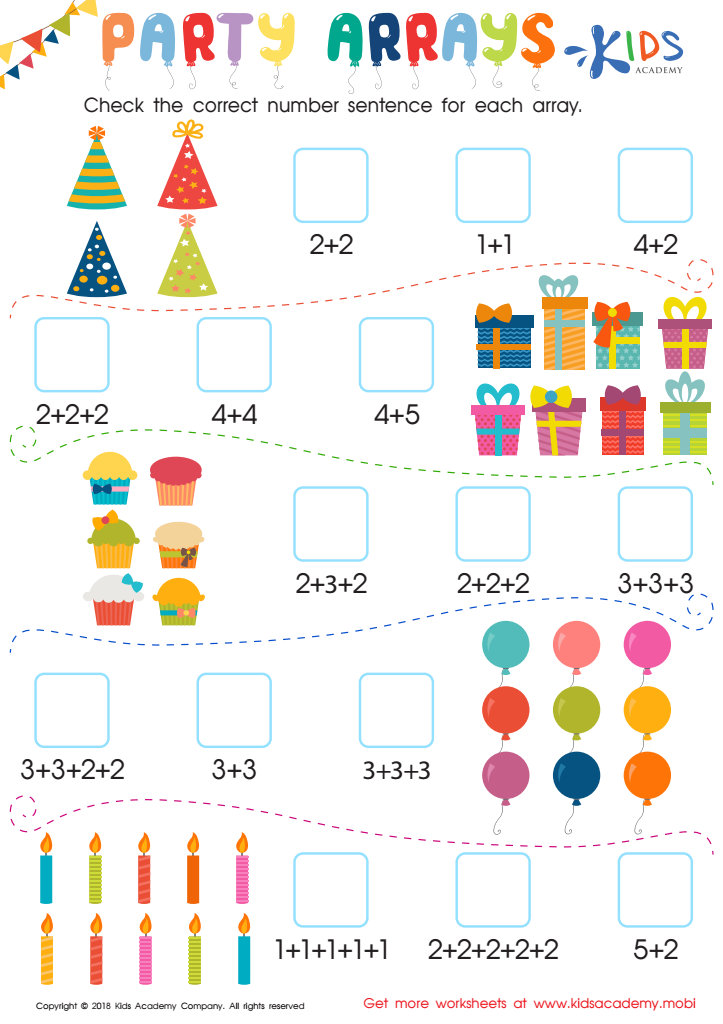
Party Arrays Worksheet
Help your child count the objects in each of the five arrays, then check the correct number sentence for each. This exercise will test their math skills and understanding of number sentences. Guide them to select the appropriate boxes.
Party Arrays Worksheet
Worksheet
Join Kids Academy for Free
Who is primarily going to use this learning content?








Observational skills are crucial for children aged 7-8, especially regarding numbers and mathematical concepts. At this developmental stage, children are beginning to understand more abstract ideas, and enhanced observational skills help them grasp these concepts more effectively. When parents and teachers encourage children to observe and analyze numerical patterns, they build a strong foundation for problem-solving and critical thinking.
By nurturing observational skills, caregivers can help children recognize relationships between numbers, such as identifying even and odd numbers, understanding basic operations, and noticing shapes and symmetry in real-world contexts. This ability to observe lays the groundwork for later mathematical learning, including more complex skills like multiplication and division.
Moreover, observational skills foster curiosity and engagement in learning. When children are encouraged to explore numbers in their environment—whether by counting objects, measuring ingredients for a recipe, or analyzing sports statistics—they develop a more dynamic understanding of math as a part of their everyday lives.
Ultimately, by focusing on observational skills related to numbers, parents and teachers can help children develop confidence, enhance their mathematical literacy, and prepare them for future academic success in mathematics and other subjects.








