
Spatial awareness Numbers Worksheets for Ages 7-8
3 filtered results
Difficulty Level
Grade
Age
-
From - To
Subject
Activity
Standards
Our Spatial Awareness Numbers Worksheets for ages 7-8 are designed to boost children's math skills and spatial reasoning. Through engaging and interactive activities, kids will learn to recognize, arrange, and compare numbers, which enhances their understanding of mathematical concepts and spatial relationships. Perfect for at-home learning or classroom use, these worksheets help children develop critical thinking and problem-solving skills. Our fun and educational resources ensure that math learning is effective and enjoyable, setting a strong foundation for future STEM success. Download these invaluable tools today to support your child’s journey to math mastery!
Favorites
With answer key
Interactive
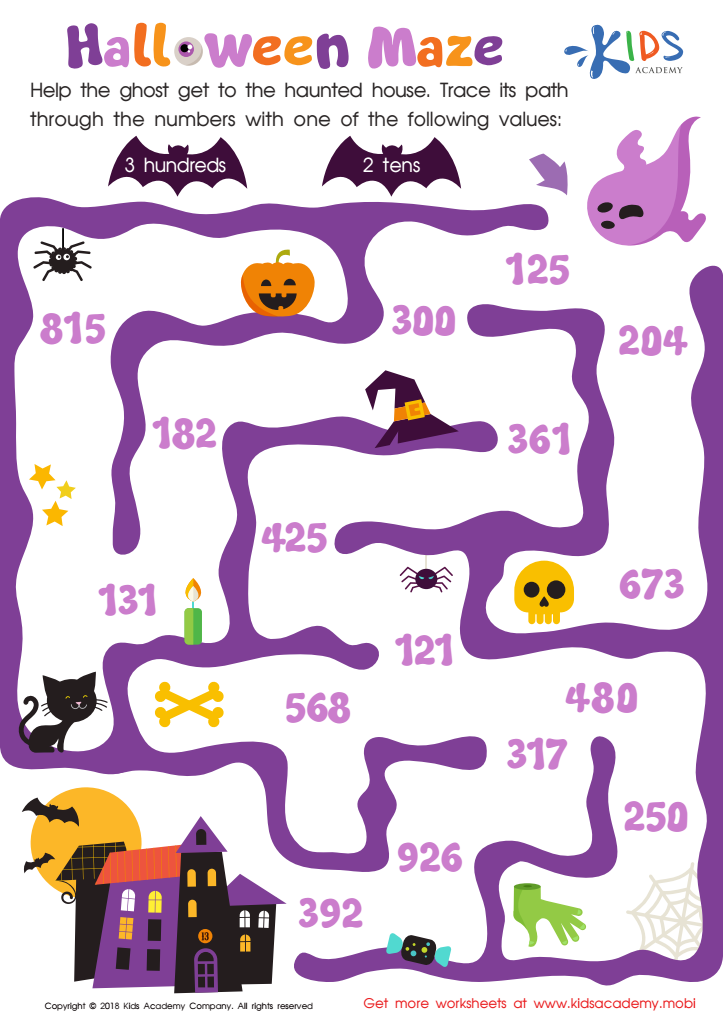
Place Value: Halloween Maze Worksheet
Kids who love haunted houses and Halloween will love this worksheet! Help the ghost reach its haunted house by tracing the path of 3 hundreds or 2 hundreds numbers. At the end is the ghost's spooky home. Have fun!
 Assign to My Students
Place Value: Halloween Maze Worksheet
Worksheet
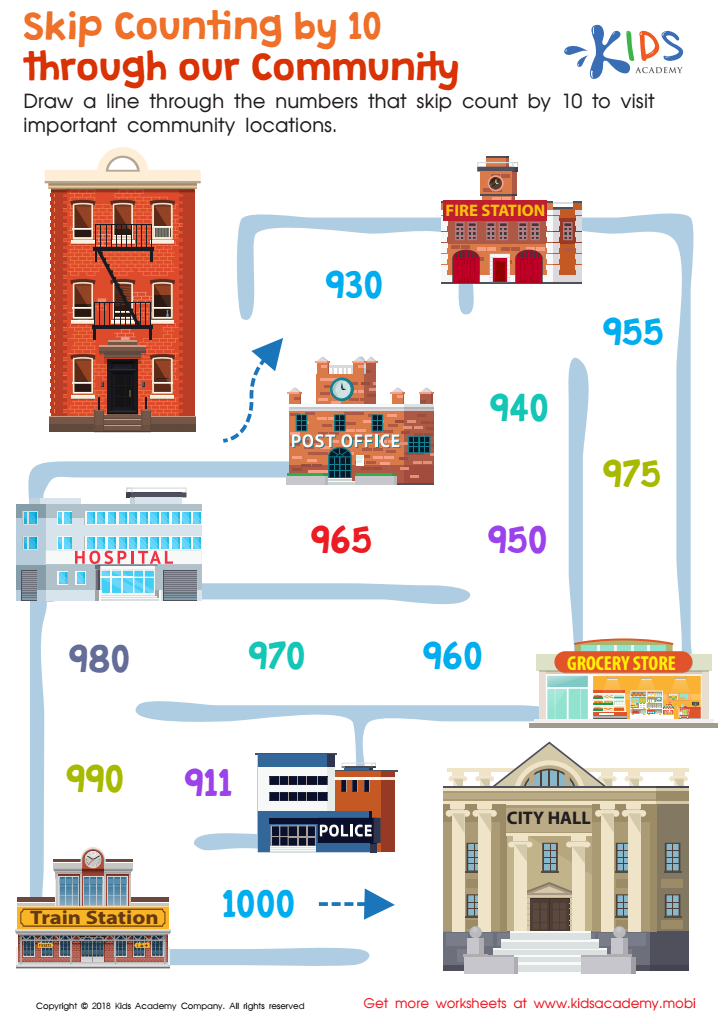
Skip Counting by 10 Through Our Community Worksheet
Our kids need to 'make a ten' and skip count by tens to boost their speed and accuracy in math. This cool, free worksheet takes them on a journey through their local community to practice counting by tens. They'll work on social studies and fine motor skills while having fun with the maze they get to count by tens in!
Skip Counting by 10 Through Our Community Worksheet
Worksheet
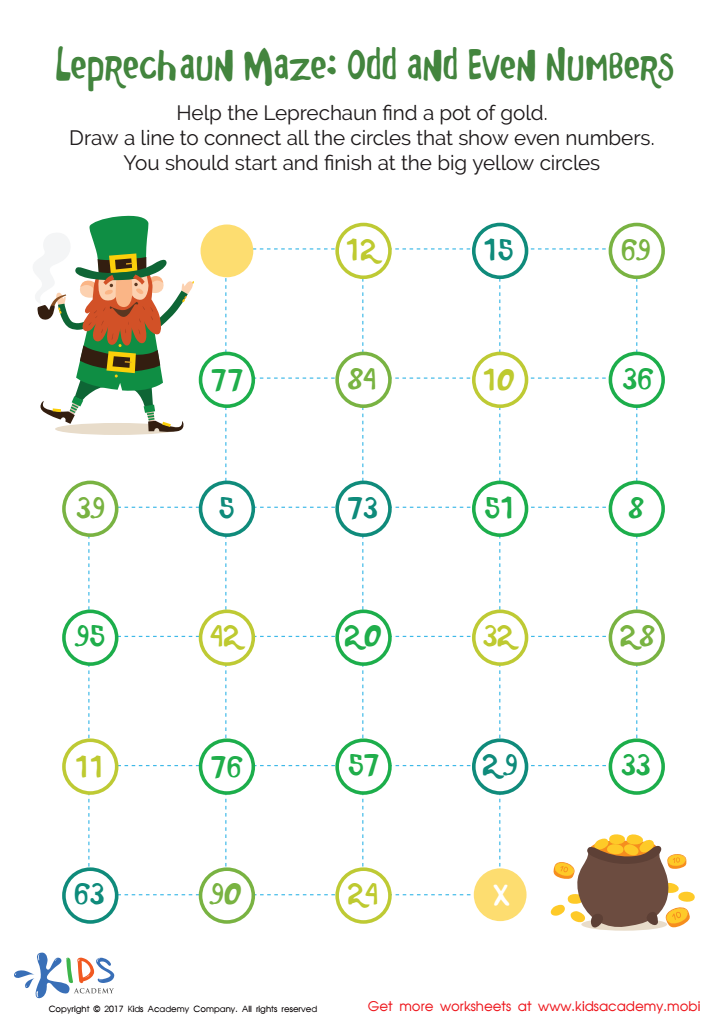
Leprechaun Maze Printable
Help the leprechaun find his pot of gold! Challenge your learner with this St. Patrick's Day worksheet. Let them identify odd or even numbers in the maze and connect the dots. It will be a fun way to celebrate St. Patrick's Day!
Leprechaun Maze Printable
Worksheet
Join Kids Academy for Free
Who is primarily going to use this learning content?








Spatial awareness and numbers are fundamental cognitive skills for children ages 7-8, forming the foundation for more complex mathematical understanding and problem-solving abilities.
First, spatial awareness enables children to comprehend and relate to objects in the space around them. This skill is vital for tasks such as reading maps, understanding diagrams, and organizing their work efficiently. By nurturing spatial skills, parents and teachers help children develop the ability to visualize shapes, patterns, and objects, which is critical for geometry, measurement, and even skills like handwriting and navigation.
Secondly, a grasp of numbers, including counting, basic arithmetic, and number relationships, sets the stage for future math success. At this age, children are transitioning from concrete to abstract thinking. They're starting to perform simple calculations, recognize number patterns, and solve organic problems like sharing or budgeting pocket money. These abilities build their confidence, fostering a positive attitude toward math.
When parents and teachers emphasize these skills through interactive activities, such as puzzles, building blocks, or educational games, they support a child's intellectual growth and enthusiasm for learning. These foundational skills, strengthened early on, increase children's problem-solving capabilities, academic performance, and overall intellectual curiosity, paving the way for a lifetime of learning.








