Building vocabulary Math Worksheets for Ages 7-8
3 filtered results
-
From - To
Enhance your child's mathematical skills with our Building Vocabulary Math Worksheets designed for ages 7-8! These engaging worksheets aim to reinforce essential math terms and concepts, helping young learners strengthen their vocabulary while tackling fun math problems. Each worksheet is crafted to promote understanding of language used in math, from basic operations to more complex challenges. With colorful illustrations and diverse activities, children will be motivated to explore the world of mathematics confidently. Perfect for home or classroom use, our resources provide the ideal blend of learning and fun, ensuring your child builds a strong foundation in math vocabulary that will last a lifetime!
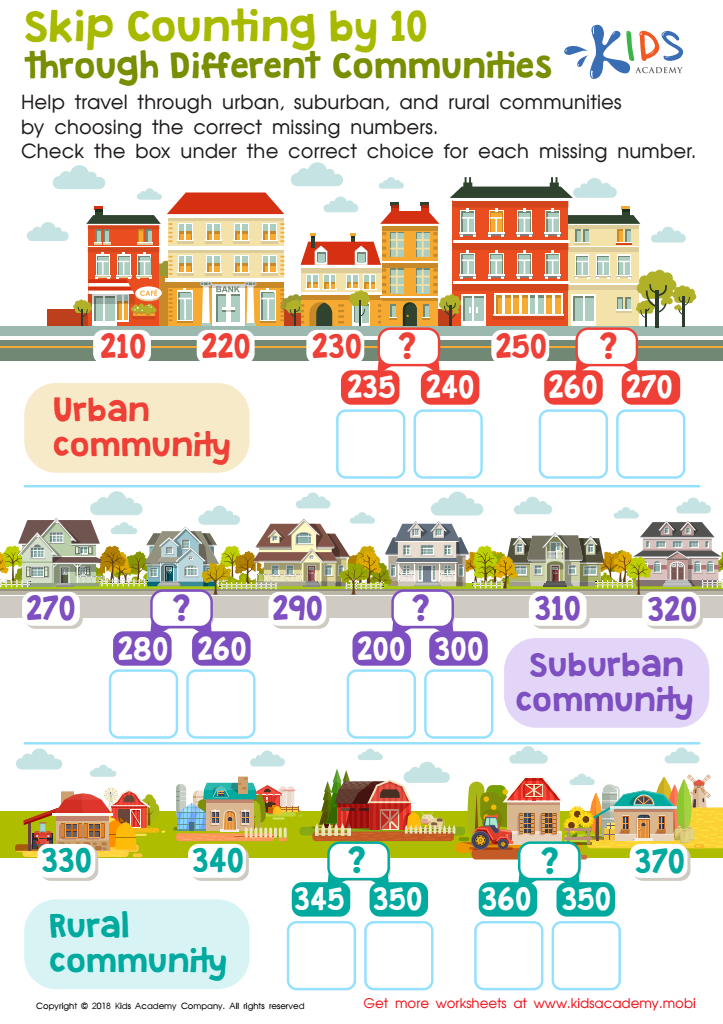
Skip Counting by 10 through Different Communities Worksheet
 Assign to My Students








Building vocabulary in math for children ages 7-8 is crucial for their overall academic success and confidence in the subject. At this age, students begin mastering more complex mathematical concepts, including addition, subtraction, fractions, and basic geometry. A strong math vocabulary provides the essential language tools they need to comprehend instructions, explain their reasoning, and write about mathematical concepts clearly.
Developing a robust math vocabulary helps children articulate their thought processes and ask questions, fostering better communication and teamwork in collaborative settings. When students understand terms like “numerator,” “denominator,” or “equilateral triangle,” they can engage more actively in discussions and problem-solving, which enhances their critical thinking skills.
Moreover, strong vocabulary skills enhance reading comprehension in word problems, enabling children to connect math with real-world situations effectively. When parents and teachers emphasize math vocabulary, they cultivate a supportive learning environment that encourages curiosity and exploration of the subject. Ultimately, this investment in early vocabulary building not only boosts students’ confidence and performance in math but also lays a foundation for future learning in STEM fields. By prioritizing math vocabulary, parents and teachers empower young learners and encourage a lifelong love for mathematics.








