
Compare fractions Math Worksheets for Ages 7-8
6 filtered results
Difficulty Level
Grade
Age
-
From - To
Subject
Activity
Standards
Discover our engaging "Compare Fractions Math Worksheets for Ages 7-8" on Kids Academy! These expertly designed worksheets help young learners master the concept of fractions by comparing and contrasting them seamlessly. With age-appropriate exercises, colorful visuals, and easy-to-follow instructions, children build strong mathematical foundations while having fun. Perfect for both classroom use and at-home practice, our printable worksheets cover various difficulty levels, ensuring that students stay challenged and motivated. Start your child’s journey to fractional fluency today. Visit Kids Academy for effective, hands-on learning experiences that make math enjoyable and rewarding for kids!
Favorites
With answer key
Interactive
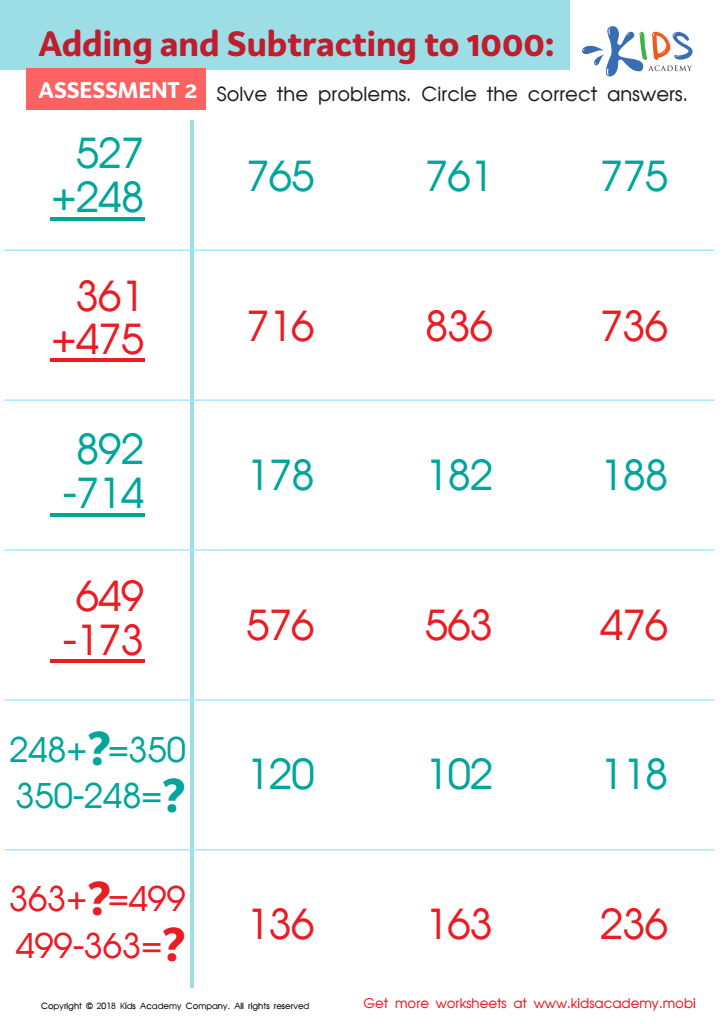
Adding and Subtracting to 1 Worksheet: Assessment 2
Test your child's addition and subtraction of 3-digit numbers with this assessment worksheet! They'll practice regrouping and pre-algebra skills to show their expertise. Have them work through the page and circle their answers, then see how many they got right to check their understanding and progress.
 Assign to My Students
Adding and Subtracting to 1 Worksheet: Assessment 2
Worksheet
Join Kids Academy for Free
Who is primarily going to use this learning content?






.jpg)

Understanding how to compare fractions is an essential math skill for children aged 7-8, as it lays the groundwork for more advanced mathematical concepts that they will encounter in later grades. When parents and teachers emphasize the importance of learning to compare fractions, children develop a stronger number sense and a deeper understanding of part-whole relationships.
At this age, students are transitioning from whole number arithmetic to more complex ideas, and fractions often pose a conceptual challenge. Mastery of comparing fractions allows children to engage with tasks involving addition, subtraction, and division of fractions, which are crucial for higher-level math topics. Recognizing why one fraction is larger or smaller than another also aids in grasping proportions, ratios, and decimals.
Furthermore, comparing fractions nurtures critical thinking and problem-solving skills. It encourages students to use logical reasoning and draw upon their prior knowledge of multiplication and division. Real-world applications abound; from sharing pizza slices to dividing classroom resources, everyday activities become teachable moments, reinforcing the relevance of fractions in daily life.
Ultimately, investing time in helping children grasp fraction comparisons builds confidence and sets the stage for their future academic success, by making subsequent mathematical concepts more accessible and less intimidating. By supporting this learning process, parents and teachers play a crucial role in empowering young learners.








