
Fraction identification Math Worksheets for Ages 7-8
6 filtered results
Difficulty Level
Grade
Age
-
From - To
Subject
Activity
Standards
Discover our engaging Fraction Identification Math Worksheets designed specifically for ages 7-8. These worksheets are perfect for young learners to understand and master the concept of fractions. With exciting visuals and interactive exercises, children will learn to identify fractions, differentiate between numerators and denominators, and compare sizes. Ideal for classroom activities or at-home practice, these printable resources help reinforce critical math skills through fun and challenging tasks. Foster a strong foundation in mathematics and boost your child’s confidence with our carefully crafted fraction worksheets. Start your educational journey today and watch your child's math skills flourish!
Favorites
With answer key
Interactive
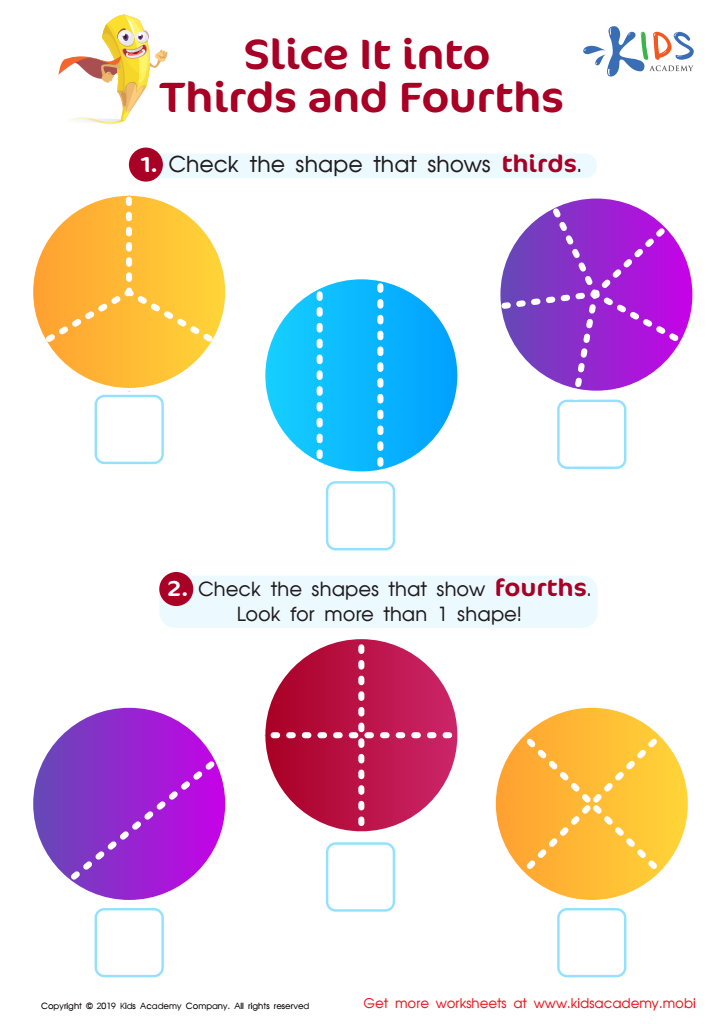
Slice in Thirds Fourths Worksheet
This worksheet helps kids learn fractions visually by dividing circles into thirds and fourths. They will learn that fractions must be equal parts, not just sets, by choosing the right colorful circles. It's an easy way to master fractions and have fun doing it!
 Assign to My Students
Slice in Thirds Fourths Worksheet
Worksheet
Join Kids Academy for Free
Who is primarily going to use this learning content?







Fraction identification is a crucial skill for children aged 7-8 as it lays the foundation for more advanced mathematical concepts later in their education. Understanding fractions helps children grasp the idea of part-to-whole relationships, which is essential in various real-life contexts, such as cooking, measuring, and dividing resources. When parents and teachers emphasize fraction identification, they empower children to become confident problem solvers who can analyze and approach challenges logically.
Moreover, mastering fractions enhances children's mathematical reasoning and critical thinking skills. It enhances their ability to compare, order, and perform operations with fractions, ultimately contributing to their success in subsequent math topics, such as ratios, proportions, and even algebra.
Encouraging fraction identification also supports cognitive development, as children start forming connections between numbers and visual representations (like pie charts or blocks). Additionally, when parents and teachers frequently engage students in practical activities involving fractions, it fosters a more profound enthusiasm for math, breaking the stigma of numeracy being difficult or uninteresting. By investing in fraction identification at this early stage, parents and teachers prepare children for a future of successful mathematical learning and problem-solving.








